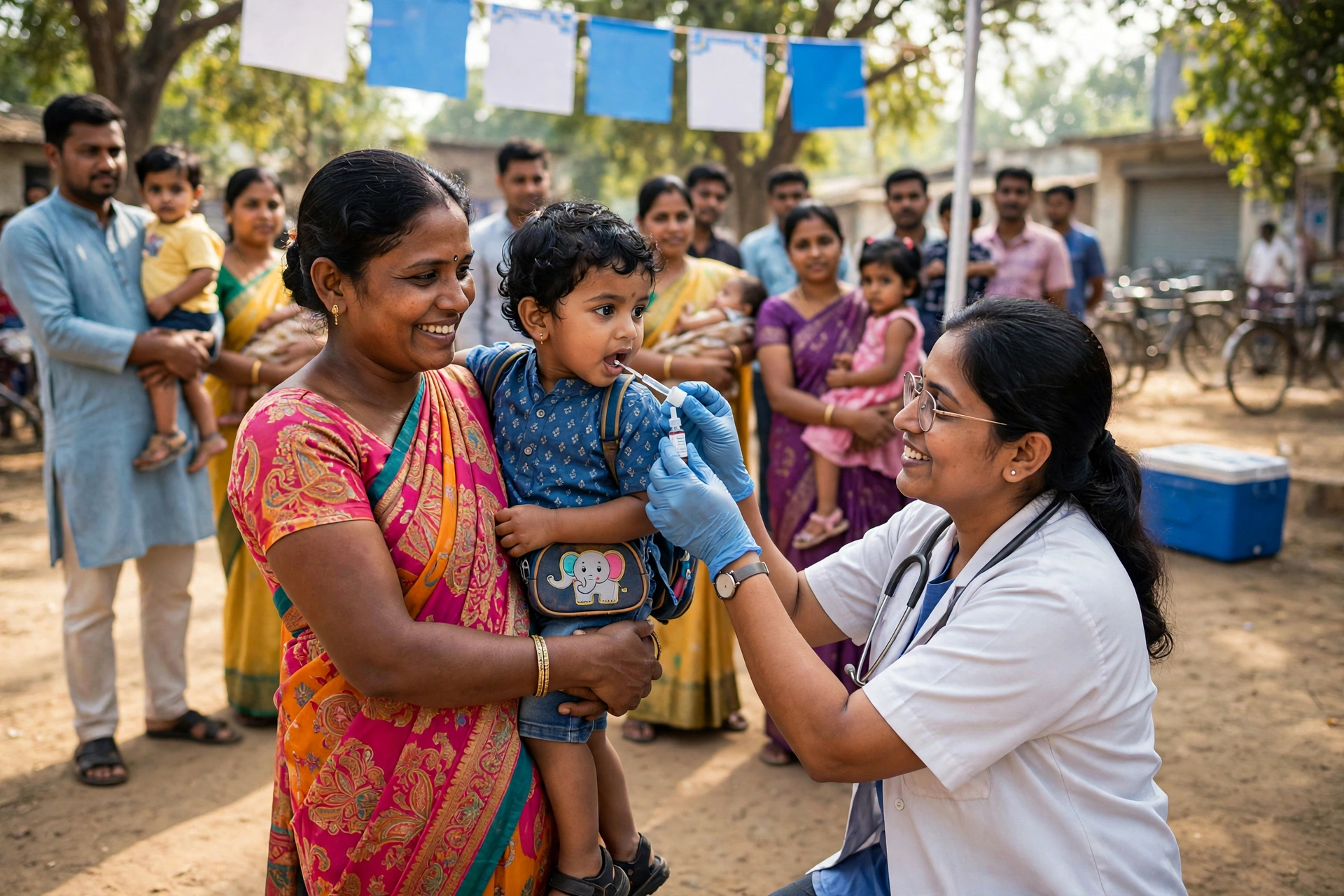
Every parent wants just one thing for their child – that the child stays healthy, happy and never falls prey to a serious disease. Today is the day to turn that wish into action. Across the country, thousands of health teams are ready at booths with just one job – to reach every small child with two drops of protection.
In this guide, we explain everything a parent needs to know about the Pulse Polio 2026 campaign. Where the booths are set up, what time to go, which children must get the drops, when teams will visit homes, and what to do if you cannot reach a booth today – all in one place, in simple and clear language.
Pulse Polio 2026: Everything at a Glance
The pulse polio 2026 round is being observed as a Sub-National Immunisation Day (SNID). This means the campaign is being run with special focus in those parts of the country where reaching children with the polio dose matters most. Two drops of bivalent oral polio vaccine (bOPV) are given at the booth, and there is no charge at all.
| Detail | Information |
|---|---|
| Campaign name | Sub-National Immunisation Day (SNID) Pulse Polio |
| Booth day | Sunday, 22 November 2026 |
| Door-to-door days | 23-24 November 2026 |
| Children covered | All children below 5 years of age (0-5 years) |
| Dose | Two drops of bivalent oral polio vaccine (bOPV) |
| Cost | Completely free |
| Documents needed | No documents needed; carry the child’s vaccination card if available |
Every parent should remember one important point: even if your child has already received the polio dose under routine immunisation, the drops in this round are still necessary. The pulse polio dose is different from routine immunisation, and it gives extra protection. So do not stay at home thinking the child has already been vaccinated.
State-Wise Booths, Timings and Targets
This round of the campaign is running at the same time in several states. The number of booths, timings and targets are different in each state. The table below gives the details of all the states and districts included in this round.
| State | Districts / Areas | Children Targeted (where verified) | Booth Timings | Door-to-Door Dates |
|---|---|---|---|---|
| Maharashtra | Mumbai (BMC), Pune (PMC), Thane (TMC) | Pune – 3,16,275 children, 1,367 booths | Pune – 8 AM to 5 PM | 23-27 November (Mumbai/Thane areas) |
| Telangana | Hyderabad, Rangareddy, Sangareddy, Medchal-Malkajgiri, Hanamkonda | Total 18,01,698 children; Hyderabad district 5,22,000 children, 2,626 booths, 38 transit points, 91 mobile teams | Hyderabad – 7 AM to 6 PM | Till 25 November (Hyderabad and nearby districts) |
| Kerala | 10 districts, except Idukki, Wayanad, Kozhikode and Malappuram | 12,92,421 children | Local timings on booth day | 23-24 November |
| Odisha | Angul, Balasore, Bhadrak, Boudh, Cuttack, Gajapati, Ganjam, Jajpur, Jharsuguda, Kalahandi, Keonjhar, Khordha, Sambalpur, Malkangiri, Mayurbhanj, Sundargarh, Puri – 17 districts in total | 17 districts covered in this round | Local timings on booth day | 23-24 November |
| Jharkhand | Giridih district | 4,90,549 children | Local timings on booth day | 23-24 November |
| Assam | Booths at local level across the state | As per local targets | 7 AM to 6 PM | 23-24 November |
Special arrangements have been made in Telangana this time. In Hyderabad, booths have also been set up at transit points such as railway stations and bus stands, so that families who are travelling can also get the drops for their children. At these transit points, services are running round the clock from midnight of 21 November to midnight of 24 November. Telangana has also issued a helpline number, 7702555479, for help.
If your state or district is not in the table above, do not worry. Only selected states and districts are included in this round. Check with your nearest health centre or ASHA worker whether a booth has been set up in your area. The government health department keeps running such rounds in different districts from time to time.
How to Find the Nearest Polio Booth – Step by Step
Finding a booth is very easy. Booths are set up in your own locality, and you do not need any app or online form to find them. Just follow these steps:
Step 1 – Look around your neighbourhood: Booths are usually set up at government health centres, primary health centres (PHCs), anganwadi centres, government schools, railway stations and bus stands. You may see crowds at these places from this morning itself.
Step 2 – Ask the ASHA worker: The ASHA worker of your village or locality knows the exact location of the booth. If you ask her, she will tell you the way to the booth, and in many cases she also helps take children to the booth.
Step 3 – Visit the anganwadi centre: If you cannot find the booth, go to the nearest anganwadi centre. The polio campaign team is present there and will direct you to the right booth.
Step 4 – Take the child with you: You must take the child to the booth yourself, because the drops are given directly into the child’s mouth. If you have the child’s vaccination card, carry it along, but there is no problem if you do not have the card – the drops will still be given.
Step 5 – Get the dose at the booth: The health worker at the booth will give the child two drops. It takes less than a minute. After the dose, a mark is put on the child’s finger to show that the child has received the drops.
Step 6 – Ask about the next dose: Ask the health worker at the booth when the next polio round will be held and whether any other vaccine is pending. This information will be useful for you later.
What to Do If You Miss the Booth Day
Sometimes it happens that a family is out of town on booth day, or the child is unwell and cannot reach the booth. There is no need to worry in such a situation. The health department has made full arrangements for this as well.
After booth day, on 23 and 24 November, health teams will visit homes and give the polio drops to children. In Mumbai and Thane areas, this door-to-door campaign will run from 23 to 27 November, while in Greater Hyderabad, Rangareddy, Medchal-Malkajgiri and Sangareddy, teams will visit homes till 25 November. When the team comes to your home, make sure your child gets the drops.
If the door-to-door team does not reach your home for some reason, you can yourself visit the nearest primary health centre (PHC) or government health centre and get the drops for your child. The department makes every possible effort so that no child is left out of this protection.
One more thing to remember: if your child is travelling, the drops can also be given at transit booths at railway stations and bus stands. In Telangana, these booths are running round the clock from midnight of 21 November to midnight of 24 November.
Why Do Polio Drops Still Matter Today?
Many people ask why the drops are needed when polio has already been wiped out in India. It is a fair question, and every parent should know the answer.
The Pulse Polio campaign began in India in 1995. At that time, thousands of children in the country became disabled every year because of polio. After years of hard work, booth campaigns and door-to-door drives, India was officially declared polio-free. The last polio case in India was found in 2011. This is a very big victory for India.
But the polio virus still exists in some countries of the world. A virus has no borders – it can travel from one country to another along with travellers. If the immunity of our children falls, the virus can return. That is why these rounds must continue until polio is fully wiped out from the whole world.
Along with this, Acute Flaccid Paralysis (AFP) surveillance is also continuing. This means that if any child suddenly shows weakness in the arms or legs, the health department immediately investigates it, so that any possible case of polio can be caught at the very beginning. This monitoring plays a very big role in keeping India polio-free.
Every time you give your child two drops, you are not only protecting your own child – you are also contributing to the safety of your whole neighbourhood and the whole country. The more children get the dose, the lower the risk of the virus returning.
Are the Polio Drops Safe?
This question comes to every parent’s mind, and the answer is clear – yes, the polio drops are completely safe. Crores of children have received this dose and its safety record is very good.
Mild fever is seen only in very rare cases after the two drops. Even if mild fever appears, there is no need to worry, but if you have any concern, ask the health worker immediately. The dose can be given even to newborn babies, and it is also given to mildly sick children.
Just remember one thing: if your child is seriously ill, first take advice from the health worker at the booth. The worker will check and tell you whether the dose should be given now or whether you should wait a little. Trained health workers are present at the booth, so you can ask them any question without hesitation.
This dose is free and no document is needed for it. If anyone asks you for money in the name of the polio dose, understand that it is wrong and immediately inform the nearest health centre or ASHA worker.
Important Points About This Campaign
Families going to the booth in this round will find it useful to know a few things in advance. First, there may be crowds at the booth, so it is better to go early in the morning. Second, there is no need to take the child on an empty stomach – the child can take the dose even after eating. Third, if there is more than one child below 5 years of age in your home, take all of them along.
For this round, the health department has set up thousands of booths and lakhs of health workers, ASHA workers and volunteers are working day and night. Their only goal is that not a single child should be left out. Your cooperation is what makes this campaign successful.
If there is a family in your neighbourhood with a child below 5 years of age who does not know about the campaign, please do tell them. Making neighbours aware is also a part of this campaign.
To know more about other government health schemes, you can also read these articles: Ayushman Card – How to Apply, ABHA Card Apply Online 2026 and Janani Suraksha Yojana Guide.
Pulse Polio 2026 – Frequently Asked Questions (FAQ)
1. When is the pulse polio 2026 booth day?
Booth day is Sunday, 22 November 2026. After that, on 23-24 November, health teams will visit homes to give the drops to children. In Mumbai and Thane, the door-to-door campaign will run from 23 to 27 November.
2. Which children need the polio drops?
Every child from 0 to 5 years of age needs the drops, whether or not the child has already received the polio dose in routine immunisation. The pulse polio dose gives extra protection.
3. What documents are needed for the polio drops?
No documents are needed. Carry the child’s vaccination card if you have it, but the drops will be given even without the card. The service is completely free.
4. Where will the nearest polio booth be set up?
Booths are set up at government health centres, primary health centres (PHCs), anganwadi centres, government schools, railway stations and bus stands. You can ask the ASHA worker of your village or locality for the exact location of the booth.
5. What if the child is unwell on booth day?
Even a mildly sick child can be given the dose. But if the child is seriously ill, first take advice from the health worker at the booth. The worker will tell you whether the dose should be given now or later.
6. What if we miss booth day?
Nothing is lost. On 23-24 November, the health team will visit your home and give the drops. If the team does not come, you can yourself visit the nearest PHC and get the drops for your child.
7. India is polio-free, so why is pulse polio 2026 being run?
The last polio case in India was found in 2011 and India is polio-free. But the virus still exists in some countries of the world, so these rounds are run to keep children’s immunity strong.
8. What to do if the child gets fever after the polio drops?
Mild fever after the dose is very rare and usually goes away on its own. If the fever is high or you are worried, contact the nearest health centre.
Official Links – Where to Get Correct Information
For correct and latest information about the polio campaign, trust only official sources:
- Ministry of Health and Family Welfare, Government of India – mohfw.gov.in
- Your state Health Department – check the polio round information on the official website of your state
- Nearest Primary Health Centre (PHC) or government health centre – for local information about booths and the door-to-door campaign
- Telangana helpline number for help – 7702555479
Today is a short day, but its impact is very big. Just two drops – and your child is protected from a dangerous disease like polio. Go to the booth, get the drops for your child, and also make your neighbours aware. Not a single child should be left out – that is the goal of this campaign.
GramSuvidha is a private information portal, not a government website.