Last Updated: 27 November 2026
In the last months of 2025, the same question was being asked in villages and towns across India. The voter list was being checked under SIR. Would Aadhaar work or not? Would showing only an Aadhaar card keep your name on the voter list? Would your name be removed if you did not have Aadhaar? The answers are written clearly in the Election Commission's orders, and this guide explains that official information in simple words. By November 2026 the second phase of SIR is complete, but the same questions about Aadhaar are still just as important today — especially for people who received a notice or whose name was removed from the list.
First, understand the biggest point. In SIR, which stands for Special Intensive Revision, Aadhaar is accepted as proof of identity. It is one of 12 accepted documents. But Aadhaar is not proof of citizenship. Aadhaar also does not prove your date of birth. The Election Commission has written this clearly in its order. So Aadhaar is very useful, but Aadhaar alone does not answer every question.
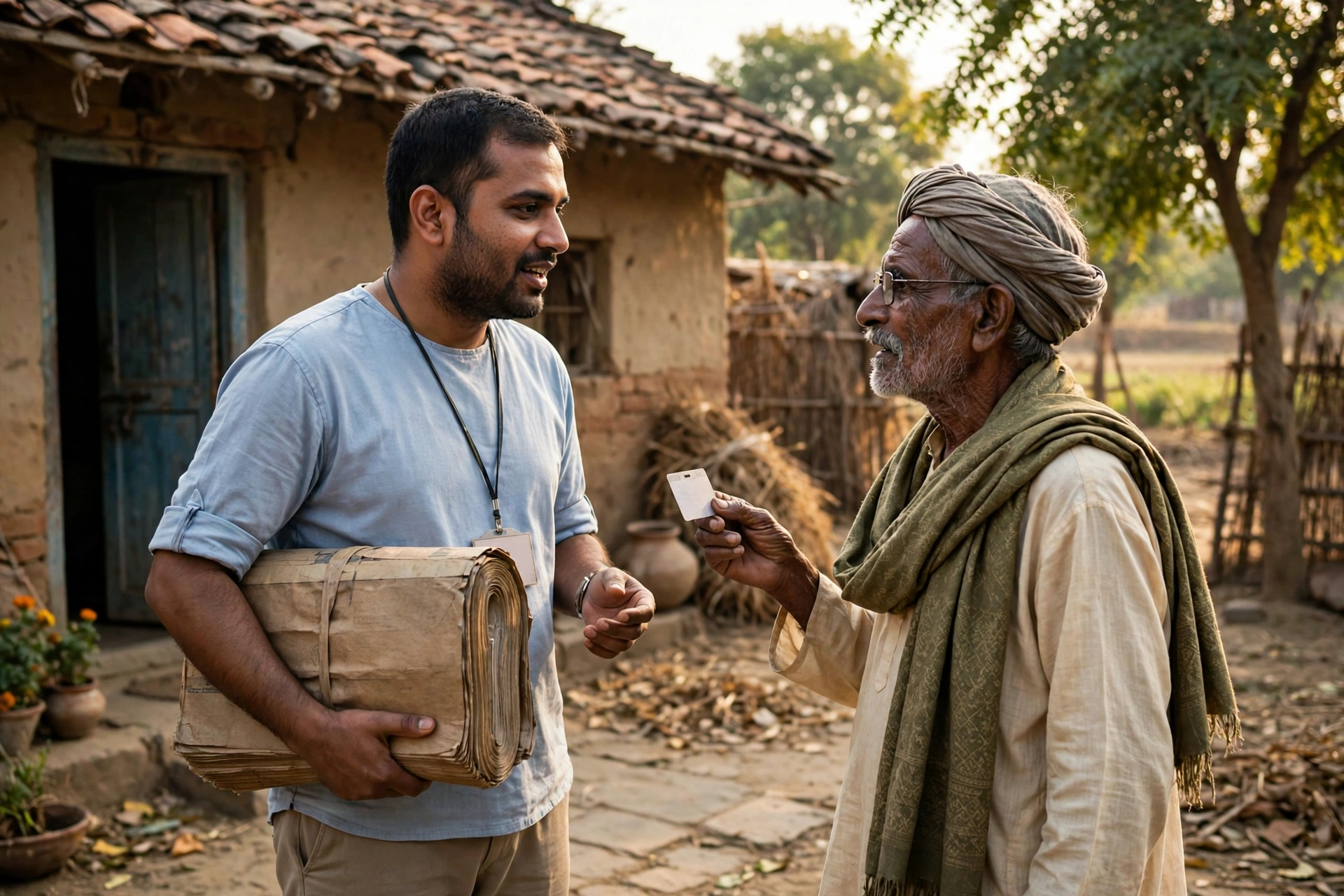
The second big point is that no document was asked for when the enumeration form was filled during the house-to-house visit. When the BLO, the Booth Level Officer, came to your home with the Enumeration Form, you did not need to show any paper at that time. Documents were asked for only later, if your name could not be linked with the previous voter list and the election officer sent you a notice. This is very important to understand, because in many places a rumour spread that documents must be submitted along with the form. That was not true.
Quick Facts
| Item | Details |
|---|---|
| Full name of SIR | Special Intensive Revision of electoral rolls |
| Conducted by | Election Commission of India (ECI) |
| Status of Aadhaar | One of 12 accepted documents; proof of identity only, not proof of citizenship or date of birth |
| First phase (Bihar) | Completed in 2025; final list published on 30 September 2025; about 7.42 crore electors |
| Second phase (12 states/UTs) | Enumeration November-December 2025; draft roll 16 December 2025; final rolls February-April 2026 — phase complete |
| Qualifying date | 1 January 2026 (Indian citizens who turn 18 on this date) |
| Enumeration period | 4 November 2025 to 11 December 2025 (to 26 December 2025 in some states) |
| Draft electoral roll | 16 December 2025 (original plan was 9 December; 19-31 December in some states) |
| Claims and objections | 16 December 2025 to 15 January 2026 |
| Final electoral roll | February-April 2026 (revised schedule had fixed 14 February 2026) |
| Electors covered | About 51 crore |
| Phase 2 result | List fell from about 51 crore to about 44.92 crore |
| Supreme Court judgment | 27 May 2026 — Bihar SIR upheld; Aadhaar is identity proof, not citizenship proof |
| Website to check your name | voters.eci.gov.in |
| Helpline | 1950 (toll free) |
| When are documents asked for | Only after a notice, after the draft roll is published |
| Documents during enumeration | No document is collected |
What is SIR
SIR means a special, intensive checking and correction of the voter list. In India, the voter list is updated before every election. New names are added, the names of people who have moved away or died are removed, and wrong details are corrected. Normally this is done through an ordinary revision. But when there is a chance of large errors in the list, or when an intensive check has not been done for a long time, the Election Commission orders a Special Intensive Revision.
In SIR, an Enumeration Form is filled at the home of every voter. The BLO visits every house and gives a form with details already filled in from the earlier voter list. The voter has to fill in their own details and the name of a family member as per the previous voter list. This process shows who actually lives at that address and is eligible to be a voter.
SIR is not happening for the first time. The first phase in Bihar was completed in 2025. The final voter list of Bihar was published on 30 September 2025, with about 7.42 crore electors. After that, the second phase was carried out in 12 states and Union Territories between November 2025 and April 2026.
Which states are covered in the second phase
The Election Commission announced the second phase on 27 October 2025. It covers 12 states and Union Territories: Andaman and Nicobar Islands, Chhattisgarh, Goa, Gujarat, Kerala, Lakshadweep, Madhya Pradesh, Puducherry, Rajasthan, Tamil Nadu, Uttar Pradesh and West Bengal.
Of these, Tamil Nadu, Puducherry, Kerala and West Bengal were due to hold Assembly elections in 2026. Goa, Gujarat and Uttar Pradesh will hold elections in 2027. About 51 crore voters are covered in this phase, which makes it one of the largest voter-list checks in the country.
Assam was not part of this phase. Citizenship rules in Assam are different, so instead of SIR a separate special revision was carried out there, which was completed on 10 February 2026.
Full SIR schedule (completed phase)
The Election Commission announced the timetable for the second phase on 27 October 2025. On 30 November 2025 the Commission extended the schedule by one week. The timeline below shows what actually happened.
The first step was preparation and training, which ran from 28 October to 3 November 2025. BLOs and election officials were trained and forms were printed. The voter lists were frozen at midnight on 27 October 2025, so that no changes could be made after that.
The second step was house-to-house enumeration, which began on 4 November 2025. The original plan was to finish by 4 December 2025, but under the revised schedule enumeration ran until 11 December 2025, and in some states until 26 December 2025. During this period, the BLO visited every home and gave the Enumeration Form. Filled forms were also collected back.
The third step was the publication of the draft electoral roll. The original plan was 9 December 2025, but under the revised schedule the draft roll was published on 16 December 2025. In some states it came later — 19 December in Tamil Nadu and Gujarat, 23 December in Madhya Pradesh, Chhattisgarh, Andaman and Nicobar Islands and Kerala, and 31 December in Uttar Pradesh. This list carried the names of all electors whose forms were found correct.
The fourth step was the claims and objections period, from 16 December 2025 to 15 January 2026. If your name was missing from the draft roll, you could file a claim to get it added. If a wrong name was on the list, an objection could also be filed.
The fifth step was the notice, verification and hearing stage, from 16 December 2025 to 7 February 2026. This was the time when electors whose names could not be linked with the previous list were sent notices asking for documents.
The final step was the publication of the final electoral roll. The revised schedule had fixed 14 February 2026, but in practice the final rolls were published on different dates between February and April 2026 — Uttar Pradesh's final roll came last, on 10 April 2026.
The result of this phase was that the combined list of the 12 states and Union Territories fell from about 51 crore to about 44.92 crore — a reduction of about 6 crore names.
The exact status of Aadhaar
This is the most important part of this guide, so please read it carefully.
In September 2025, the Supreme Court directed the Election Commission to accept Aadhaar as a document for voter identity verification during the SIR in Bihar. After that, the Election Commission issued an order on 9 September 2025. Under this order, Aadhaar was treated as the 12th document, in addition to the 11 documents already listed.
The Election Commission also made it clear that Aadhaar will be accepted and used as proof of identity, not as proof of citizenship. According to the Commission, Aadhaar can be used for identification and e-signing, but not for validating age or nationality. The same rule applies to the 12 states and Union Territories in the second phase.
In simple words, Aadhaar proves that you are the same person whose name is written on the form. But Aadhaar does not prove that you are an Indian citizen. It also does not prove your date of birth. For citizenship and date of birth, the Election Commission looks at other documents.
One more point to remember: giving your Aadhaar number on the Enumeration Form is optional, not compulsory. The Aadhaar field on the form can be left blank. So even if you do not have an Aadhaar card, your form is still filled and you are still counted. Not having Aadhaar does not remove your name.
The 12 documents accepted in SIR
When the election officer sends a notice asking for documents, any one of the 12 documents below can be given. This list is taken from the Election Commission's instructions dated 27 October 2025.
The first document is any identity card or pension payment order issued to a regular employee or pensioner of the Central Government, a State Government or a PSU.
The second document is any identity card, certificate or document issued in India by the Government, local authorities, banks, post office, LIC or PSUs before 1 July 1987.
The third document is a birth certificate issued by the competent authority.
The fourth document is a passport.
The fifth document is a matriculation or educational certificate issued by a recognised board or university.
The sixth document is a permanent residence certificate issued by the competent state authority.
The seventh document is a forest right certificate.
The eighth document is an OBC, SC, ST or any caste certificate issued by the competent authority.
The ninth document is the National Register of Citizens, wherever it exists.
The tenth document is a family register, prepared by state or local authorities.
The eleventh document is any land or house allotment certificate issued by the Government.
The twelfth document is Aadhaar, which is accepted as proof of identity.
In addition, an extract of the electoral roll of Bihar published after SIR, with reference to 1 July 2025, can also be given as a document. If a person shows that the names of their parents appear in that list, they will not have to give any additional proof of citizenship, except for proof of date of birth.
Remember that this list is indicative. It means the election officer can accept any one of these documents. No single document is compulsory for every voter.
How the Enumeration Form was filled: step-by-step guide
The first job in SIR was to fill the Enumeration Form. The BLO brought this form to your home. The form was partly pre-filled, with your name and details taken from the earlier voter list. Filling it was easy. You just had to follow the steps below.
Step 1: When the BLO came to your home, take your Enumeration Form from them. Check the name, address and details printed on the form carefully. If there was any mistake, correct it on the form itself.
Step 2: Fill in the name of one family member whose name was on the voter list during the last SIR. This member could be your parent, spouse or any other family member. If you could not find your name in the old list, you could check the old list on the website voters.eci.gov.in.
Step 3: Fill in the other information asked for on the form, such as your mobile number. Giving your Aadhaar number was optional. You could fill it if you wished, or you could leave that field blank.
Step 4: Sign the form or put your thumb impression on it. No document needed to be attached to the form. Give the form back to the BLO.
Step 5: If you were not at home when the BLO came, do not worry. The BLO would come again, or you could contact your booth's BLO and get the form. The name and number of your area's BLO could be found on voters.eci.gov.in or from your district election office.
Step 6: After the draft roll was published on 16 December 2025, check your name on voters.eci.gov.in. If your name was there, your work was done. If your name was missing, file a claim in Form 6 during the claims and objections period to get it added.
What to do now: both the draft roll and the final roll have now been published. If your name is on the final roll, your work is done. If your name is missing, you can still file Form 6 to get it added — fresh enrolment continues all year round. If you received a notice, go for the hearing on the date written in it and carry the documents asked for.
How your name was checked in the draft roll (and how to check it now)
The draft roll was published on 16 December 2025 (between 19 and 31 December in some states). To check your name, you first had to open the website voters.eci.gov.in. There you would find the option to search the electoral roll. Select your state, district and Assembly constituency. Then enter your name or your EPIC number, which is your voter ID number, and search.
If your name was on the list, you did not need to do anything more. If your name was missing or had a mistake, a claim or objection had to be filed between 16 December 2025 and 15 January 2026. Form 6 was used to add a new name. Form 8 was used to correct a name. These forms could be filled online on voters.eci.gov.in, or you could get them from your BLO and fill them in.
How to check your name today: the final electoral roll has now been published. Go to voters.eci.gov.in and check your name in the final roll. If your name is there, your EPIC will continue as before. If your name is missing, file Form 6 to get it added.
If you have received a notice, go for the hearing on the date written in the notice. Carry the documents asked for in the notice. Take any document from the list of 12 given above that you have. You can carry Aadhaar alone, but remember that Aadhaar is only proof of identity. If the officer asks for proof of citizenship or date of birth, also carry another document, such as a birth certificate, passport or Class 10 marksheet.
Who will have to give documents
Not every voter will have to give documents. Documents will be asked for only from those electors whose details cannot be linked with the previous SIR electoral roll, or do not match the database. For example, if your name is not found in the previous voter list of around 2002-2004 and you also cannot give the name of a family member from that list, the election officer will send you a notice.
Such a notice was sent only after the draft roll was published. No notice was sent during enumeration, and no document was collected then. If anyone asked you for documents during the enumeration visit, that was wrong. You could complain to your BLO or the district election officer.
Electors whose names were found in the previous list, or whose family member's name was found in the previous list, did not have to give any document. Their names appeared directly in the draft roll.
Do not believe rumours
Many rumours are spreading about SIR. The biggest rumour is that if you do not have Aadhaar, your name will be removed from the voter list. This is wrong. Aadhaar is optional, and there are many other documents in the list.
The second rumour is that only Aadhaar will work in SIR. This is also wrong. A total of 12 documents are accepted. Aadhaar is only one of them.
The third rumour is that documents must be submitted while filling the form. This is also wrong. The Election Commission's order clearly says that no document will be collected from electors during the enumeration phase.
The fourth rumour is that after SIR, everyone will have to get a new voter ID made. This is also wrong. Those whose names are on the final list can continue using their old voter ID, the EPIC.
For correct information, trust only the Election Commission's website eci.gov.in and the voter services portal voters.eci.gov.in. Do not blindly believe any WhatsApp message or social media post.
SIR in November 2026: what is happening now
The second phase of SIR is complete, but SIR is still in the news in November 2026.
Supreme Court judgment (27 May 2026): The Supreme Court upheld the Bihar SIR. A bench headed by Chief Justice Surya Kant held that SIR is within the Election Commission's powers under Article 324 of the Constitution and Section 21(3) of the Representation of the People Act, 1950, and that it advances the constitutional goal of free and fair elections. The court also made it clear that being struck off the electoral roll does not mean losing citizenship. Aadhaar and ration cards were held not to be proof of citizenship — Aadhaar is only an identity document.
Nationwide SIR challenge: In October 2026, Rahul Gandhi, Mallikarjun Kharge and nine other opposition leaders filed a petition in the Supreme Court alleging large-scale deletion of voters during the nationwide SIR. On 15 October 2026 the Supreme Court issued notice to the Election Commission. The Commission filed its counter-affidavit on 26 October and a supplementary affidavit on 14 November 2026. The case is still pending — there is no ruling yet. The next hearing is listed for 9 December 2026.
Delhi SIR 2026: Delhi is covered under the third phase of SIR. The draft roll was published on 31 August 2026 with about 97.5 lakh electors, against nearly 1.45 crore when the exercise began. About 47.5 lakh names were left out as Absent, Shifted, Dead or Duplicate (ASDD). Notices were issued to 33.1 lakh electors on the draft roll — 13.8 lakh for "no mapping" with previous SIR rolls and 19.3 lakh for logical discrepancies in their forms. In Delhi, Aadhaar alone is not being treated as enough — BLOs have been asked to seek additional proof of citizenship from electors who submitted only Aadhaar. The deadline for claims and objections was extended to 25 November 2026, notices are to be disposed of by 15 December 2026, and the final roll is due on 22 December 2026, though the Commission is considering a further two-week extension to re-verify the 47.5 lakh excluded voters.
West Bengal SIR: About 91 lakh names were removed in West Bengal. Around 22.2 lakh appeals for re-inclusion were filed before tribunals (about 38 lakh appeals are pending in all). On 23 November 2026 the Supreme Court directed the tribunals to give priority to appeals seeking re-inclusion and to defer hearings on pleas to strike off names. Between 25 and 29 November 2026, police in several districts are verifying the documents of people who appealed to the tribunals. The Election Commission has distanced itself from this police verification drive.
Frequently asked questions
Question 1: Is Aadhaar card valid for the voter list in SIR 2026? Yes, Aadhaar is valid in SIR. After the Supreme Court's direction in September 2025, the Election Commission made Aadhaar the 12th accepted document. But Aadhaar is only proof of identity, not proof of citizenship or date of birth.
Question 2: Will Aadhaar prove my citizenship? No. The Election Commission has clearly said that Aadhaar is not proof of citizenship. For citizenship, documents such as a passport, birth certificate or other documents from the list are looked at.
Question 3: Will Aadhaar prove my age? No. According to the Election Commission, Aadhaar does not prove age or date of birth. For date of birth, documents such as a birth certificate, passport or Class 10 certificate are used.
Question 4: I do not have an Aadhaar card. Will my name be removed from the voter list? No. Giving your Aadhaar number on the Enumeration Form is optional. You can give any one of the 12 documents in the list. If your name is linked with the previous list, you will not have to give any document at all.
Question 5: Will any document be needed while filling the Enumeration Form? No. According to the Election Commission's order, no document will be collected from electors during the enumeration phase. Documents are asked for only if you get a notice after the draft roll is published.
Question 6: In which states is SIR running? The second phase ran in 12 states and Union Territories and is now complete: Andaman and Nicobar Islands, Chhattisgarh, Goa, Gujarat, Kerala, Lakshadweep, Madhya Pradesh, Puducherry, Rajasthan, Tamil Nadu, Uttar Pradesh and West Bengal. SIR in Bihar was already complete. Assam was not part of this phase. The third phase of SIR, including Delhi, is running in 2026.
Question 7: What should I do if my name is not in the draft roll? The claims and objections window ran from 16 December 2025 to 15 January 2026 and is now closed. If your name is not on the final roll, you can still file Form 6 to get it added — fresh enrolment continues all year round. The form can be filled online on voters.eci.gov.in or obtained from your BLO.
Question 8: When will the final voter list of SIR come out? The final electoral rolls were published between February and April 2026. Uttar Pradesh's final roll came last, on 10 April 2026.
Question 9: How can I see my name in the old voter list? Old SIR voter lists can be seen on the website voters.eci.gov.in. The Election Commission has made the old lists of around 2002-2004 available online.
Question 10: Which number should I contact for help? Contact the voter helpline 1950. It is a toll-free number. Information is also available on voters.eci.gov.in.
Official links
- Election Commission of India: https://eci.gov.in
- Voter Services Portal (check your name, fill Form 6/8): https://voters.eci.gov.in
- SIR order, 27 October 2025 (ECI): https://eci.gov.in
- Voter helpline: 1950 (toll free)
Disclaimer
GramSuvidha is not a government website. This article is for information only. For final and official information about SIR, please check the Election Commission of India website eci.gov.in or the voter services portal voters.eci.gov.in. Dates and rules can change, so please verify from the official source before taking any step. If you have received a notice, follow the instructions written in it and contact your BLO or district election officer.