The PMGKAY Ration Card is one of the most searched topics for ration card holders in India today, and yet there is a lot of confusion around it. Every month, when the grain at home starts running low, the same questions come up in millions of homes: how much ration will we get this month, will we have to pay for it, and is our name still on the list. If you have taken ration from a fair price shop in the last few years, you will have noticed a change. Earlier you had to pay a small amount for your grain, then there was a time when the quantity went up, and then there came a time when the ration became completely free. This change did not happen by accident. Behind it is a large scheme called the Pradhan Mantri Garib Kalyan Anna Yojana, or PMGKAY. In this article we will tell you the full story of this scheme, step by step and in simple words, so that you understand everything clearly and do not need to look anywhere else.
After reading this article you will know what the PMGKAY Ration Card is and how it is different from an ordinary ration card, how much grain your family should get every month, how to check whether your name is on the list, what e-KYC is and why it matters so much, and what you should do if your name is missing or if you get less ration than you should. We will also tell you how you can take your ration in any state of the country, even if your ration card belongs to a different state. So let us begin, and first look at the key facts of this scheme at a glance.
PMGKAY Ration Card: At a Glance
| Detail | Information |
|---|---|
| Scheme name | Pradhan Mantri Garib Kalyan Anna Yojana (PMGKAY) |
| Launched | March 2020 |
| Free grain period | 1 January 2024 to 31 December 2028 |
| Decision | Union Cabinet, 29 November 2023 (PIB, 29 Nov 2023) |
| Beneficiaries | About 81.35 crore intended; 79.40 crore identified |
| Antyodaya families (AAY) | 35 kg per family per month |
| Priority Households (PHH) | 5 kg per person per month |
| Grains | Rice, wheat and coarse grains / millets; fortified rice also supplied |
| Cost | About Rs 11.80 lakh crore over 5 years; fully borne by the Centre |
| e-KYC | 87.37% of beneficiaries completed as of 31 January 2026 |
| Ration card Aadhaar seeding | 99.7% of ration cards seeded with Aadhaar |
| Ration anywhere | One Nation One Ration Card: all 36 States and UTs covered |
| Separate application | No separate application for PMGKAY; NFSA ration card holders get it automatically |
What Is the PMGKAY Ration Card
To understand the PMGKAY Ration Card, you first need to know that PMGKAY is not a separate card. The ration card you already have is also the PMGKAY card. PMGKAY is a scheme under which ration card holders covered by the National Food Security Act, or NFSA, get free foodgrains. Under NFSA there are two types of ration cards in the country. The first is the Antyodaya Anna Yojana card, called AAY, which is given to the poorest families. The second is the Priority Household card, called PHH, which is given to identified needy families. Card holders of both types get free grain under PMGKAY.
You should understand this clearly: no separate card is made for PMGKAY and no separate application is needed for it. If your name is on the NFSA list and you hold an AAY or PHH ration card, you get the PMGKAY benefit automatically. That is why, when you search the internet for PMGKAY Ration Card, you will find information about NFSA, ration card lists and free ration in many places. These are different names for the same thing, and understanding the difference between them is the first step of this article.
Under NFSA, up to 75% of the rural population and 50% of the urban population is covered. That is a very large coverage. That is also why the number of beneficiaries of this scheme is so large. The government set a target of reaching about 81.35 crore people, and 79.40 crore people have already been identified, which is about 97.6%. These figures show how big this scheme is for ordinary families in the country and how many people are connected to it.
The Journey of PMGKAY: From March 2020 to December 2028
The story of PMGKAY began in March 2020. At that time the country was facing a difficult situation because of COVID-19, and many families were facing a food crisis. In that difficult time the government launched the Pradhan Mantri Garib Kalyan Anna Yojana. Under this scheme at that time, every person got an extra 5 kg of foodgrain free every month, over and above the NFSA entitlement. This help continued in phases and ran till December 2022.
Then, from 1 January 2023, a big change came. The government decided that the foodgrain given under NFSA itself would be made free. That means no extra 5 kg of grain was given separately any more, but the grain that was given under NFSA became completely free. This arrangement was applied for one year, that is, for 2023. The benefit of this change was that people did not have to pay any money at the shop for their ration, and their monthly expense came down.
Then on 29 November 2023 the Union Cabinet took a very big decision. The Cabinet extended the free foodgrain arrangement for five years. This decision applies from 1 January 2024 to 31 December 2028. The Press Information Bureau gave this information on 29 November 2023, release number PRID 1980686. This means that throughout this period, NFSA beneficiaries will keep getting free foodgrains and will not have to pay anything for them.
The cost of this five-year period is estimated at about Rs 11.80 lakh crore. This entire cost is borne by the Central Government. This figure shows how large the free grain arrangement is and how much the government is spending on it. During this same period fortified rice is also supplied, and it will be supplied till December 2028. Fortified rice means rice to which essential nutrients have been added, so that people get not only food to fill their stomach but also nutrition.
One very important thing you should know clearly is that no proposal to extend this arrangement beyond 31 December 2028 is under consideration at present. The government told Parliament in March 2026 that no such proposal is under consideration. This means we should trust only what has been decided so far, that is, free foodgrains will be given till 31 December 2028. Guessing about what will happen after that would not be right, and we are not writing anything in this article that has not been decided.
How PMGKAY and NFSA Are Different
Many people think PMGKAY and NFSA are the same thing, and some people think they are completely different. The real position is that they are connected, but they are not the same. NFSA is a law, the National Food Security Act, under which needy people in the country were given the right to get foodgrains at subsidised rates. Under this law, AAY and PHH ration cards are made and people names are added to the list. PMGKAY is a scheme under which the foodgrain given under NFSA has been made free.
To put it in simple words, NFSA decides who will get how much grain, and PMGKAY decides that no money has to be paid for that grain. Before March 2020, people got grain under NFSA at a low price. From March 2020 to December 2022, under PMGKAY, an extra 5 kg of grain was given free over and above the NFSA entitlement. And from 1 January 2023, the NFSA grain itself became free, which was extended from 1 January 2024 to 31 December 2028. Understanding this is very important, because on the internet you will find many old news reports that talk about the extra 5 kg of grain. That was correct for that time, but the present arrangement is different. Now the NFSA grain is free, and no extra 5 kg is given over and above it.
How Much Grain Does Each Family Get
Now the most important question is how much grain your family should get every month. The answer depends on the type of your ration card. Under NFSA there are two types of cards and the quantity of grain is different for each. In the table below you can clearly see how much grain is given on each card.
| Ration Card Type | How Much Grain | Who Gets It |
|---|---|---|
| Antyodaya (AAY) | 35 kg per family per month | Poorest families; 35 kg per family |
| Priority Household (PHH) | 5 kg per person per month | Identified needy families; 5 kg for each member |
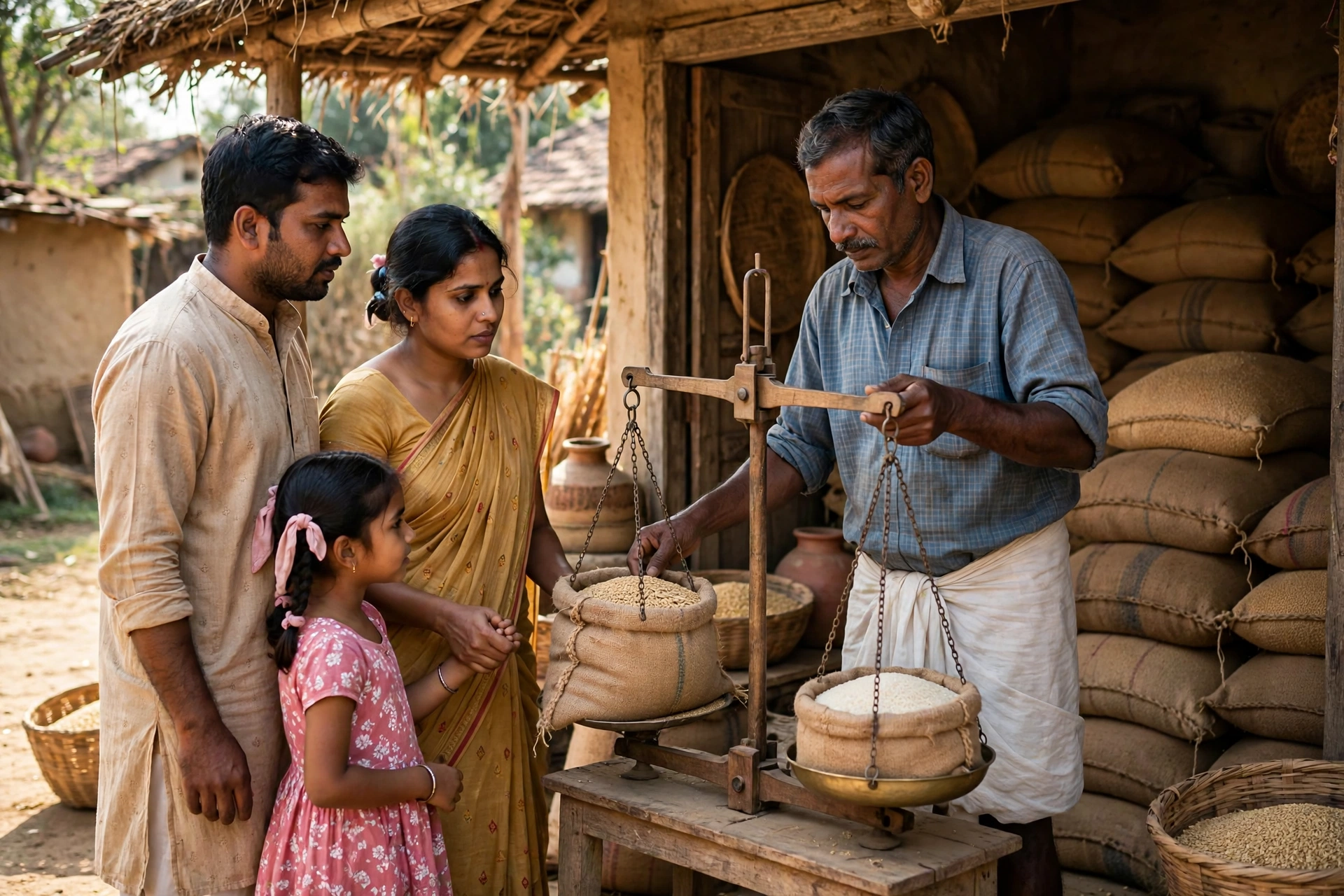
A family with an AAY card gets 35 kg of foodgrain every month, no matter how many people are in the family. This quantity is fixed per family. In a family with a PHH card, every person gets 5 kg of grain. That means if there are four people in your family and you have a PHH card, your family will get 20 kg of grain every month. If there are five people in the family, you will get 25 kg of grain. Understanding this calculation is very important, so that you can go to the shop and ask for your full share of grain, and raise a question if you are given less.
The grains given are rice, wheat and coarse grains, or millets. Coarse grains include jowar, bajra and ragi. Fortified rice is also supplied, and it will be given till December 2028. In every state, how much of which grain is given depends on the state arrangement and availability, but the total quantity remains the same as stated above. If you feel you are being given less grain than your share, you can complain in the way described in the last part of this article.
How to Check Your Name in the List
The most asked question about the PMGKAY Ration Card is how to check your name in the list. The answer is that you do not need to look for your name in a separate PMGKAY list. You need to look for your name in your state NFSA or ration card list. If your name is on that list, you will get free grain under PMGKAY. Below we are telling you three ways in which you can check your name in any state.
Way 1: Check Your Name on nfsa.gov.in
nfsa.gov.in is the national food security portal of the country. By going there you can reach the list of your state. First open nfsa.gov.in on your mobile or computer. There you will find the option for the state-wise list. Select your state. After that you will have to select the name of your district. Then select the name of your block or tehsil. After that select the name of your village or town. In the end you will see the list of fair price shops, that is, ration shops. Select your shop and the list of ration cards linked to that shop will open. In that list you can see your name and the names of your family members. This way works for the whole country, because from this portal you can reach the list of any state.
Way 2: Check on Your State PDS Portal
Every state has its own PDS portal, from where you can see the ration card list of your state. For example, people in Uttar Pradesh can go to fcs.up.gov.in and check their name. In the same way, the ration card information of every state is available on its portal. On your state portal you will find the option for the ration card list or ration card details. There you can also see the information by entering your ration card number, or you can open the list as per your district and village and search for your name. If you are from Uttar Pradesh, our article on UP Ration Card 2026 will help you step by step. For people in Punjab, our article on Punjab Ration Card is also useful.
Way 3: Check on the Mera Ration 2.0 App and DigiLocker
These days, checking your name from a mobile is the easiest way. The Mera Ration 2.0 app is the official app of the Government of India. By installing this app on your mobile you can see the details of your ration card, find the ration shop nearest to you, and also see the details of your grain. Apart from this, your e-ration card can also be found on DigiLocker, from where you can see a digital copy of your card. For people in Madhya Pradesh, the article on M Ration Mitra MP 2026 is useful, and for people in Bihar the articles on AEPDS Bihar and ePOS Bihar are useful, because they explain the ways to check information from the state portal.
While checking your name, keep one thing in mind. To see your name in the list, you may need your ration card number. If you do not have the card number, you can search in the list by the name of the head of your family and your village. In the list you should see your name, the names of your family members and the type of card. If your name does not appear in the list, do not worry. In the last part of this article we have explained what you should do in such a situation.
Why e-KYC Is Important and How to Check Its Status
e-KYC means electronic Know Your Customer, that is, confirming your identity with Aadhaar. In the ration system, e-KYC is important so that wrong people do not get ration and only the genuine beneficiary gets the grain. When your e-KYC is complete, your name and Aadhaar get linked and your ration card is correctly identified. This reduces the problem of fake cards and duplicate names, and the grain reaches the right people.
As of 31 January 2026, the e-KYC of 87.37% of beneficiaries in the country had been completed. Along with this, 99.7% of ration cards are seeded with Aadhaar. These figures show that the e-KYC of most people has already been completed, but some people are still left. If your e-KYC is not yet complete, you should go to your nearest ration shop or to your state PDS portal and get your e-KYC done. In many states there is an arrangement for e-KYC at the ration shop itself, where you can confirm your identity with your thumb impression or Aadhaar on the machine installed at the shop.
To check the status of your e-KYC, you can use the Mera Ration 2.0 app or go to your state PDS portal and see the details of your ration card. If your e-KYC is not complete, you may face difficulty in getting your ration, so this work should not be put off. It is also important to complete the e-KYC of every member of your family, so that no one name is removed from the list and everyone keeps getting their share.
One Nation One Ration Card: Take Ration Anywhere
One Nation One Ration Card, or ONORC, is a very big facility that very few people know about. Under this arrangement you can take ration in any state of the country, even if your ration card belongs to a different state. All 36 States and Union Territories of the country are covered under this arrangement. This means that if you have gone from your village to another state for work, you will still get your share of grain there, from the ration shop in that place.
Under this arrangement, more than 233 crore portability transactions have taken place, as stated in the PIB backgrounder of 12 November 2026. This number shows how many people have used this facility. If you live in another state, you will have to show your ration card and Aadhaar at the ration shop there and you will get your share of grain. For this you do not need to get your ration card transferred. This facility is especially for those people who live outside their state for work and are away from their families.
What to Do If Your Name Is Missing or You Get Less Ration
If your name is not on the list, first check whether you have selected the right state, district and village. Many times the name does not appear because wrong information was entered. Try searching with your ration card number as well. If the name still does not appear, you will have to apply for a new ration card on your state PDS portal or contact the food department office nearest to you. A new ration card application is made through the state portal, because there is no separate application for PMGKAY.
If you get less ration than your share, first calculate how much grain you should get as per your card. An AAY card should get 35 kg and a PHH card should get 5 kg per person. If you are being given less grain than this at the shop, you can ask about it at the shop itself and ask for a receipt for your grain. In many states there is an electronic machine at the ration shop, on which the information of your grain is recorded. You can also see the information of your grain on the Mera Ration 2.0 app.
If the shopkeeper does not listen to you or you feel that something wrong is happening to you, you can complain on your state PDS portal or register a complaint at the food department office. In your complaint, clearly write your ration card number, the name of the shop and what went wrong. If your ration card has been stopped or you feel that your card has been disabled without telling you, read our article on Silent Ration Card Disable 2026. If you want to surrender your old card, the article on Ration Card Surrender Kaise Karein 2026 will help you. For people in Chhattisgarh, the article on Chhattisgarh Ration Card 2026 is useful, and to know about the PVC card, the article on PVC Ration Card 2026 is also useful.
Frequently Asked Questions on PMGKAY Ration Card
1. What is the PMGKAY Ration Card?
PMGKAY is not a separate card. It is the Pradhan Mantri Garib Kalyan Anna Yojana, under which NFSA AAY and PHH ration card holders get free foodgrains. Your same ration card is also the PMGKAY card.
2. Is PMGKAY the same as NFSA?
No. NFSA is a law under which it is decided who will get how much grain. PMGKAY is a scheme under which the NFSA grain has been made free. The two are connected, but they are not the same.
3. Is ration really free till December 2028?
Yes. The Union Cabinet decided on 29 November 2023 that the free foodgrain arrangement will run from 1 January 2024 to 31 December 2028. This information was given by PIB on 29 November 2023.
4. Do I need to apply separately for PMGKAY?
No. There is no separate application for PMGKAY. If you hold an AAY or PHH ration card under NFSA, you get free grain automatically. A new ration card application is made through the state portal.
5. How much grain will my family get?
A family with an AAY card gets 35 kg of grain every month. In a family with a PHH card, every person gets 5 kg of grain. For example, a PHH family of four people will get 20 kg of grain.
6. How do I check my name in the list?
You can go to nfsa.gov.in, select your state, district and village, and see your name. You can also check your name through your state PDS portal, the Mera Ration 2.0 app or DigiLocker.
7. Can I take ration in another state?
Yes. Under One Nation One Ration Card you can take ration in any state of the country. All 36 States and Union Territories are covered under this arrangement.
8. Why is e-KYC important?
e-KYC links your identity with Aadhaar and makes sure that only the genuine beneficiary gets the grain. As of 31 January 2026, the e-KYC of 87.37% of beneficiaries had been completed. If your e-KYC is not complete, get it done as soon as possible.
9. What should I do if my name is not in the list?
First check again after selecting the right state, district and village. If the name still does not appear, apply for a new ration card on your state PDS portal or contact the food department office.
10. Will free ration continue after 31 December 2028?
At present no proposal to extend this arrangement is under consideration. The government told Parliament in March 2026 that this is the position. What has been decided is this: free foodgrains will be given till 31 December 2028.
Final Word
The most important thing about the PMGKAY Ration Card is that it is not a separate card and no separate application is needed for it. If you have an NFSA ration card, you will get free foodgrains till 31 December 2028. An AAY family gets 35 kg and every person in a PHH family gets 5 kg of grain. You should do three things: check your name in the list, complete your e-KYC, and take your full share of grain correctly. If you get less ration or your name is not on the list, do not hesitate to complain, because this is your right. Share this article with your family and friends too, so that they also get the correct information and no one falls for wrong information.
This article is published on a private information portal. GramSuvidha is a private information portal, not a government website. The information given in this article is based on government sources such as PIB and the answer given in Parliament. For any application or complaint, always contact the government portal or office.
private information portal, not a government website