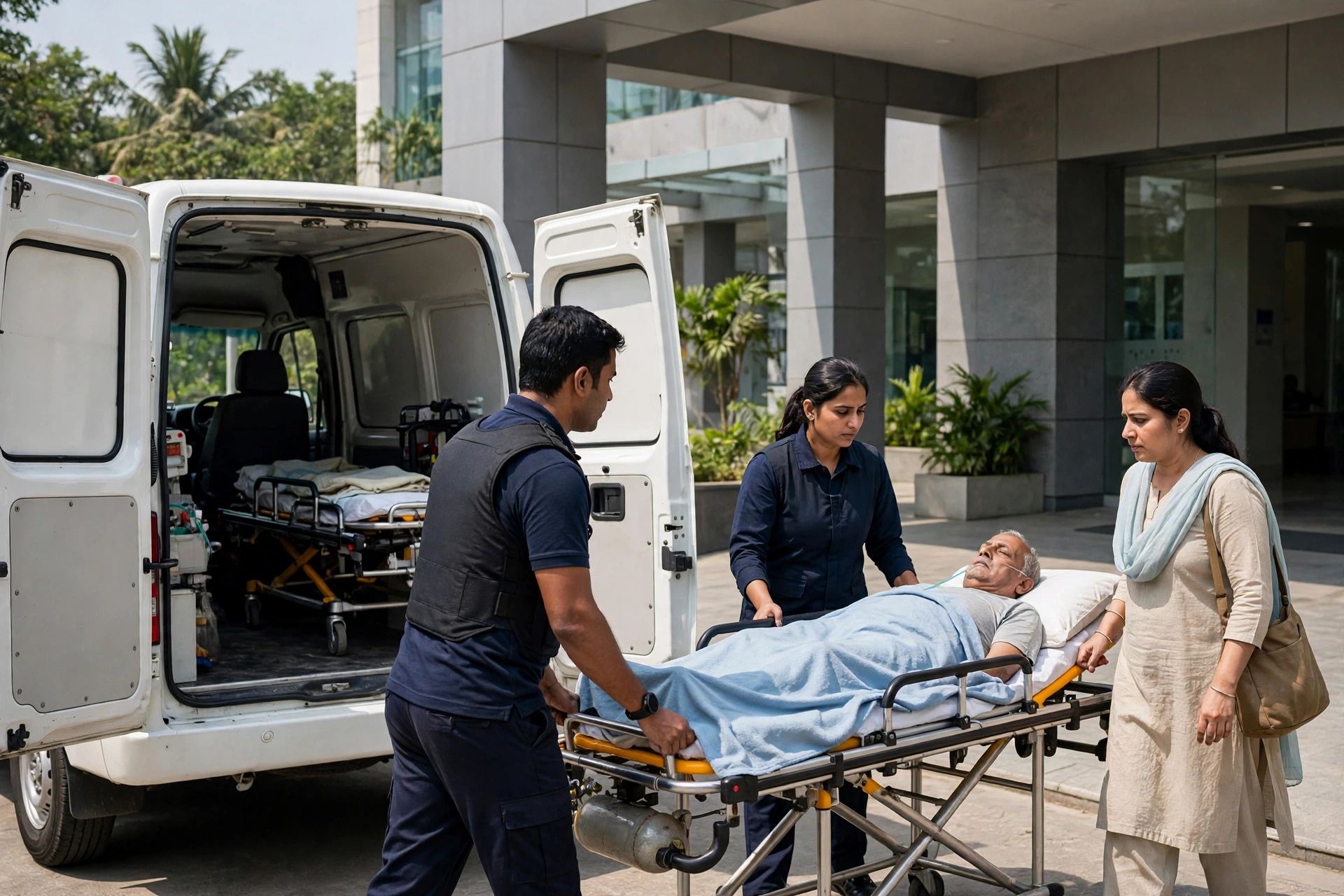
A road journey can change in a single moment. One crash, one injured person, and the family faces a frightening question: where will the hospital money come from? In many cases, people delay taking an injured person to hospital because of this fear. Sometimes the family first worries whether they will have to pay from their own pocket. Sometimes the worry starts at the hospital itself, when they fear they will be asked to deposit money before treatment begins. This fear and delay can cost lives, because doctors consider the first hour after an accident to be the most precious time for treatment.
To remove this fear, the Government of India has created a special scheme for road accident victims. Its name is the Cashless Treatment of Road Accident Victims Scheme, 2025. It is now also known as PM RAHAT, which stands for Road Accident Victim Hospitalization and Assured Treatment. The purpose of the scheme is simple: the treatment of a person injured in a road accident should not stop because of a lack of money. At the time of admission, the family should not have to deposit money for treatment, because the treatment will be cashless.
In this article, we will give you complete information about this scheme in simple language. First, we will explain what the scheme is and when it came into force. Then we will look at who can benefit from it and which kinds of roads it covers. After that, we will explain the treatment limit, the hospital system, what a family should do after an accident, and the step-by-step process inside the hospital. Finally, we will compare this scheme with Ayushman Bharat, the Rah-Veer Scheme and the Hit and Run Compensation Scheme, so that there is no confusion. Answers to frequently asked questions are given at the end.
If you drive a vehicle, if someone in your family travels by road every day, or if you ever witness an accident, read this article till the end. The information in it may one day help save someone’s life.
What is the PM RAHAT Cashless Treatment Scheme?
The Cashless Treatment of Road Accident Victims Scheme, 2025 is a statutory scheme. It has been created under Section 162 of the Motor Vehicles Act, 1988. This means it is not a temporary announcement but an arrangement fixed under law. The government notified the scheme on 5 May 2025. Detailed guidelines for it were issued on 4 June 2025. On 13 February 2026, the scheme was launched for implementation across the whole country under the name PM RAHAT.
Under this scheme, a person injured in a road accident gets cashless treatment up to a fixed limit. The cost of treatment is paid directly to the hospital under the scheme. The injured person or their family does not have to pay from their own pocket, as long as the treatment stays within the fixed limit. This is what makes the scheme different from most other health schemes, because there is no condition of prior registration. A person becomes a beneficiary of this scheme only after an accident happens.
The scheme is implemented by the National Health Authority (NHA), the same body that implements the Ayushman Bharat Pradhan Mantri Jan Arogya Yojana. But it is important to understand that PM RAHAT is not a part of Ayushman Bharat. It is a separate scheme made only for road accident victims. Having an Ayushman card is not required, and there is no income condition or poverty-line condition.
The money for the scheme comes from the Motor Vehicle Accident Fund (MVAF). In cases where the offending vehicle is insured, payment comes from contributions by general insurance companies. In cases where the vehicle is not insured, the central government provides budgetary support. For the financial year 2025-26, a budget of Rs 272 crore was kept for cases other than insured cases.
Quick Facts: PM RAHAT Scheme at a Glance
| Point | Detail |
|---|---|
| Scheme name | Cashless Treatment of Road Accident Victims Scheme, 2025 (PM RAHAT) |
| PM RAHAT full form | Road Accident Victim Hospitalization and Assured Treatment |
| Legal basis | Section 162 of the Motor Vehicles Act, 1988 |
| Notification | 5 May 2025 (S.O. 2015(E)) |
| Guidelines | 4 June 2025 (S.O. 2489(E)) |
| Launched across India | 13 February 2026 |
| Treatment limit | Up to Rs 1.5 lakh per victim |
| Time limit | Maximum 7 days from the date of accident |
| Implementing body | National Health Authority (NHA) |
| Emergency number | 112 (Emergency Response Support System) |
| Income or insurance condition | None — any road accident victim is eligible |
| Online application | No — treatment starts through the hospital itself |
Who is Eligible?
The eligibility for this scheme is very simple. Any person injured in a road accident caused by the use of a motor vehicle is eligible. It does not matter what kind of road the accident happened on — a national highway, a state highway, a district road or a village road. The scheme applies to every category of road.
The victim’s income is not checked. Whether the victim is rich or poor, whether they have their own health insurance or not, does not stop the benefit. Having an Ayushman card is also not required. This is why the scheme also works for people who do not fall under any other health scheme.
It also does not matter who owns the vehicle. Whether the victim was walking, cycling, riding a two-wheeler, travelling in a car or travelling as a bus passenger — if the accident was caused by a motor vehicle, they are eligible. One point must be clear: the accident must be connected to a motor vehicle. An injury from simply falling on the road, without any vehicle involved, does not fall under this scheme.
Another important condition is that treatment must take place at a designated hospital. If an injured person is first taken to some other hospital, only stabilisation treatment is given there. In non-life-threatening cases this stabilisation treatment is given for up to 24 hours, and in life-threatening cases for up to 48 hours. This arrangement depends on police response. After that, the victim is shifted to a designated hospital, where the full cashless treatment arrangement applies.
How Much Treatment is Covered: Amount and Time Limit
Under this scheme, every victim gets cashless treatment of up to Rs 1.5 lakh. This limit applies separately to each victim. If several people are injured in the same accident, the limit of Rs 1.5 lakh applies separately to each injured person. One person’s limit is not linked to another person’s limit.
The second limit is time. The treatment facility is available for a maximum of 7 days from the date of the accident. This counting starts from the date of the accident, not from the date of admission to hospital. That is why reaching hospital on time is so important. If treatment continues beyond 7 days, or if the cost goes beyond Rs 1.5 lakh, the further cost is not covered under this scheme. In such a situation, further treatment would have to be paid through the victim’s own insurance, another scheme, or their own expense.
Treatment is given as per the standard health benefit packages of the NHA. This means a hospital cannot charge arbitrary prices. Packages for trauma and polytrauma care from Ayushman Bharat have also been included in this scheme. After treatment, the hospital has to submit its claim to the State Health Agency (SHA). Once a claim is approved by the SHA, a period of 10 days has been fixed for payment to the hospital. This arrangement exists so that hospitals do not hesitate to give treatment.
One more point must be made clear. This scheme does not send money to the victim’s bank account. No cash amount of Rs 1.5 lakh is given. It only covers the cost of treatment in hospital, and the money is paid directly to the hospital. If anyone claims that they can arrange a cash payment under this scheme, do not believe them.
Which Hospitals Give Treatment?
Under this scheme, treatment is given at designated hospitals. These hospitals have been fixed by states and union territories together with the NHA. Hospitals empanelled under the Ayushman Bharat Pradhan Mantri Jan Arogya Yojana, which follow the guidelines issued by the NHA, are automatically treated as designated hospitals under this scheme. In addition, states can add more hospitals as per NHA guidelines.
At the time of an accident, the biggest problem is that people do not know which is the nearest hospital. To solve this problem, the scheme has been linked with the 112 emergency service. When you call 112, the operator tells the victim about the nearest designated hospital and also provides an ambulance facility if required. So the first step after an accident is to call 112. This number is the same across the country and easy to remember.
If an injured person is mistakenly taken to a hospital that is not designated under this scheme, do not panic. Even such a hospital gives stabilisation treatment — up to 24 hours in non-life-threatening cases and up to 48 hours in life-threatening cases. After that, the victim is shifted to a designated hospital. So initial treatment should not be delayed, even if the hospital is not on the designated list.
What to Do After an Accident: Steps for Family and Helpers
The first minutes after an accident are the most precious. Doctors call this the golden hour. Taking the right steps during this time can save a life. The steps given below are for family members, helpers and witnesses. Read them carefully and remember them.
Step 1: Call 112. On the call, clearly tell the location of the accident, how many people are injured, and ask for an ambulance. The 112 operator can also tell you about the nearest designated hospital. Even if you are taking the injured person to hospital yourself, informing 112 is still important, because police information is part of this scheme’s process.
Step 2: Take the injured person to the nearest designated hospital. If the designated hospital is far away and another hospital is nearby, first get initial treatment at the nearby hospital. Delay can be dangerous for the injured person. On reaching the hospital, clearly tell them that this is a road accident case, so that the hospital can start the scheme’s process.
Step 3: At the hospital, make it clear that treatment should be under the PM RAHAT scheme. The hospital records the injured person’s details and starts the treatment process. The police record the accident report on the eDAR system. eDAR stands for electronic Detailed Accident Report, and it is the system of the Ministry of Road Transport and Highways. The hospital uses the NHA’s TMS 2.0 system for treatment, claim submission and payment. The family does not have to fill anything in these systems themselves, but giving correct information to the hospital is important.
Step 4: During treatment, keep taking information from the hospital. Ask under which package the treatment is happening and how much of the Rs 1.5 lakh limit has been used. If the treatment period is coming close to 7 days, or the cost is coming close to the limit, talk to the hospital in advance about further arrangements. This will avoid last-minute running around.
Step 5: After discharge, keep the hospital claim information. The hospital submits its claim to the State Health Agency after treatment. The family should not be asked to pay the hospital bill, as long as the treatment is within the fixed limit. If any hospital asks for money for treatment within the fixed limit, a complaint can be made through the State Health Agency or the NHA.
What is Not Covered?
Every scheme has some limits, and it is important to know them in advance. Under this scheme, any cost above Rs 1.5 lakh is not covered. Treatment after 7 days from the date of the accident is also not covered. If the accident did not involve a motor vehicle, it also does not fall under this scheme.
This scheme covers the cost of treatment, but it does not give compensation for loss of earnings, damage to a vehicle, or mental distress. For such matters, there is a separate arrangement of insurance claims or compensation. In hit and run cases, there is a separate compensation scheme for death or serious injury, which is explained below.
Another confusion must be cleared. There is no online form to apply for this scheme. If any website or person says that they will register you online for this scheme and asks for money, that is wrong. The benefit of this scheme is available at the time of treatment in hospital. No one has to pay anything for it.
Difference from Other Schemes: Clearing the Confusion
| Scheme | For whom | What is given |
|---|---|---|
| PM RAHAT (Cashless Treatment Scheme, 2025) | Any road accident victim | Cashless treatment up to Rs 1.5 lakh for 7 days |
| Ayushman Bharat PM-JAY | Families identified in advance | Health insurance up to Rs 5 lakh per year, not limited to accidents |
| Rah-Veer Scheme | Citizen who helps an accident victim | Rs 25,000 reward and appreciation certificate for help in the golden hour |
| Hit and Run Compensation Scheme (2022) | Family of hit and run victim | Fixed amount of Rs 2 lakh on death, Rs 50,000 on grievous hurt |
The biggest difference from Ayushman Bharat is that in Ayushman, beneficiaries are identified in advance, while in PM RAHAT, any victim becomes a beneficiary after an accident. The difference from the Rah-Veer Scheme is that Rah-Veer rewards the person who helps, while PM RAHAT treats the injured person. Both schemes run together and do not replace each other. The difference from the Hit and Run Compensation Scheme is that it gives compensation, not treatment.
Important Dates and Progress So Far
The story of this scheme has developed over a few years. The Supreme Court had also stressed that a cashless treatment arrangement should be made for road accident victims. After that, the government notified the scheme on 5 May 2025. Its guidelines were issued on 4 June 2025. On 13 February 2026, it was launched across the country under the name PM RAHAT.
According to the government’s answer in the Lok Sabha, by 31 July 2026, a total of 22,481 victims had received free treatment under this scheme across 34 states and union territories. This figure shows that the scheme is not only on paper but is also working on the ground. Even so, many people still do not know about this scheme. That is why people fear the cost of treatment at the time of an accident. Spreading this information to as many people as possible is the purpose of this article.
The government has also started a road safety campaign to spread awareness about this scheme. This campaign is being run through the Central Bureau of Communication. Its purpose is to tell people not to worry about the cost of treatment after an accident and to take the injured person to hospital immediately.
Frequently Asked Questions (FAQ)
1. Is prior registration required for PM RAHAT?
No. There is no prior registration. Any person injured in a road accident can get the benefit at a designated hospital at the time of treatment.
2. Are both poor and rich people eligible under this scheme?
Yes. There is no income condition. Having an Ayushman card is also not required.
3. Will this scheme apply to an accident on a village road?
Yes. This scheme applies to motor vehicle accidents on any category of road.
4. Will the victim have to deposit money at the hospital?
No, as long as the treatment is within the Rs 1.5 lakh limit and the 7-day period. Treatment within this limit is cashless, and payment is made to the hospital under the scheme.
5. Does this scheme send money to a bank account?
No. It does not give any cash amount. It only covers the cost of treatment in hospital.
6. What happens if the injured person is first taken to a non-designated hospital?
Such a hospital gives stabilisation treatment — up to 24 hours in non-life-threatening cases and up to 48 hours in life-threatening cases. After that, the victim is shifted to a designated hospital.
7. What should be done first after an accident?
First, call 112. Tell the location of the accident, ask for an ambulance, and take the injured person to the nearest designated hospital. Reaching hospital on time is the most important step.
8. Do I need to apply online for this scheme?
No. There is no online application. If anyone asks for money in the name of this scheme, that is wrong.
Important Links
| Information | Official link |
|---|---|
| PIB press release on PM RAHAT / Cashless Treatment Scheme | https://www.pib.gov.in/PressReleasePage.aspx?PRID=2220125 |
| PIB information on the scheme notification and guidelines | https://www.pib.gov.in/PressReleasePage.aspx?PRID=2153890 |
The information in this article is based on the government notification, PIB press releases and answers given in the Lok Sabha. Rules and hospital lists may change from time to time, so at the time of an accident, call 112 to get information about the nearest designated hospital.
Note: GramSuvidha is a private information portal, not a government website. This article is for information only. For any treatment or claim, take final information from the hospital, the State Health Agency or the concerned government department.