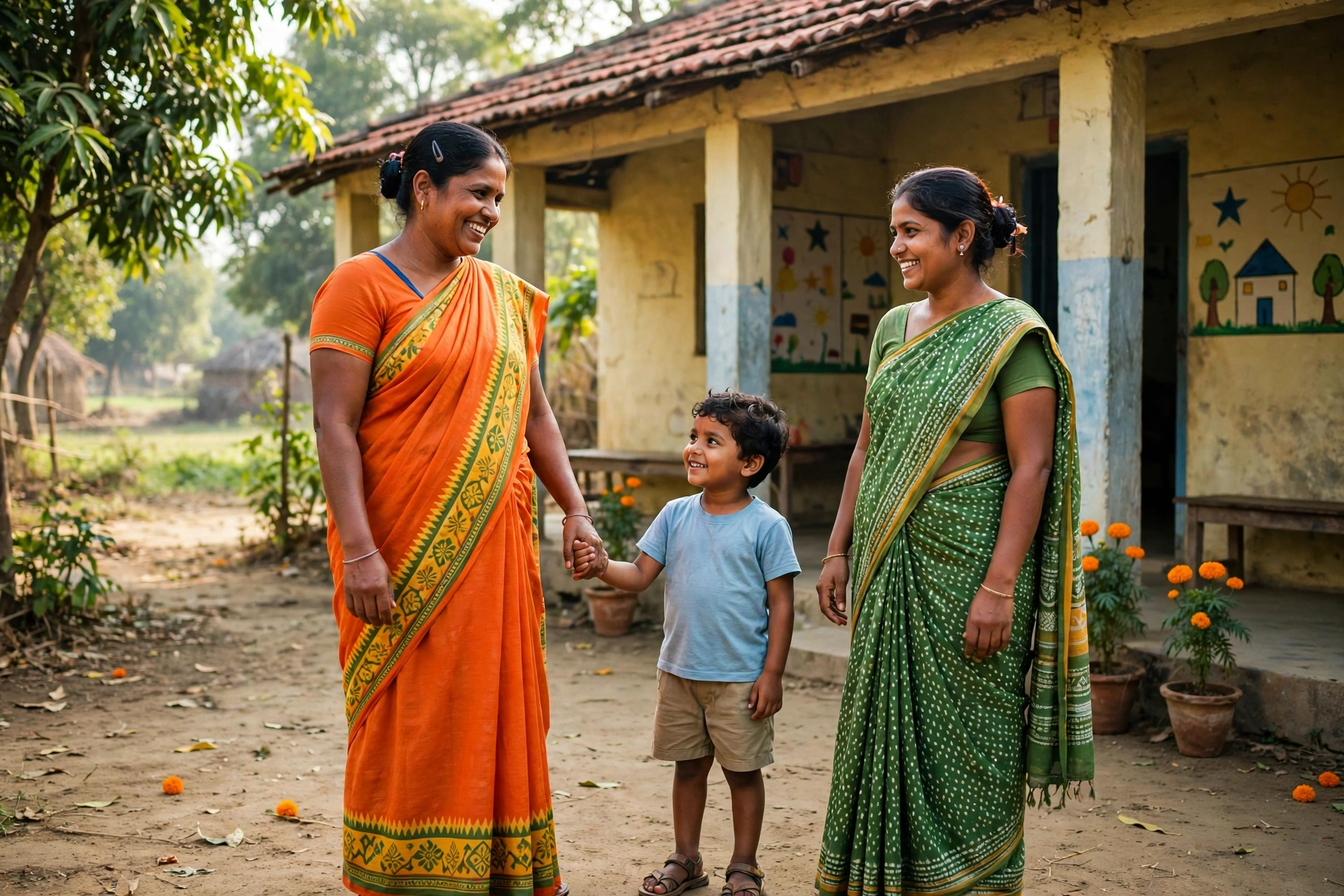
For lakhs of women across Uttar Pradesh, the Anganwadi centre is the first door of the village. It is where a pregnant mother gets her first advice on food and health, where a small child gets a hot meal and early learning, and where a family in need finds someone who knows their name. The women who run these centres — the Anganwadi workers and their helpers — have carried this responsibility for years, often on modest pay and with little public attention.
In September 2026, the state government made an announcement that changed the conversation around their work. The UP Anganwadi Honorarium Hike 2026 was declared at a public ceremony in Ayodhya, and since then, workers across the state have been asking the same questions: how much has the pay gone up, when will the new amount reach their bank accounts, and what else has changed besides the monthly honorarium? This article answers all of those questions in simple language, using only confirmed information from official announcements and reputed news reports.
If you are an Anganwadi worker or helper in Uttar Pradesh, or if someone in your family is, read this guide till the end. It covers the new honorarium, the health cover, the extra saree, the smartphone scheme, and what to do if the increased payment has not yet reached you.
UP Anganwadi Honorarium Hike 2026: Quick Facts
| Detail | Information |
|---|---|
| Announcement date | 10 September 2026 |
| Announced by | Chief Minister Yogi Adityanath |
| Occasion | ICDS felicitation ceremony for Anganwadi workers and helpers in Ayodhya Dham, ahead of Poshan Maah (Nutrition Month) |
| Anganwadi worker honorarium | ₹8,000 per month → ₹12,000 per month |
| Anganwadi helper honorarium | ₹4,000 per month → ₹6,000 per month |
| Effective from | September 2026 |
| Increased payments from | October 2026; payments began reaching workers ahead of Diwali (early November 2026) |
| Beneficiaries | About 2.91 lakh workers and helpers in Uttar Pradesh |
| Health benefit | Cashless treatment up to ₹5 lakh per year for workers, helpers and their families |
| Third saree | ₹500 via DBT (provision rises from 2 sarees to 3) |
| Smartphones | About 1.28 lakh smartphones provided to Anganwadi centres in the first phase |
Who Benefits From the Hike?
The hike covers the Anganwadi workforce of Uttar Pradesh — one of the largest such workforces in the country. According to Leena Johri, Additional Chief Secretary of the Women and Child Development Department, the state has 1,75,982 Anganwadi workers and 1,70,656 helpers. Together, that is nearly 2.91 lakh women whose monthly honorarium has gone up.
Anganwadi workers are the women who run the centres. They organise the daily feeding of children, keep growth and health records, counsel pregnant and lactating mothers, distribute take-home rations, and help with pre-school activities. Helpers support them in this work — cooking the food, cleaning the centre, and assisting with the children and the daily routine.
Both groups benefit from this announcement. The worker’s honorarium has risen by ₹4,000 a month, and the helper’s by ₹2,000 a month. For a family that depends on this income, that is a meaningful change — roughly ₹48,000 more in a year for a worker, and ₹24,000 more for a helper, if the full amount is paid every month.
It is worth understanding what an honorarium means here. Anganwadi workers and helpers are not regular government employees with a salary scale. They receive an honorarium — a fixed monthly payment for their service. That is why announcements like this one matter so much: the honorarium is their main income from this work, and any increase directly changes what their households can afford.
Honorarium Breakdown: Old vs New
| Role | Old honorarium (per month) | New honorarium (per month) | Increase |
|---|---|---|---|
| Anganwadi worker | ₹8,000 | ₹12,000 | ₹4,000 |
| Anganwadi helper | ₹4,000 | ₹6,000 | ₹2,000 |
The amounts include both central and state contributions and incentives. A government order issued in September 2026 fixed the state share increase at ₹4,000 for workers and ₹2,000 for helpers. The order has fixed and performance-linked components, so the actual payment a worker receives may depend on the applicable rules. In simple words: the headline figures are ₹12,000 and ₹6,000, but part of the payment is linked to performance conditions set by the government.
The hike is effective from September 2026, and the increased payments started from October 2026. Reports in early November 2026 said the increased honorarium had begun reaching workers ahead of Diwali, which was welcome news for families preparing for the festival.
Benefit 1: Higher Monthly Honorarium
The headline benefit is the honorarium itself. A worker who earlier received ₹8,000 a month now receives ₹12,000. That is a 50 percent increase. A helper who earlier received ₹4,000 a month now receives ₹6,000 — also a 50 percent increase.
For many workers, this is the biggest single jump in their honorarium in years. The work itself has only grown over time: Anganwadi centres today handle nutrition, health tracking, early childhood education, and record-keeping, and workers are expected to maintain data on registers and, increasingly, on digital platforms. The hike is a recognition that the job has become more demanding, not less.
Because the payment has fixed and performance-linked parts, workers should keep their records up to date and follow the instructions given by their supervisors. If any part of the payment depends on completing certain tasks — such as updating registers, feeding data, or attending training — completing those tasks on time is the surest way to receive the full amount.
Benefit 2: Cashless Treatment up to ₹5 Lakh per Year
Alongside the pay hike, the government announced cashless treatment of up to ₹5 lakh per year for Anganwadi workers, helpers and their families. This is a major benefit, because a single hospital admission can wipe out months of savings for a family living on a modest income.
The treatment is available at eligible government hospitals, medical colleges and empanelled hospitals. The exact list of hospitals, the registration process and the package details are subject to the final guidelines, which workers should confirm from their department. Do not assume that every private hospital is covered, and do not pay anyone who promises to arrange this benefit for a fee.
What workers should do now is simple: ask their area supervisor, Child Development Project Officer (CDPO) or District Programme Officer (DPO) how the health cover registration works in their district, and whether any card, form or document is needed. Keep any official communication about the scheme safely, and check with the department — not with middlemen — if anything is unclear.
Benefit 3: Third Saree — ₹500 via DBT
The government has also increased the saree provision for Anganwadi workers from two sarees to three. An amount of ₹500 will be transferred through Direct Benefit Transfer (DBT) for the third saree.
The saree is part of the worker’s uniform and identity in the village. An Anganwadi worker in her saree is instantly recognised at the centre, at a home visit, or at a health camp. Adding a third saree is a small benefit in money terms, but it is a practical one — uniforms wear out with daily use, washing and field visits.
Because the ₹500 comes through DBT, it will go directly to the worker’s bank account. Workers should make sure their bank account is active and linked correctly, and that their details with the department are up to date, so that DBT payments do not fail.
Benefit 4: Smartphones for Anganwadi Centres
About 1.28 lakh smartphones have been provided to Anganwadi centres in the first phase. The aim is to turn the centres into “smart” centres, with real-time data on children, mothers, meals and supplies.
This matters because much of an Anganwadi worker’s day is now about records: how many children attended, what food was served, which child needs a health check, which mother is due for a visit. Doing this on paper takes time and can lead to delays. A smartphone with the right application can record the same information quickly and send it to the department the same day.
For workers who are not comfortable with smartphones, the department is expected to provide training and support. Workers should not hesitate to ask their supervisor for help in learning the application. The phone is a work tool, and learning to use it well will make the daily record-keeping easier, not harder.
From 2017 to 2026: How the Honorarium Has Grown
The 2026 hike is best understood by looking back. In 2017, an Anganwadi worker in Uttar Pradesh received ₹3,000 a month. That was later raised to ₹8,000, with the payment linked to performance. Now it has risen to ₹12,000. In nine years, the worker’s honorarium has gone up four times — from ₹3,000 to ₹12,000.
Helpers have seen a similar journey. Their honorarium rose from ₹2,000 to ₹6,000 over the same nine-year period — a three-fold increase. The latest step alone, from ₹4,000 to ₹6,000, is a 50 percent jump.
This history shows a steady direction: the state has repeatedly raised the honorarium, and each rise has been larger than the last in rupee terms. But it also shows why workers should keep track of announcements and government orders. Each hike has come with its own conditions and its own effective date, and the amount that reaches the bank account depends on the order in force at the time.
What to Do If the Increased Payment Has Not Arrived
Most workers should have started receiving the increased honorarium from October 2026, with payments reaching them ahead of Diwali in early November 2026. If your increased payment has not arrived, do not panic — but do act. Follow these steps:
1. Check your bank account and DBT status
First, check your bank passbook, bank app or SMS alerts to see whether the new amount has been credited. Sometimes the payment is made but the SMS does not arrive. Check the full amount, not just the message. If you receive DBT payments, confirm that your account is active and that your Aadhaar and bank details are correctly linked.
2. Contact your area supervisor
Your area supervisor is the first person to ask. Supervisors handle the records of the workers in their area and can tell you whether your payment has been processed, whether any document is missing, or whether there is a delay in your block or district.
3. Approach the CDPO or DPO
If the supervisor cannot resolve the matter, contact your Child Development Project Officer (CDPO) or the District Programme Officer (DPO). They are the officers responsible for the ICDS programme in your project area and district. Carry your worker ID, bank account details and any payment slips or messages you have received, so they can check your case quickly.
4. Keep your records ready
Keep a small file of your payment records — bank statements, SMS alerts, and any letters from the department. If a payment is delayed or short, these records are the proof you will need. Do not hand over original documents to anyone except an authorised officer, and never pay anyone who claims they can release your payment for a fee. If someone asks for money to process your honorarium, report it to the CDPO or DPO.
UP vs Other States: How the Honorarium Compares
Anganwadi honorarium is not the same in every state, because it is made up of a central share and a state top-up. The central share for an Anganwadi worker is ₹4,500 a month, according to a Lok Sabha reply in December 2024. States then add their own contribution on top, so the total varies from state to state.
Uttar Pradesh’s new total of ₹12,000 for workers and ₹6,000 for helpers is therefore a combination of the central share, the state share and incentives. Other states pay different totals depending on how much they add. This is why comparing honorarium across states needs care: two states may receive the same central share but pay very different totals because their state top-ups differ.
For UP workers, the practical point is this: the state government has used its share to lift the total to ₹12,000 for workers and ₹6,000 for helpers, and the September 2026 government order fixed the state share increase at ₹4,000 and ₹2,000 respectively. The central share is only one part of the total — the state top-up is what makes the difference.
Why This Hike Matters
Anganwadi workers and helpers are the backbone of child nutrition and early learning in rural Uttar Pradesh. They reach homes that no office can reach. They notice when a child is losing weight, when a pregnant woman has missed a check-up, or when a family needs help. They do this work in their own villages, among people they know, and that trust is something no poster or campaign can replace.
A pay hike does not solve every problem these workers face. Centres still need better buildings, regular supplies and lighter paperwork. But a 50 percent increase in the honorarium, a health cover of up to ₹5 lakh a year, an extra saree and a smartphone are real, practical improvements. They put more money in the worker’s hand, protect her family from a medical emergency, and give her a better tool for her daily work.
The timing also matters. The announcement came ahead of Poshan Maah, the Nutrition Month, when the work of Anganwadi centres is in the spotlight. And the increased payments began reaching workers ahead of Diwali, when household expenses are at their highest. For many families, that timing made the hike feel real, not just announced.
Frequently Asked Questions (FAQ) — UP Anganwadi Honorarium Hike 2026
1. What is the new Anganwadi worker honorarium in UP after the UP Anganwadi Honorarium Hike 2026?
Anganwadi workers in Uttar Pradesh now receive ₹12,000 per month, up from ₹8,000 per month. The hike was announced on 10 September 2026 and is effective from September 2026.
2. What is the new honorarium for Anganwadi helpers in UP?
Anganwadi helpers now receive ₹6,000 per month, up from ₹4,000 per month — an increase of ₹2,000 per month.
3. When did the increased payments start?
The increased payments started from October 2026, and reports in early November 2026 said the new amounts had begun reaching workers ahead of Diwali.
4. How many workers and helpers benefit from the UP Anganwadi Honorarium Hike 2026?
About 2.91 lakh workers and helpers benefit — 1,75,982 Anganwadi workers and 1,70,656 helpers in Uttar Pradesh, according to the Women and Child Development Department.
5. Is the ₹12,000 a fixed salary?
No. It is an honorarium, not a regular government salary. The amount includes central and state contributions and incentives, and the government order has fixed and performance-linked components, so the actual payment may depend on the applicable rules.
6. What is the ₹5 lakh cashless treatment benefit?
Workers, helpers and their families are to get cashless treatment up to ₹5 lakh per year at eligible government hospitals, medical colleges and empanelled hospitals. The final guidelines, hospital list and registration process should be confirmed from the department.
7. What is the third saree benefit?
The saree provision has risen from 2 sarees to 3. An amount of ₹500 will be transferred via DBT for the third saree.
8. How many smartphones have been given to Anganwadi centres?
About 1.28 lakh smartphones have been provided to Anganwadi centres in the first phase, to help centres become “smart” centres with real-time data.
9. What should I do if my increased payment has not arrived?
First check your bank account and DBT status. Then contact your area supervisor, and if needed your Child Development Project Officer (CDPO) or District Programme Officer (DPO), with your worker ID and bank details. Never pay anyone who claims they can release your payment for a fee.
10. Where can I get official information about the UP Anganwadi Honorarium Hike 2026?
Contact your area supervisor, CDPO or DPO, or check official channels of the Uttar Pradesh government (up.gov.in) and the Women and Child Development Department / ICDS Uttar Pradesh. This portal is a private information portal, not a government website.
Official Links
- Uttar Pradesh government portal: https://up.gov.in
- Women and Child Development Department, Uttar Pradesh / ICDS Uttar Pradesh — contact your area supervisor, Child Development Project Officer (CDPO) or District Programme Officer (DPO) for payment records, healthcare registration and package details.
Disclaimer: GramSuvidha is a private information portal, not a government website. The information in this article is based on official announcements and news reports cited above; workers should confirm payment, health cover and registration details with their supervisor, CDPO or DPO.