Every farmer knows the same pain — irrigation costs too much. Run a diesel pump and thousands of rupees burn away as fuel every month. Own an electric pump and you still cannot trust when the power will come or go. The Government of India launched a scheme to fix exactly this problem, using the one thing a farm never runs out of: sunlight.
In this article, we explain PM Kusum Yojana in full — what the scheme is, which of its three parts (Component A, B or C) suits you, how the subsidy structure works, who can apply, which documents you need, how to apply in your state, how to check your application status, and most importantly, how to stay safe from the fake websites running in this scheme’s name. The FAQ section at the end answers the most common questions. Let us go through it step by step.
Quick Facts
| Detail | Information |
|---|---|
| Scheme name | Pradhan Mantri Kisan Urja Suraksha evam Utthaan Mahabhiyan (PM-KUSUM) |
| Ministry | Ministry of New and Renewable Energy (MNRE), Government of India |
| Launched | March 2019 |
| Purpose | Solar irrigation for farmers, less diesel dependence, higher farmer income |
| Main benefits | Subsidy on solar pumps, income from selling solar power |
| Subsidy pattern (general states) | 30% Centre + 30% State + 30% bank loan + about 10% farmer share upfront |
| Official portal | pmkusum.mnre.gov.in (applications routed through state departments) |
| Toll-free helpline | 1800-180-3333 |
What Is PM Kusum Yojana?
PM Kusum Yojana’s full name is Pradhan Mantri Kisan Urja Suraksha evam Utthaan Mahabhiyan. It is a scheme of the Ministry of New and Renewable Energy (MNRE), launched in March 2019. Its goal is simple: let farms irrigate with solar power, cut the farmer’s diesel and electricity bill, and wherever possible, let the farmer earn by generating power too.
The scheme targets about 34,800 MW of solar capacity, with central support of about ₹34,422 crore. According to the government, around 2.46 lakh farmers have already benefited. The scheme has three parts — Component A, Component B and Component C — and each part does a different job. Before applying, it is important to understand which part fits your need.
The Three Components — Which One Is for You?
Component A — Solar Plant on Idle Land, Earn by Selling Power
Under this part, farmers can set up a small solar power plant — 500 kW to 2 MW capacity — on barren or idle land. The local power distribution company (DISCOM) buys the electricity the plant generates. So the same land starts earning a second income from power sales.
Note that Component A does not work like the pump subsidy — there is no capital subsidy of the pump type here. The benefit comes from the Power Purchase Agreement (PPA) with the DISCOM, and the DISCOM receives a performance-based incentive (PBI). This part suits farmers and landowners who have barren or low-yield land lying unused.
Component B — Standalone Solar Pump for Farms Without Power
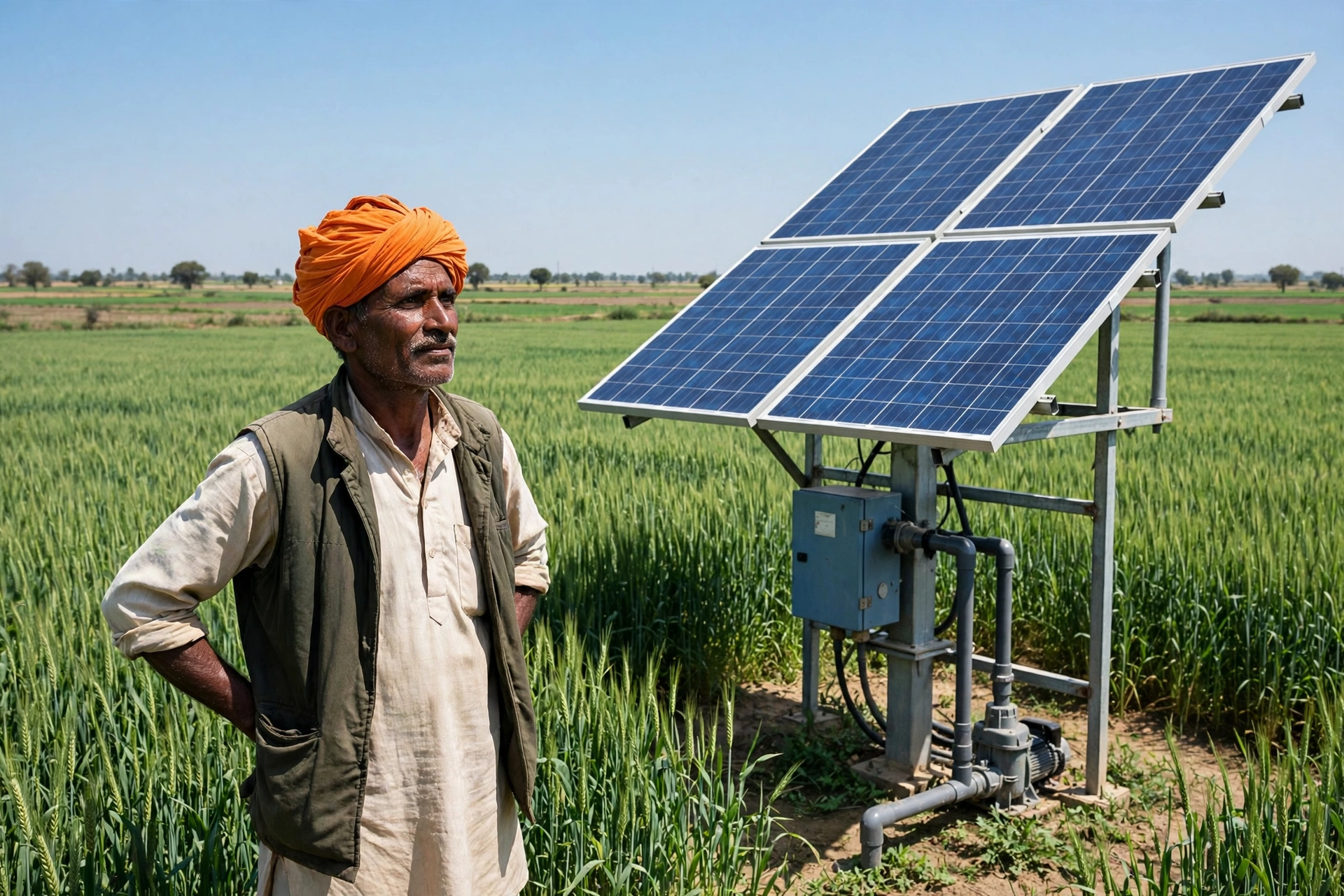
This is the fastest-moving part of the scheme. It gives a standalone solar pump to farmers whose fields have no electricity connection or very poor supply. The solar pump replaces the diesel pump — it runs on daylight, and the diesel expense ends.
Component B covers pumps from 2 HP to 10 HP (several states cap this at 7.5 HP — check your state’s rules). If your field has no power connection and you are tired of diesel costs, this is the part for you.
Component C — Solarisation of an Existing Electric Pump
Farmers who already own an electric pump fall under Component C. The existing pump is connected to solar power. The benefit is double — the electricity bill falls, and surplus power can be sold to the grid for extra income.
Component C works in two ways — Individual Pump Solarisation (solarising your own pump) and Feeder Level Solarisation (powering an entire agricultural feeder from a solar plant). The feeder-level model is being adopted fast in states such as Maharashtra and Rajasthan.
How Much Subsidy Do You Get? (Subsidy Structure)
This is the most-asked question — how much must the farmer pay from his own pocket? The answer depends on the state and the component, but the standard pattern is:
| Part | Central Government (CFA) | State Government | Bank Loan | Farmer’s Upfront Share |
|---|---|---|---|---|
| General states (Components B/C) | 30% | At least 30% | Up to 30% | About 10% |
| Special states (North-East, Sikkim, J&K, Himachal, Uttarakhand, Ladakh, Andaman-Nicobar) | 50% | At least 30% | Up to 30% | About 10% |
Important points:
- CFA is calculated on the benchmark cost or the tender cost, whichever is lower.
- With a bank loan, the farmer pays only about 10% upfront; the remaining 30% comes from the loan.
- Some states give even more — in Maharashtra, the farmer share for SC/ST farmers is reported to be around 5%, and in notified tribal blocks of Madhya Pradesh total subsidy can reach up to 90%. Always check your state’s latest rules.
- Component A does not follow this subsidy pattern — there the power sale agreement is the main benefit.
An example to understand the pattern (illustrative only): Suppose an approved solar pump system costs ₹1,00,000. In a general state, 30% Centre (₹30,000) + 30% State (₹30,000) subsidy leaves ₹40,000. Of this, 30% (₹30,000) can come from a bank loan and about 10% (₹10,000) is the farmer’s upfront share. The real cost depends on the pump’s HP, the state’s tender and the benchmark price — this is only to explain the structure.
Who Can Apply? (Eligibility)
- Individual farmers who own cultivable land and have a water source (borewell/well).
- Groups of farmers, cooperatives, FPOs (Farmer Producer Organisations) and panchayats — especially for Component A.
- For Component C, an existing grid-connected agricultural pump is required.
- The applicant must not be a bank loan defaulter.
Who may not be eligible: Farmers who have already taken a solar pump subsidy from another scheme or state department cannot claim it again for the same pump. Every state has its own detailed rules — read your state’s guidelines before applying.
Documents Required
- Aadhaar Card
- Land records (Khasra-Khatauni / RTC / Pahani)
- Proof of water source (borewell proof)
- Bank account passbook / bank details
- Existing electricity connection bill (for Component C)
- Passport-size photograph
- Caste certificate (if applicable)
How to Apply (Online + Offline)
Please note: PM Kusum Yojana is implemented through state government departments. So in most states, you do not apply on the national portal alone — you apply through your state’s nodal department/portal. The national portal pmkusum.mnre.gov.in carries scheme information, state-wise details and a farmer registration option, but the final process belongs to the state.
General online application steps:
- Go to your state’s nodal department portal (see the table below) or pmkusum.mnre.gov.in.
- Choose Farmer Registration / Apply and select your Component (A, B or C).
- Fill in the farmer’s name, mobile number, Aadhaar number, address, land and pump details.
- Upload the required documents.
- Submit the form and note down your application/registration ID.
- The state nodal agency will verify the land records and the pump capacity.
- After approval, the farmer’s share (about 10%) must be paid — the bank loan option is available.
- An empanelled vendor installs the solar pump, followed by inspection and commissioning. The subsidy is adjusted directly against the system cost.
Offline method: You can fill the form and submit documents at your district agriculture department, nodal agency office or DISCOM sub-division office.
State-Wise Nodal Agencies (Examples)
| State | Nodal Agency | Point to Know |
|---|---|---|
| Maharashtra | MEDA (MahaUrja) | Farmer share around 5% for SC/ST farmers |
| Rajasthan | RRECL | Strong focus on Component A, using fallow land |
| Madhya Pradesh | MPUVNL | Total subsidy up to 90% in notified tribal blocks |
| Uttar Pradesh | UPNEDA | Enhanced state subsidy for ST, Vantangia and Musahar farmers |
| Gujarat | GEDA | Fully online application |
This table is only a guide — benchmark costs, quotas and application windows open and close at different times in each state. Always check your state’s portal for the latest status before applying.
How to Check Application Status
- Go to your state’s portal or pmkusum.mnre.gov.in.
- Click Login / Application Status.
- Enter your Application ID or registered mobile number.
- You will see which stage your application is at — approval, vendor allotment, installation or subsidy. Approval and installation updates also come by SMS/email.
Latest Status in 2026 — An Honest Update
This section matters because many websites still show old information. The latest position is:
- Scheme timelines have been extended. For projects whose PPA or Notice to Proceed was issued on or before 31 December 2025, the completion deadline has been extended to 31 March 2027.
- For Component A and Component C (Feeder Level Solarisation) projects, the financial closure deadline has been extended to 30 November 2026.
- Committed liabilities under the current scheme will be carried forward into the proposed PM Kusum 2.0. In plain words: PM Kusum 2.0 is still at the proposal/under-consideration stage as of October 2026 — it has NOT launched. It is reported to add Battery Energy Storage Systems (BESS) to store extra daytime solar power for evening use. Until MNRE announces it officially, do not trust any “Kusum 2.0 applications open” claim.
- An honest progress picture: Component B is far ahead (about 71% of its target as per September 2025 data), while Component A had reached only about 6.5% of its target. The pump part is moving fast; the plant part is slow.
- What this means for you: quotas are limited and applications move on a first-come, first-served basis. Apply as soon as the window opens in your state, and if installation is delayed, contact the state nodal agency directly — never pay a middleman.
Beware of Fake Websites — MNRE’s Warning
This is the most important part of this article. MNRE has issued a clear warning on its official website: several fake websites and mobile apps are asking farmers for registration fees and online payment of the pump’s price in the name of PM Kusum Yojana. MNRE has even named some such domains — for example kusumyojanaonline.in.net, pmkisankusumyojana.co.in, onlinekusamyojana.org.in, pmkisankusumyojana.com — and says many more similar websites exist.
Safety rules:
- Apply only through your state’s official department/portal or pmkusum.mnre.gov.in.
- If any website or person asks for a “registration fee” or says “pay the pump price online first”, it is fake — there is no application fee, and no agent or middleman is ever needed.
- In doubt, call MNRE’s toll-free number 1800-180-3333 or check mnre.gov.in.
- Never share your OTP, bank details or UPI PIN with anyone — the government never asks for OTP on a call.
Frequently Asked Questions (FAQ)
1. How much subsidy does PM Kusum Yojana give on solar pumps?
In general states, 30% Centre + at least 30% State subsidy, up to 30% bank loan, and the farmer pays about 10% upfront. In special states (North-East, hill and island regions), the Centre’s share goes up to 50%.
2. How do I apply for PM Kusum Yojana?
Applications go through your state’s nodal department portal — MEDA in Maharashtra, RRECL in Rajasthan, MPUVNL in Madhya Pradesh, UPNEDA in Uttar Pradesh, GEDA in Gujarat. The national portal pmkusum.mnre.gov.in has information and a registration option, but the final process is the state’s.
3. Is there any fee to apply online for PM Kusum Yojana?
No. Application is free. Any website or person asking for a registration fee is fake — MNRE has issued an official warning about this.
4. What is the difference between Component A, B and C?
Component A — set up a solar plant on idle land and sell power. Component B — standalone solar pump for fields without power. Component C — solarisation of an existing electric pump, with surplus power sold to the grid.
5. Has PM Kusum 2.0 launched?
No. As of October 2026, PM Kusum 2.0 is at the proposal stage — it is reported to add BESS (battery storage). Do not trust “2.0 applications open” claims until there is an official MNRE announcement.
6. Up to how many HP are solar pumps covered?
Generally 2 HP to 10 HP pumps are covered, but several states cap this at 7.5 HP. Check your state’s rules and tender details.
7. Who gets the subsidy money — the farmer or the vendor?
The subsidy is adjusted against the system cost — the farmer pays only his share, and the government share goes directly into the vendor/system cost. So the farmer does not receive the subsidy amount in hand; the pump simply costs less.
8. How long does installation take after applying?
It depends on the state, quota, vendor availability and verification speed. Track your application status on your state’s portal with your Application ID, and contact the state nodal agency if there is a delay.
Note: GramSuvidha is a private information portal, not a government website. Before taking any final decision about an application or payment, please verify the information on the official portal pmkusum.mnre.gov.in or with your state’s nodal department.