What is Gopal Krishna Gram Puraskar Yojana
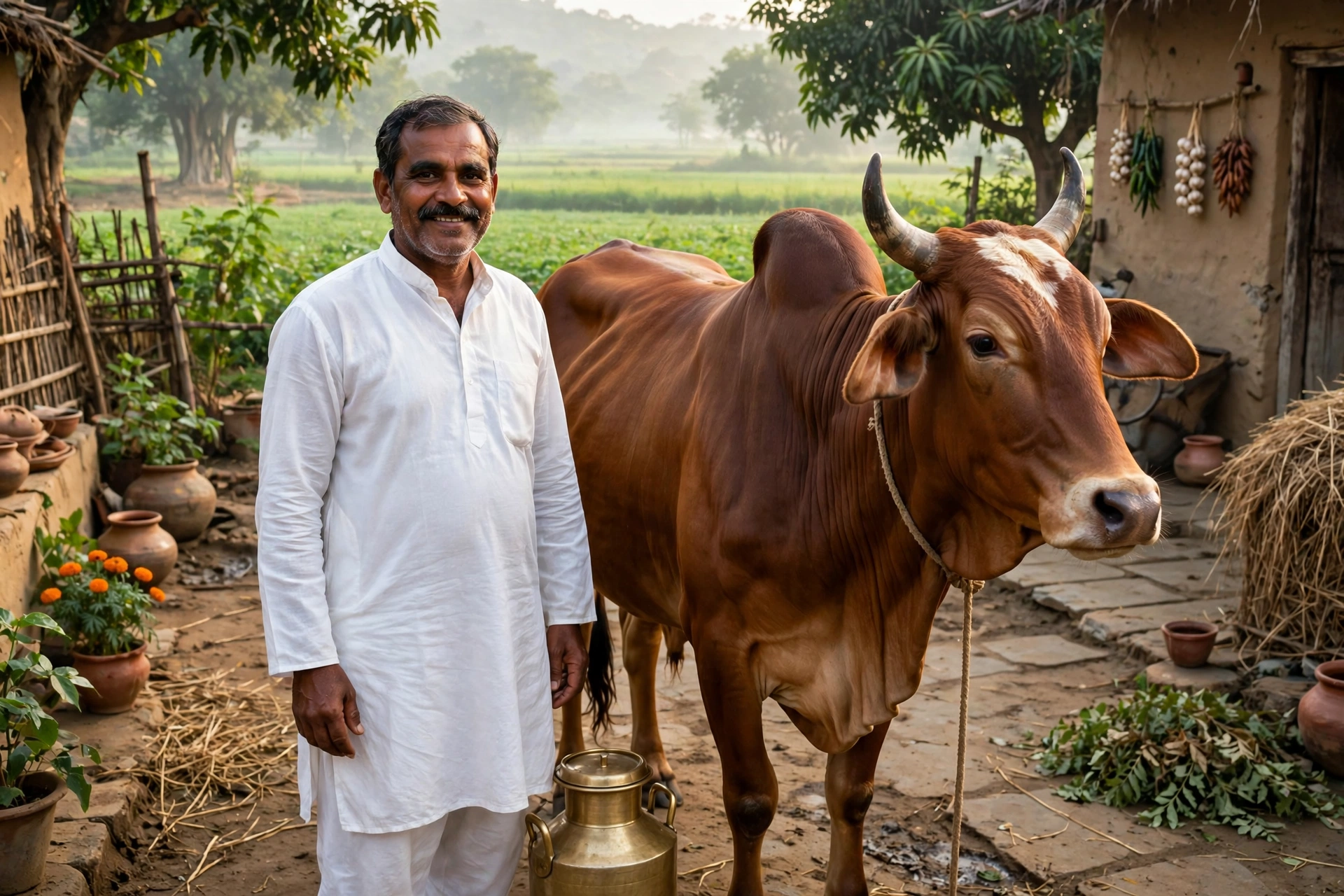
The Government of Madhya Pradesh has launched the Gopal Krishna Gram Puraskar Yojana to increase milk production in the state and to protect indigenous cow breeds. Under this scheme, cattle rearers whose indigenous milch cow gives the highest milk yield receive a cash prize. The first prize is Rs 1 lakh, the second prize is Rs 50,000 and the third prize is Rs 25,000. The scheme is aimed especially at farmers and cattle rearers who keep improved indigenous breeds such as Gir, Sahiwal, Tharparkar and Malvi.
The scheme was announced by Chief Minister Dr Mohan Yadav on 3 October 2026. The Animal Husbandry and Dairy Department then issued an order on 26 October 2026 to start the scheme. On 23 November 2026, the state Cabinet formally approved the implementation of the scheme. In the same Cabinet meeting, proposals worth more than Rs 7,000 crore were cleared for the overall development of the state, expansion of infrastructure and public welfare.
The biggest goal of the scheme is to more than double milk production in Madhya Pradesh and to make the state the milk capital of the country. Along with this, the scheme aims to raise the income of cattle rearers and to conserve indigenous breeds. The government believes that when owners of high-yielding indigenous cows get recognition and cash prizes, more farmers in the villages will turn towards keeping indigenous breeds.
In the first phase, the competition was held in 208 Vrindavan Grams across the state. In 2026-27, one identified Vrindavan Gram in each rural Assembly constituency hosted the competition. From 2027-28, the scheme will expand to all 313 development blocks of the state. This means that in the coming years, cattle rearers in every block of Madhya Pradesh will be able to take part in this prize competition.
Gopal Krishna Gram Puraskar Yojana: Quick Facts
| Point | Detail |
|---|---|
| Scheme name | Gopal Krishna Gram Puraskar Yojana |
| State | Madhya Pradesh |
| Department | Animal Husbandry and Dairy Department, Government of Madhya Pradesh |
| Announced on | 3 October 2026 by Chief Minister Dr Mohan Yadav |
| Department order | 26 October 2026 |
| Cabinet approval | 23 November 2026 |
| First competition | 27 to 31 October 2026, in 208 Vrindavan Grams |
| First prize | Rs 1 lakh |
| Second prize | Rs 50,000 |
| Third prize | Rs 25,000 |
| Eligibility | Owner of an improved indigenous milch cow giving 6 litres or more milk per day |
| Main breeds covered | Gir, Sahiwal, Tharparkar, Malvi (Nimari also named in some districts) |
| Selection basis | Average milk yield across three milking sessions |
| Prize distribution | Every year on Govardhan Puja, directly into bank accounts (DBT) |
| Expansion | All 313 development blocks from 2027-28 to 2030-31 |
| How to apply | Offline, through the nearest veterinary hospital or extension officer |
How much prize money is given
Three prizes are given in every Vrindavan Gram, and later in every development block. The owner of the highest-yielding cow receives Rs 1 lakh as the first prize. The second-place cattle rearer gets Rs 50,000 and the third-place winner gets Rs 25,000. Winners also receive a certificate of appreciation along with the cash prize.
The first round of prizes was given on 9 November 2026, on the occasion of Govardhan Puja, at a state-level ceremony held at Ravindra Bhavan in Bhopal. Chief Minister Dr Mohan Yadav transferred Rs 2.95 crore in prize money directly into the bank accounts of 466 livestock farmers at this ceremony. The payment was made through Direct Benefit Transfer, or DBT, in a single instalment. Ten livestock farmers were honoured symbolically at the state event, while Gau Poojan and cattle rearer felicitation programmes were also organised at all district headquarters.
One important condition applies to the prize money. The entire amount must be used only for the purchase, conservation and promotion of indigenous cattle. This means the winning cattle rearer must invest the prize money in work related to indigenous breeds. The purpose is to ensure that the prize money goes back into the indigenous cattle economy of the villages and that the number of good indigenous cows keeps growing.
If all three prizes had been given in all 208 Vrindavan Grams, the total number of prizes would have been 624 and the total amount would have been about Rs 3.64 crore. In the first round, however, 466 winners were selected and Rs 2.95 crore was distributed. This shows that prizes were given only in villages where eligible cows were found and the competition was completed as per the rules.
Who can take part: eligibility conditions
The scheme has clear eligibility conditions. The first condition is that the cattle rearer must be a resident of the Vrindavan Gram where the competition is held. A cattle rearer from another village cannot take part in that village competition. The second condition is that the person must own an improved indigenous milch cow. Cows of breeds such as Gir, Sahiwal, Tharparkar and Malvi fall within the scope of the scheme. The Nimari breed has also been named in some districts.
The third and most important condition relates to milk yield. The cow must give at least 6 litres of milk per day. A cow giving less than 6 litres a day cannot take part in the competition. This limit has been set so that only cows with good production capacity enter the prize race and the objective of the scheme is met.
The good news is that cattle rearers from all categories can take part in this scheme. There is no restriction based on caste or category. Small farmers, landless cattle rearers, women cattle rearers and large dairy farmers are all welcome, as long as they meet the conditions.
During the competition, the cow is milked three times and the average of the three sessions is calculated. The owner of the cow with the highest average yield wins the first prize. This method prevents anyone from gaining an unfair advantage from a single high milking, and it keeps the competition transparent.
How the competition is conducted
The competition is organised under the supervision of block-level and district-level committees. These committees include officials from the Revenue Department and the Animal Husbandry Department. The competition is held in the identified Vrindavan Gram itself. Cattle rearers bring their cows to the competition venue, where milk is drawn at fixed times.
Milking is done three times during the competition. The yield of each session is recorded, and the average of the three sessions is worked out. The first, second and third places are decided on the basis of this average. The whole process is kept transparent so that no participant has any reason to complain. The dates of the competition are announced in advance. In the first round, the competition was held between 27 and 31 October 2026, on different dates in different villages.
After the winners are decided, a prize distribution ceremony is organised. In the first round, prizes were given on Govardhan Puja. The government has decided that prizes will be given every year on Govardhan Puja. The money is sent directly to the bank accounts of the winners, so there is no scope for cash handling or middlemen.
How to take part: step-by-step guide
Step 1: First, find out whether your village has been identified as a Vrindavan Gram. In 2026-27, one village was selected from each rural Assembly constituency. Contact your nearest veterinary hospital, veterinary officer or gram panchayat for information about your village.
Step 2: Keep a record of your cow milk yield. Note down the quantity of milk every day for a few days before the competition. If your cow gives 6 litres or more milk per day, you are eligible. Keeping an accurate record of milk yield is important.
Step 3: Contact your nearest veterinary hospital or the extension officer of the Animal Husbandry Department. You will get information about registration and participation in the competition from them. No online form or website has been issued for this scheme so far, so the entire process is offline.
Step 4: Get the date and venue of the competition. The officials will tell you on which day and at which place the milking competition will be held. Reaching on time is important, because the three milking sessions follow a fixed schedule.
Step 5: On the competition day, bring your cow to the fixed venue. The cow will be milked three times, and the yield of each session will be recorded. Follow the instructions of the officials and take full care of your cow.
Step 6: Wait for the results to be announced. After the winners are decided, information about prize distribution is shared. If you win, the prize money will be sent directly to your bank account through DBT. Keep your bank account details correct and updated.
What are Vrindavan Grams
Vrindavan Gram is a special identity given by the Government of Madhya Pradesh. The state government has identified selected villages as Vrindavan Grams to promote the tradition of cattle rearing in rural areas. The name Vrindavan is linked to the cattle-rearing tradition of Lord Shri Krishna. In these villages, special attention is given to cow rearing, milk production and the development of gaushalas.
Chief Minister Dr Mohan Yadav reviewed the Mukhyamantri Vrindavan Gram Yojana on 16 October 2026. The government is also linking all Vrindavan Grams with the Ksheer Sagar Yojana, so that village-level milk collection and cold-chain infrastructure become stronger. This will directly benefit cattle rearers, because their milk can be sold on time and at a fair price.
In 2026-27, one Vrindavan Gram was selected in each of the 208 rural Assembly constituencies. From 2027-28 to 2030-31, the competition will be held at block level in all 313 development blocks. This means the scheme will spread across the whole state in the coming years, and lakhs of cattle rearers will be able to benefit from it.
Why this scheme was started
Madhya Pradesh is home to several good indigenous cow breeds, but in recent years the trend towards crossbred cattle has affected the population of indigenous breeds. Breeds such as Gir, Sahiwal, Tharparkar and Malvi are considered the most suitable for the Indian climate. These breeds have a better ability to withstand heat and disease, and their maintenance cost is also lower.
Through this scheme, the government wants to achieve two things at the same time. First, to increase milk production and make Madhya Pradesh the milk capital of the country. Second, to conserve indigenous breeds and promote them. When cattle rearers get a prize of up to Rs 1 lakh for keeping a good indigenous cow, they will give priority to indigenous breeds.
The scheme replaces the indigenous-breed award component of the Mukhyamantri Pashupalan Vikas Yojana. Earlier, a prize component for indigenous breeds ran under that scheme. Now it is being run as a separate and bigger scheme, so that this work gets its own identity and more attention.
On Govardhan Puja, 9 November 2026, the state also released Rs 65.66 crore for more than 3,000 registered gaushalas. This amount was given for the upkeep of about 5.51 lakh cattle. This makes it clear that the government wants to strengthen the entire structure of gaushalas and animal husbandry together.
Frequently asked questions
Question 1: What is the first prize under Gopal Krishna Gram Puraskar Yojana?
Answer: The first prize is Rs 1 lakh. The second prize is Rs 50,000 and the third prize is Rs 25,000. Winners also receive a certificate of appreciation.
Question 2: Who can take part in this scheme?
Answer: Any cattle rearer of a Vrindavan Gram can take part if he or she owns an improved indigenous milch cow that gives at least 6 litres of milk per day. Cattle rearers from all categories are eligible.
Question 3: Which cow breeds are covered under the scheme?
Answer: Gir, Sahiwal, Tharparkar and Malvi are the main breeds. The Nimari breed has also been named in some districts. The cow must be an improved indigenous milch cow.
Question 4: How do I apply? Is there an online form?
Answer: No online form or website has been issued for this scheme so far. The cattle rearer has to contact the nearest veterinary hospital or the extension officer of the Animal Husbandry Department. Participation is organised through block-level committees.
Question 5: How is the winner selected?
Answer: During the competition, the cow is milked three times. The average of the three sessions is calculated. The owner of the cow with the highest average yield gets the first prize.
Question 6: When and how is the prize money paid?
Answer: Prizes are given every year on Govardhan Puja. The first round of prize money, Rs 2.95 crore, was sent to the bank accounts of 466 winners through DBT on 9 November 2026.
Question 7: Can the prize money be spent on anything?
Answer: No. The entire prize amount must be spent only on the purchase, conservation and promotion of indigenous cattle. This condition is clearly written in the rules of the scheme.
Question 8: Is this scheme active across all of Madhya Pradesh?
Answer: In 2026-27, the scheme was limited to 208 Vrindavan Grams. From 2027-28, it will expand to all 313 development blocks of the state.
Official links
Madhya Pradesh government portal: https://mp.gov.in/
Madhya Pradesh Public Relations Department: https://jansampark.mp.gov.in/
Department of Animal Husbandry and Dairying, Government of India: https://dahd.gov.in/
Disclaimer
This article is for general information only. GramSuvidha is not a government website. The rules, eligibility conditions and dates of the scheme may change. Before taking part, please get the latest information from your district Animal Husbandry Department, nearest veterinary hospital or extension officer. The government announcement is final for prize money, competition dates and the list of villages.