Last Updated: 26 November 2026
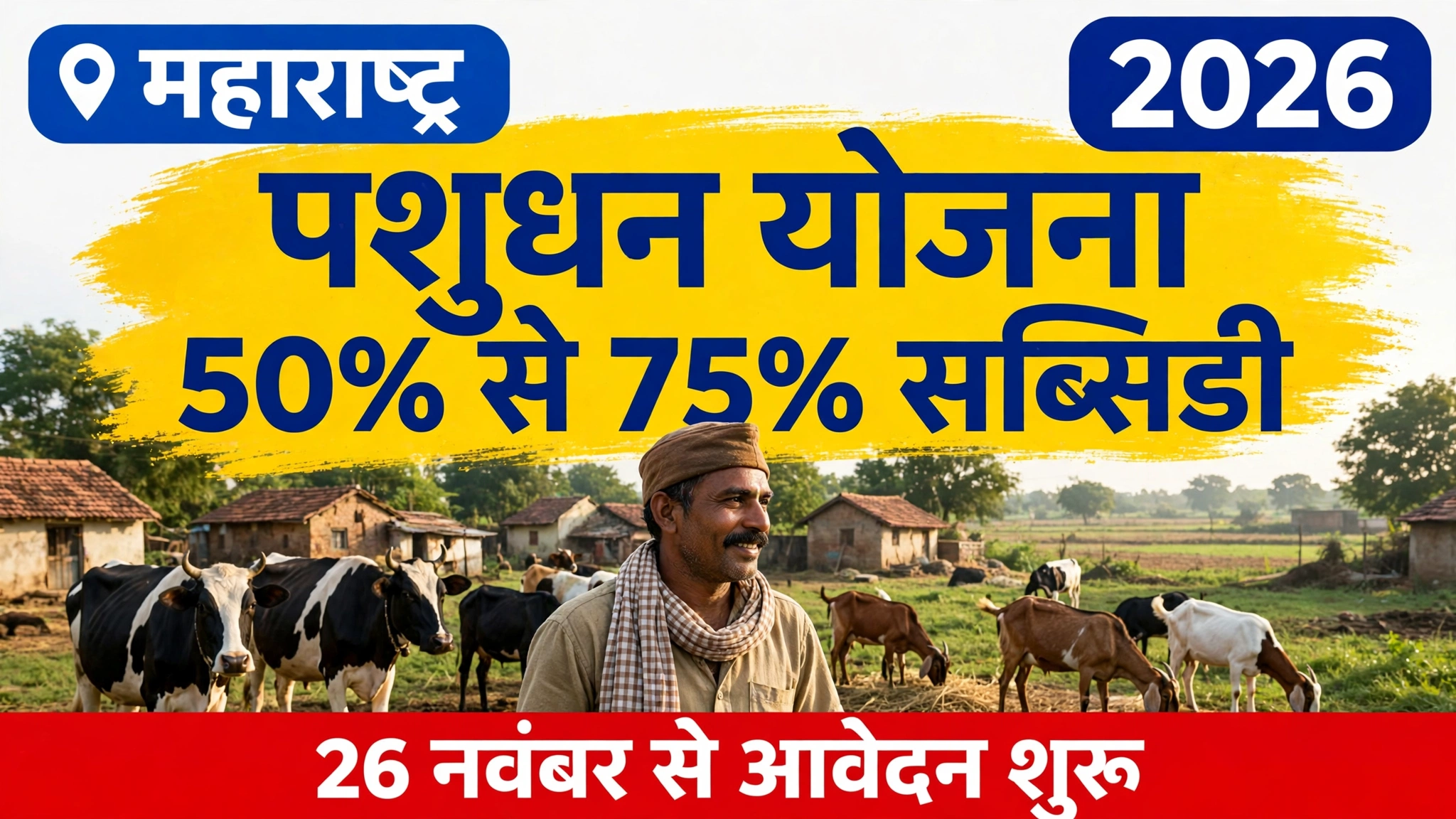
There is big news for farmers and unemployed youth living in the villages of Maharashtra. Online applications for the Mukhyamantri Gramin Pashudhan Udyojakta Yojana will open on 26 November 2026. Under this scheme, the government gives a subsidy of 50 percent to 75 percent to start a dairy business, goat and sheep rearing, poultry farming or pig rearing. Chief Minister Devendra Fadnavis will launch the scheme on Constitution Day, 26 November, and applications will be accepted from the same day.
The aim of the scheme is to give self-employment to rural people through livestock farming, so that a farmer’s income rises and village youth do not have to move to the city in search of a job. According to the Animal Husbandry Department, applications will be fully online and will be taken on the MahaDBT portal. Before applying, you must have a Farmer ID and a MahaID. This article explains every important detail of the scheme — which businesses get a subsidy, how much money you will get, who can apply, which documents are needed and what the application steps are.
Mukhyamantri Gramin Pashudhan Udyojakta Yojana — Quick Facts
| Detail | Information |
|---|---|
| Scheme name | Mukhyamantri Gramin Pashudhan Udyojakta Yojana |
| State | Maharashtra |
| Department | Animal Husbandry and Dairy Development Department, Government of Maharashtra |
| Launch and applications open | 26 November 2026 (Constitution Day) |
| How to apply | Online, on the MahaDBT portal |
| Subsidy | 50% for general category, 75% for Scheduled Caste and Scheduled Tribe |
| Businesses covered | Dairy (cow-buffalo), goat-sheep, poultry, pig rearing, fodder (silage) unit |
| Selection | First come, first served; a target is fixed for every district |
| Identity needed | Farmer ID (AgriStack) and MahaID |
| Helpline | 1962 (toll-free) |
| Government Resolution (GR) | 9 March 2026; supplementary GR 13 April 2026 |
What is this scheme
The Mukhyamantri Gramin Pashudhan Udyojakta Yojana is a state-level scheme of the Agriculture, Animal Husbandry, Dairy Development and Fisheries Department of the Government of Maharashtra. It was approved through a Government Resolution dated 9 March 2026. Its aim is to turn livestock farming from a side activity into a full business, so that rural farmers, landless workers, women and unemployed youth can start their own enterprise.
Under the scheme, many activities have been brought under one roof — dairy farming, goat and sheep rearing, poultry farming, pig rearing and fodder development. Animal Husbandry Minister Pankaja Munde told a press conference on 19 November 2026 that applications will be taken online from 26 November and a separate target has been fixed for every district. After a review meeting on 18 November 2026, the department also said that 21 individual-benefit schemes, including this one, are moving to a single online portal, where forms can also be filled in Marathi.
Livestock farming has already been given the status of agriculture in Maharashtra. The state government says that with rising demand for milk, eggs, meat and fodder, livestock farming is the most direct way to raise village incomes. That is why the scheme includes both small and large units — from one or two cows to a 5,000-bird poultry unit — so that every family can choose according to its means.
Why applications from 26 November matter
26 November 2026 is Constitution Day, and on this day Chief Minister Devendra Fadnavis will launch the scheme. The application form on the MahaDBT portal will open on the same day. The Animal Husbandry Minister said clearly on 19 November that applicants must keep their Farmer ID and MahaID ready before applying, because the application cannot be completed without them.
Selection will be on a first come, first served basis. This means applications can close once a district’s target is filled. People who want the benefit of the scheme should therefore be ready from the very first day of applications. While applying, the portal will work out the cost of the business you have chosen, subtract the subsidy that applies, and show you how much money you must invest yourself.
Another important point is that on 7 October 2026 the department warned that some private people and companies were collecting people’s documents in the name of this scheme. The government has not authorised any private person or organisation to fill applications. Apply only on the MahaDBT portal yourself, or take help from your nearest veterinary dispensary.
Which businesses get a subsidy
The scheme has two types of units — larger state-level units and smaller units under the district annual plan. Both are explained below.
State-level units
| Business | Unit size |
|---|---|
| Dairy (cow-buffalo) | 5 milch animals |
| Goat-sheep rearing | 50 goats or sheep and 5 males |
| Layer poultry | 5,000-bird unit |
| Broiler poultry | 3,000 to 5,000 birds |
| Hatchery | Machine to hatch 1,000 eggs a week |
| Pig rearing | 5 females and 1 male pig |
| Fodder unit | Silage-making unit |
| Interest subsidy on loans | 4% interest subsidy on livestock loans |
District annual plan units
| Business | Unit size | Total cost (approx.) |
|---|---|---|
| Milch animals | 1 or 2 cows/buffaloes | Rs 1,12,036 or Rs 2,24,072 (with 3-year insurance) |
| Goat-sheep | 5+1 or 10+1 | Rs 86,284 or Rs 1,55,311 |
| Layer poultry | 500 birds, with shed | Rs 3,32,200 |
| Fodder seed | Up to 1 hectare | Seed worth up to Rs 4,000 |
| Fodder equipment | Hydroponic fodder, mini TMR, chaff cutter | 50% to 75% subsidy |
How much subsidy will you get
The biggest attraction of this scheme is its subsidy. A general-category beneficiary gets 50 percent of the total cost, and a Scheduled Caste (SC) or Scheduled Tribe (ST) beneficiary gets 75 percent. The subsidy is calculated on the fixed cost of the unit, so the amount is different for every business.
Take the pig rearing unit as an example. Under the supplementary Government Resolution of 13 April 2026, a pig unit has 5 sows and 1 boar, along with three years of insurance. The total cost of this unit is fixed at Rs 2,08,187 — Rs 1,58,187 for the animals, insurance and tax, plus Rs 50,000 for the shed, feeding and water equipment. A general-category beneficiary will get about Rs 1,04,093 as subsidy on this, and an SC/ST beneficiary will get about Rs 1,56,140. The remaining amount must be invested by the beneficiary.
Look at a dairy unit as well. Under the district plan, one milch cow or buffalo costs Rs 1,12,036, including three years of insurance. On this, a general-category beneficiary gets about Rs 56,018 and an SC/ST beneficiary about Rs 84,027 as subsidy. A two-animal unit costs Rs 2,24,072, and the subsidy doubles in the same proportion.
In goat and sheep rearing, a 5+1 unit costs Rs 86,284 and a 10+1 unit costs Rs 1,55,311. A 500 layer bird unit costs Rs 3,32,200, which includes the birds, feed, water and feeding equipment and egg trays. The same 50 percent or 75 percent subsidy applies to all of these.
One important thing to remember: any cost above the fixed price, and the transport cost of bringing the animals, must be paid by the beneficiary. So before buying, understand the full cost and the subsidy calculation completely.
Who can apply
The benefit of this scheme is for people living in the rural areas of Maharashtra. The main eligibility conditions are given below:
You must be a permanent resident of Maharashtra. You must have a Farmer ID (AgriStack farmer identity number) and a MahaID. You can be a landless person, a marginal farmer (land up to 1 hectare), a small farmer (land from 1 to 2 hectares), a forest-rights holder, or a member of a women’s self-help group. For the pig rearing unit, these groups get priority in this order — first the landless, then marginal farmers, then small farmers, then forest-rights holders, and then members of women’s self-help groups from these groups.
Scheme guides usually mention an age of 18 to 60 years, but check the age condition on the portal at the time of applying, because conditions can differ slightly for each unit. There is 50 percent reservation for women and 5 percent for persons with disabilities. Only one person per family gets the benefit. District annual plan units are not available for Mumbai and Mumbai Suburban districts.
Documents needed
On 7 October 2026 the department said that the MahaDBT 2.0 portal will itself pull many documents online at the time of application, such as the 7/12 extract, ration card, disability certificate and caste certificate. Even so, keep these documents ready:
Aadhaar card, MahaID login details, Farmer ID number, 7/12 extract or land papers (if any), caste certificate (for SC/ST benefit), ration card, a copy of your bank passbook, a passport-size photo, a disability certificate (if applicable), an animal husbandry training certificate (if you have one) and proof of membership of a women’s self-help group (if applicable). Your bank account should be linked with Aadhaar, because the subsidy will come directly into your bank account.
How to apply — step by step
Applications are fully online. Read the steps below carefully:
Step 1: Get a Farmer ID. If you do not have a Farmer ID, first register on AgriStack and get one. For farmers whose land records are missing, the Revenue Department has fixed a separate verification procedure — get information from your talathi or district office.
Step 2: Create a MahaID. A MahaID is needed to log in to the MahaDBT portal. If you do not have one, create it first and complete verification by linking your mobile number and Aadhaar.
Step 3: Log in to the MahaDBT portal. Go to mahadbt.maharashtra.gov.in and log in with your MahaID. Fill in your personal details and Farmer ID information.
Step 4: Select the scheme and unit. Select the Mukhyamantri Gramin Pashudhan Udyojakta Yojana and choose your business — dairy, goat-sheep, poultry, pig or fodder unit. Select your district and the size of the unit.
Step 5: Check the cost and subsidy. The portal will work out the cost of your chosen business and show you, after subtracting the subsidy, how much money you must invest yourself. Move ahead only after seeing this amount.
Step 6: Upload documents and submit the form. Upload the documents asked for, check the information once again, and submit the form. After submitting, keep the receipt and application number safely.
Step 7: Selection and purchase. If you are selected, the district committee will inform you. The animals must be purchased before a purchase committee within one month of selection. After purchase, the insurance and subsidy process moves ahead.
How selection works
Selection will be on a first come, first served basis, and a target is fixed for every district. At the district level, the office of the District Deputy Commissioner (Animal Husbandry) and the district committee look after the selection process. There is 50 percent reservation for women and 5 percent for persons with disabilities. Only one person per family gets the benefit, so that the scheme reaches as many families as possible.
For the 304 drought-affected talukas, the conditions for fodder seed have been relaxed for 2026-27. There, an individual beneficiary will get fodder seed worth Rs 4,000 for up to 1 hectare, and a farmers’ group will get seed worth Rs 20,000 for up to 5 hectares, at 100 percent subsidy, and the earlier minimum-livestock condition has been removed. Where water is available and no first-time applicant is waiting, this benefit can be given more than once.
Training and purchase rules
For a pig rearing unit, a certificate from a government or semi-government animal husbandry training course is required. If you do not have the certificate at the time of applying, you must give an undertaking that you will complete the training before the subsidy is released. This rule exists so that the beneficiary can look after the animals properly and the business does not suffer losses.
After selection, the animals must be purchased within one month before a purchase committee. Any cost above the fixed price and the transport cost will be borne by the beneficiary. The animals come with three years of insurance, which gives protection in case of disease or death of an animal.
4% interest subsidy on livestock loans
The scheme has one more big benefit — a 4 percent interest subsidy on loans taken for livestock farming. Earlier this subsidy was available on loans for goat, sheep, cow, buffalo and poultry businesses. Through the supplementary Government Resolution of 13 April 2026, it has now been extended to pig rearing as well. This means that if you take a bank loan to start the business, the government will itself pay a part of the interest, and your instalment will be lower.
Fodder development and silage units
Fodder is the biggest cost in livestock farming. That is why the scheme also includes a silage (murgaas) making unit. The supplementary Government Resolution of 13 April 2026 has opened the silage unit scheme to farmer producer organisations, companies, ATMA-registered farmer groups, MAVIM community resource centres and UMED ward federations — with the condition that the organisation has at least 50 members, share capital of at least Rs 5 lakh, audits for the last three years and a profit in the latest audit.
For small farmers, there is also a provision of 50 percent to 75 percent subsidy on hydroponic fodder production and mini TMR (total mixed ration) equipment. Fodder seed benefit of up to Rs 4,000 per hectare is also available. All these facilities are given so that animals get good fodder throughout the year and milk production stays steady.
Beware of fraud
It is very important to stay safe from fraud in the name of this scheme. On 7 October 2026 the department said clearly that some companies and people were collecting documents in the name of the scheme and asking for money to fill forms. The government has not authorised any private person or organisation to fill applications.
Remember: applying on MahaDBT is free. If anyone asks for money in the name of filling the form, do not pay, and immediately complain at your nearest veterinary dispensary or on the toll-free number 1962. Do not trust advertisements shown on social media — take correct information only from the MahaDBT portal and the Animal Husbandry Department.
Mukhyamantri Gramin Pashudhan Udyojakta Yojana — Frequently Asked Questions (FAQ)
Question 1: When do applications open for the Mukhyamantri Gramin Pashudhan Udyojakta Yojana?
Online applications open on 26 November 2026. On the same day, Constitution Day, Chief Minister Devendra Fadnavis will launch the scheme. Applications will be taken online on the MahaDBT portal.
Question 2: How much subsidy does this scheme give?
A general-category beneficiary gets 50 percent and an SC/ST beneficiary gets 75 percent subsidy. The subsidy is on the fixed cost of the unit — for example, a pig unit costs Rs 2,08,187, so a general-category beneficiary gets about Rs 1,04,093 and an SC/ST beneficiary about Rs 1,56,140.
Question 3: Why are a Farmer ID and MahaID needed to apply?
The Farmer ID is your identity as a farmer, and the MahaID is needed to log in to the MahaDBT portal. The application cannot be completed without both, so keep both ready before applying.
Question 4: Is there a subsidy on pig rearing too?
Yes. Pig rearing was added to the scheme through the supplementary Government Resolution of 13 April 2026. A unit of 5 female and 1 male pig costs Rs 2,08,187 in total, including three years of insurance. A 4 percent interest subsidy on pig rearing loans is also available.
Question 5: How is selection done — is there an exam?
No, there is no exam. Selection is on a first come, first served basis, and a target is fixed for every district. There is 50 percent reservation for women and 5 percent for persons with disabilities. Only one person per family gets the benefit.
Question 6: Which documents are needed to apply?
Aadhaar card, Farmer ID, MahaID, 7/12 extract, caste certificate (for SC/ST benefit), ration card, bank passbook and a photo. The portal will itself pull many documents online, but keep them ready.
Question 7: Is there any fee to apply, or can an agent fill the form?
No. Applying on MahaDBT is free, and the government has not authorised any private person or company to fill applications. If anyone asks for money, complain on 1962.
Question 8: Where can I get help?
Contact the Animal Husbandry Department’s toll-free helpline 1962, or meet your nearest veterinary dispensary, taluka livestock development officer, or the office of the District Deputy Commissioner (Animal Husbandry).
Official Links
| What | Link |
|---|---|
| MahaDBT Portal (apply here) | mahadbt.maharashtra.gov.in |
| Government of Maharashtra Portal | maharashtra.gov.in |
| Government Resolutions (GR) | gr.maharashtra.gov.in |
This article has been prepared by a private information portal (not a government website). All information is based on official sources — for the final and correct information, always check mahadbt.maharashtra.gov.in or maharashtra.gov.in. Before applying, do check the scheme conditions and the last date on the portal.