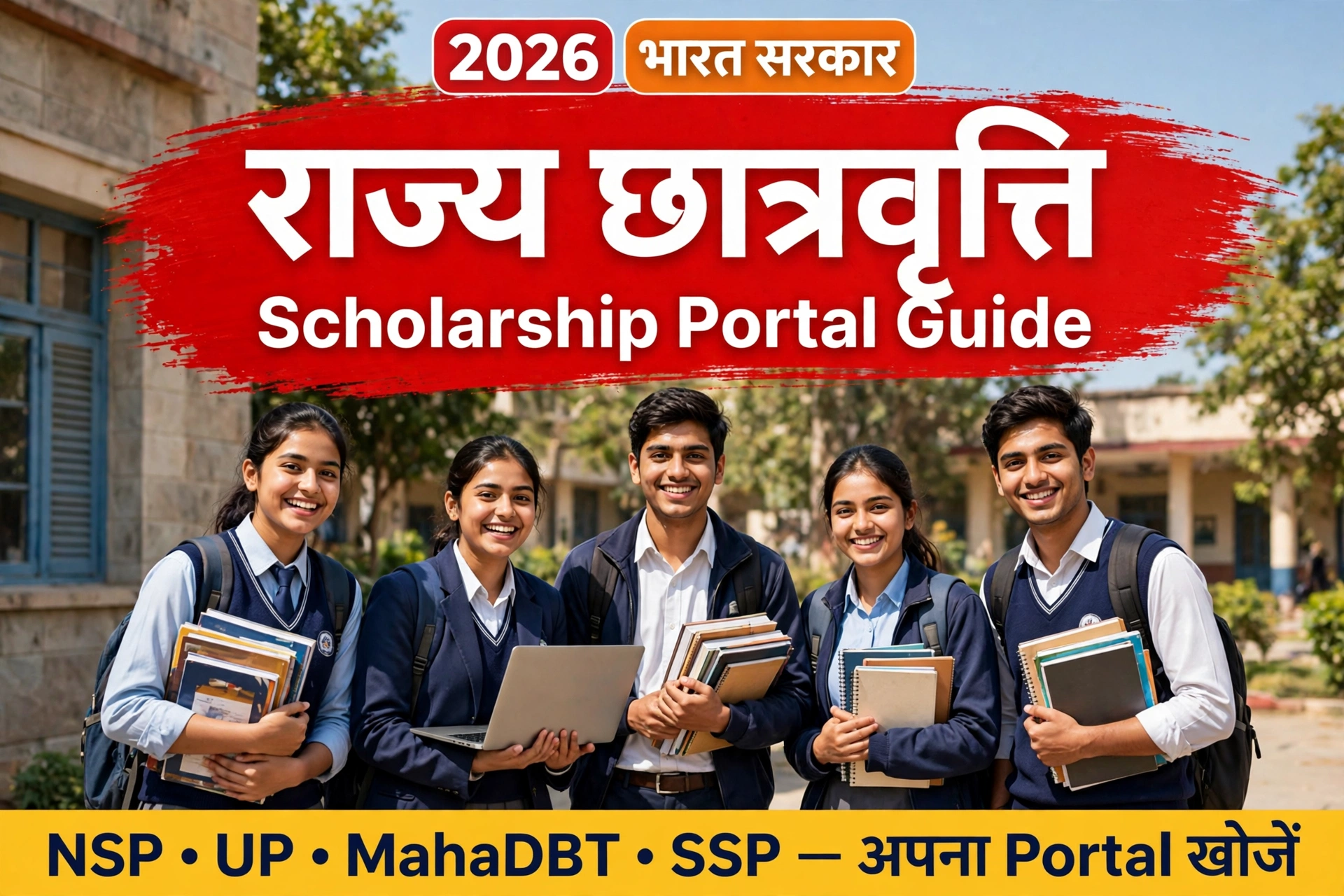
Every year, lakhs of students in India depend on scholarships to continue their studies. But the biggest problem students face is confusion about where to apply — on the National Scholarship Portal (NSP) or on their own state’s Scholarship Portal. These are two different portals, they run different schemes, and their last dates are also different. In this article, we will explain in simple language what a State Scholarship is, how to find your state’s scholarship portal, how to apply, which documents are needed, what the eligibility is, and how to check the status of your application.
A State Scholarship means a scholarship scheme run by a state government for the students of that state. Every state has its own separate portal. For example, Uttar Pradesh has the UP Scholarship Portal (scholarship.up.gov.in), Maharashtra has MahaDBT 2.0 (mahadbt2.maharashtra.gov.in), Karnataka has the SSP Portal (ssp.karnataka.gov.in), Jharkhand has e-Kalyan (ekalyan.cgg.gov.in), Bihar has the Post Matric Scholarship Portal (pmsonline.bih.nic.in) and Gujarat has Digital Gujarat (digitalgujarat.gov.in). State government schemes are applied for on these portals, while central government schemes are applied for on the National Scholarship Portal (scholarships.gov.in).
After reading this article, you will know clearly which portal is the right one for your scholarship, what the last date to apply is, and when the money will reach your bank account. Please note — the dates given in this article are for the academic session 2026-27 and are based on checks done up to 24 November 2026. Dates can change, so always check the latest notice on your portal before applying.
State Scholarship 2026: At a Glance
| Detail | Information |
|---|---|
| What it is | State government scholarship schemes — Pre-Matric, Post-Matric, Merit and Fee Reimbursement |
| Central portal | National Scholarship Portal — scholarships.gov.in |
| State portals | A separate portal for every state (see the state-wise list below) |
| Who can apply | Students from Class 9 to PhD — SC, ST, OBC, EBC, minority and general categories (as per the scheme) |
| Application fee | Completely free — no fee at all |
| Payment | Direct Benefit Transfer (DBT) — directly into the Aadhaar-linked bank account |
| Required registration | 14-digit One Time Registration (OTR) number for NSP |
What Is a State Scholarship?
A State Scholarship is a scholarship scheme run by a state government for the students of that state. The money comes from the state government’s budget, and the rules are also made by the state government. Usually these schemes are in the form of Pre-Matric (Classes 9-10), Post-Matric (Class 11 to postgraduate), merit scholarships and fee reimbursement.
For example, in Uttar Pradesh, SC, ST, OBC, general and minority students apply for the Post-Matric Scholarship (Dashmottar). In Maharashtra, the MahaDBT portal runs 104 schemes from 14 departments, of which 60 schemes are for college students. In Karnataka, the SSP Portal gives Pre-Matric and Post-Matric scholarships to students from Class 1 to postgraduate level. In Bihar, apart from the Post Matric Scholarship, schemes like the Mukhyamantri Kanya Utthan Yojana for girls who complete graduation are also running.
The biggest speciality of a state scholarship is that the rules of your state apply — such as the income limit, the domicile condition and the need for a caste certificate. So, before applying, do read the eligibility of your state’s scheme. The benefit of one state’s scheme is not available to a student of another state, even if he or she studies in that state — a domicile certificate is mandatory in most schemes.
NSP vs State Portal — What Is the Difference?
The most confusion among students is about NSP and State Portals. They look similar, but they are different. The table below makes the difference clear.
| Point | National Scholarship Portal (NSP) | State Scholarship Portal |
|---|---|---|
| Portal | scholarships.gov.in | A separate portal for every state (for example, scholarship.up.gov.in) |
| Whose schemes | Schemes of central ministries, UGC and AICTE | Schemes of the state government’s social welfare, education and minority departments |
| Run by | Ministry of Electronics and Information Technology (MeitY) and NIC | The concerned state government |
| Registration | One Time Registration (OTR) — 14-digit number, through Aadhaar Face Authentication | Separate registration on the state portal (some states also ask for OTR) |
| Number of schemes | 31 central schemes listed for the academic session 2026-27 | Depends on the state — some states have more than 100 schemes |
| Application last date | 31 October 2026 for most schemes (2026-27 session) | Different for every state — see the dates table below |
One important point — some state government schemes are also listed on NSP, and in some states, for the same scheme, you have to apply on either NSP or the State Portal. For example, in Maharashtra, first-year students from Mumbai city and suburbs belonging to OBC, VJNT and SBC categories had to apply for four Post-Matric scholarships in 2026-27 only on NSP, not on MahaDBT 2.0. So always check your state’s latest notice — applying on the wrong portal can stall your form.
Another rule in force from the 2026-27 session — on NSP, a student can apply for one merit-based scheme along with one or more welfare-based schemes. Earlier this limit was strict; now some relaxation has been given. But you cannot apply for two merit schemes of the same type.
How to Find Your State’s Scholarship Portal
The safest way to find the correct scholarship portal of your state is to ask on your state government’s official website or from the Scholarship Nodal Officer of your school or college. When searching on the internet, trust only websites ending in .gov.in or .nic.in. The portals of major states are given below.
| State | Portal / Scheme | Official Website |
|---|---|---|
| All India (Central) | National Scholarship Portal (NSP) | scholarships.gov.in |
| Uttar Pradesh | UP Scholarship — Pre-Matric and Post-Matric (Dashmottar) | scholarship.up.gov.in |
| Maharashtra | MahaDBT 2.0 — 104 schemes, 14 departments | mahadbt2.maharashtra.gov.in |
| Karnataka | SSP — State Scholarship Portal, Class 1 to PG | ssp.karnataka.gov.in |
| Bihar | Post Matric Scholarship (PMS) | pmsonline.bih.nic.in |
| Jharkhand | e-Kalyan — Post-Matric Scholarship | ekalyan.cgg.gov.in |
| Gujarat | Digital Gujarat — scholarships and all services | digitalgujarat.gov.in |
| West Bengal | Swami Vivekananda Merit Scholarship (SVMCM) and OASIS | svmcm.wbhed.gov.in |
| Madhya Pradesh | MPTAAS — Tribal Affairs Department scholarship | Check the state portal |
| Rajasthan | Post-Matric Scholarship — Social Justice Department | Check the state portal |
| Odisha | Odisha State Scholarship Portal | Check the state portal |
| Tamil Nadu | TN Scholarship — Backward Classes and Minorities Welfare | Check the state portal |
For states whose portal website is not given above, check the official website of your state’s education department or social welfare department. Never enter your documents or OTP on a private website (.com, .in or .org) — the address of a real government portal always ends in .gov.in or .nic.in.
Eligibility for State Scholarship
The eligibility of every scheme is different, but most state scholarships have these common conditions. Before applying, do check the eligibility in the official notice of your scheme.
Domicile: The student must be a permanent resident of the concerned state. A Domicile Certificate or residence certificate is asked for. Some schemes also give benefits to students studying outside the state, but they must be residents of that state.
Category: Most Post-Matric scholarships are for SC, ST, OBC, EBC and minority students. For general category students, there are Merit Scholarships and EWS (Economically Weaker Section) schemes.
Income limit: In Post-Matric scholarships, there is usually a limit on the family’s annual income. For example, in the Bihar Post Matric Scholarship, the family income of SC/ST/OBC students must be below Rs 1.5 lakh per year. This limit changes as per the state and category, so check your scheme’s notice.
Educational qualification: The student must be studying regularly in a recognised school, college or university. Some merit schemes have a minimum-marks condition in the previous class — for example, SVMCM requires at least 60 percent marks in Class 10 or 12.
Bank account: The student’s own bank account must be linked with Aadhaar (Aadhaar-Seeded), because the scholarship amount comes through Direct Benefit Transfer (DBT) directly into the account.
One student, one scholarship: The benefit of two scholarships of the same type cannot be taken together. If you are already taking the benefit of a scheme, it is necessary to give that information in the form of the other scheme.
Documents Required for Application
Keep the documents given below ready before starting the application. This will save time while filling the form and reduce the chance of mistakes.
| Document | Why It Is Needed |
|---|---|
| Aadhaar Card | For identity and linking with the bank account — mandatory |
| Mobile number | For OTP login and receiving information — must be linked with Aadhaar |
| Caste Certificate | For SC/ST/OBC category scholarships — mandatory |
| Income Certificate | For checking the income limit — usually should not be older than 6 months |
| Domicile Certificate | Proof of being a resident of the state |
| Marksheet of the previous class | As proof of educational qualification |
| Bonafide Certificate / admission proof | Proof of studying in the current institute |
| Bank passbook / account details | For DBT payment — the account must be Aadhaar-linked |
| Passport-size photo | For the form and profile |
| Fee receipt | For Fee Reimbursement schemes |
In some states, digital copies of documents can also be taken from DigiLocker. In Uttar Pradesh, DigiLocker and Aadhaar-DBT verification are part of the application process. While scanning documents, make sure the file is clear and readable — a blurred copy can make the form defective.
How to Apply for State Scholarship — Step by Step
The application process is slightly different in every state, but the basic steps are the same. The process for both NSP and State Portals is given below.
Applying on NSP (for central schemes):
Step 1: Go to scholarships.gov.in and click on “Apply for One Time Registration (OTR)”. For OTR, you need your Aadhaar number and the mobile number linked with Aadhaar.
Step 2: Complete Aadhaar Face Authentication through the NSP OTR app. After that, you will get a 14-digit OTR number — keep it safe, as this is your identity.
Step 3: Login with the OTR number and password, choose your scheme and fill the application form.
Step 4: Upload the documents, check the form and submit it. Note down the Application ID.
Step 5: Submit the hard copy of the filled form at your institute (school/college), so that the Institute Nodal Officer (INO) can verify it. Without institute verification, the application does not move forward.
Applying on a State Portal (for state schemes):
Step 1: Go to your state’s portal (from the list above) and click on Student Registration.
Step 2: Choose your category — Fresh (first time) or Renewal (you received it last year too). Choosing the wrong category can get the form rejected.
Step 3: Fill in your personal information, educational details and bank account information.
Step 4: Upload the documents and submit the form. Keep the application number safe.
Step 5: In states like Uttar Pradesh, the hard copy of the filled form has to be submitted at the institute — for UP, the last date for Dashmottar Fresh applicants to submit the hard copy was 16 November 2026. Do check your state’s rule.
How to Check Scholarship Status
After submitting the application, the most important work is to check the status. The scholarship money passes through many stages — Institute Verification, District/State Nodal Officer Verification (DNO/SNO Verification), and then payment through PFMS. If it gets stuck at any stage, the money can stop.
Status on NSP: Login at scholarships.gov.in and see “Check Your Status” or “Track Application”. There you will know at which stage your application is — Institute Verification, District Verification, State Verification, or Payment.
Status on a State Portal: Check the status through Student Login on your state’s portal. For example, on the UP Scholarship Portal through the “Status” option, on MahaDBT 2.0 from the Dashboard after login, and on e-Kalyan through Student Login.
Check payment on PFMS: The payment of central government schemes is made through PFMS (Public Financial Management System). The payment received in the bank account can be checked through “Know Your Payment” on pfms.nic.in.
If the status is stuck, what to do: First, contact the Scholarship Nodal Officer of your institute — most applications get stuck at Institute Verification. If the institute has verified it, ask the District Education Officer or the nodal officer of the concerned department. If the application is found defective, the reason is shown on the portal — correct it and submit again.
Important Dates 2026-27 (position as of 24 November 2026)
The dates given below are for the academic session 2026-27. Where the last date to apply has passed, the verification and payment stage is now running. Where the date has not been announced yet, “Not announced” is clearly written.
| Portal / Scheme | Application Last Date | Current Status (24 November 2026) |
|---|---|---|
| NSP — most central schemes | 31 October 2026 | Applications closed; Level-2 Verification till 30 November 2026 |
| NSP — NMMSS | 15 November 2026 | Applications closed; Institute Verification till 30 November 2026 |
| NSP — Post-Matric scheme for students with disabilities | 30 November 2026 | Applications open (in some schemes) |
| UP Scholarship — Classes 9-12 Fresh | 21 September 2026 | Applications closed; Fresh payment 25-31 January 2027 |
| UP Scholarship — Dashmottar Fresh | 13 November 2026 | Applications closed; hard copy till 16 November 2026 |
| UP Scholarship — Dashmottar Renewal | 13 November 2026 | Applications closed; hard copy till 13 November 2026 |
| MahaDBT 2.0 — Fresh and Renewal | Not announced | Applications open since 1 June 2026; last date not announced yet |
| Bihar Post Matric Scholarship | 30 November 2026 | Applications open (12-30 November 2026) |
| e-Kalyan Jharkhand — Post-Matric | 20 November 2026 | Applications closed; INO/DNO Verification till further orders |
| Aikyashree (West Bengal minority) | 30 November 2026 | Applications open |
One fresh news item — as per some news reports (CareerIndia, 21 November 2026), NSP has opened a final window till 30 November 2026 for Fresh, Renewal and Correction applications for 2026-27. This must be confirmed from the official portal’s notice — do check the date of your scheme on your NSP Dashboard, because the date of every scheme can be different.
Common Reasons for Application Rejection
Every year, thousands of scholarship applications get rejected due to small mistakes. Avoid the reasons given below.
Wrong bank account: The account is not linked with Aadhaar, or the name on the account and the name on Aadhaar are different. An Aadhaar-Seeded account is mandatory for DBT.
Old income certificate: In many states, an income certificate older than 6 months is not valid. Get a new certificate made.
Wrong category: Choosing Renewal instead of Fresh or vice versa — this is the most common mistake.
Blurred documents: The scanned copy is not readable. Upload a clear scan.
No verification from the institute: After filling the form online, the hard copy was not submitted at the institute, or the institute did not verify it in time. Stay in regular contact with your Nodal Officer.
Two scholarships: Applying for two schemes of the same type — this can stall both applications.
Stay Safe from Fraud — Important Precautions
Fraud in the name of scholarships happens a lot. Always remember a few things. First — applying for a scholarship is completely free. No officer, agent or website can ask you for money to apply. If someone asks for money, it is fraud.
Second — do not tell your OTP, bank PIN or password to anyone. No government department asks for an OTP on the phone. Third — use only the official portal (.gov.in / .nic.in). Do not enter your documents on .com or .in websites made in the name of scholarships. Fourth — if any person claims to be an officer and asks you for money, immediately complain at your institute or the nearest police station.
Frequently Asked Questions (FAQ)
Question: What is the difference between a State Scholarship and an NSP Scholarship?
Answer: A State Scholarship is a scheme of the state government, and the application is made on the state’s portal. An NSP Scholarship is for central government schemes, and the application is made on scholarships.gov.in. Some schemes can be listed in both places, so do check your state’s notice.
Question: Can I apply on both NSP and a State Portal?
Answer: Yes, but not for two schemes of the same type. You can apply for one merit-based scheme and one or more welfare-based schemes. Do not apply for the same scheme on both portals.
Question: What is an OTR number and why is it needed?
Answer: OTR means One Time Registration number — a 14-digit number generated through Aadhaar Face Authentication. Since the academic session 2024-25, OTR is mandatory for applying on NSP. Some state portals also ask for OTR.
Question: When will the scholarship money come?
Answer: After the application, institute verification and district/state verification are complete, the money comes through DBT directly into your Aadhaar-linked bank account. In UP Scholarship, the payment for Fresh students of Classes 9-12 is notified between 25-31 January 2027. The payment schedule of every state is different.
Question: My application is showing as Defective, what should I do?
Answer: See the reason for the defect on the portal, correct the form with the right document or information and submit again. If you do not understand the reason, contact the Scholarship Nodal Officer of your institute.
A State Scholarship is a big help in continuing your studies, but you will get its benefit only if you apply on the correct portal, for the correct scheme, and on time. The list of state portals is given above — find your state, check the eligibility, keep your documents ready and complete the application before the last date. After applying, keep checking the status and stay in touch with the Nodal Officer of your institute. Before applying, do read the official notice of the concerned department.
This article is prepared by a private information portal, not a government website.