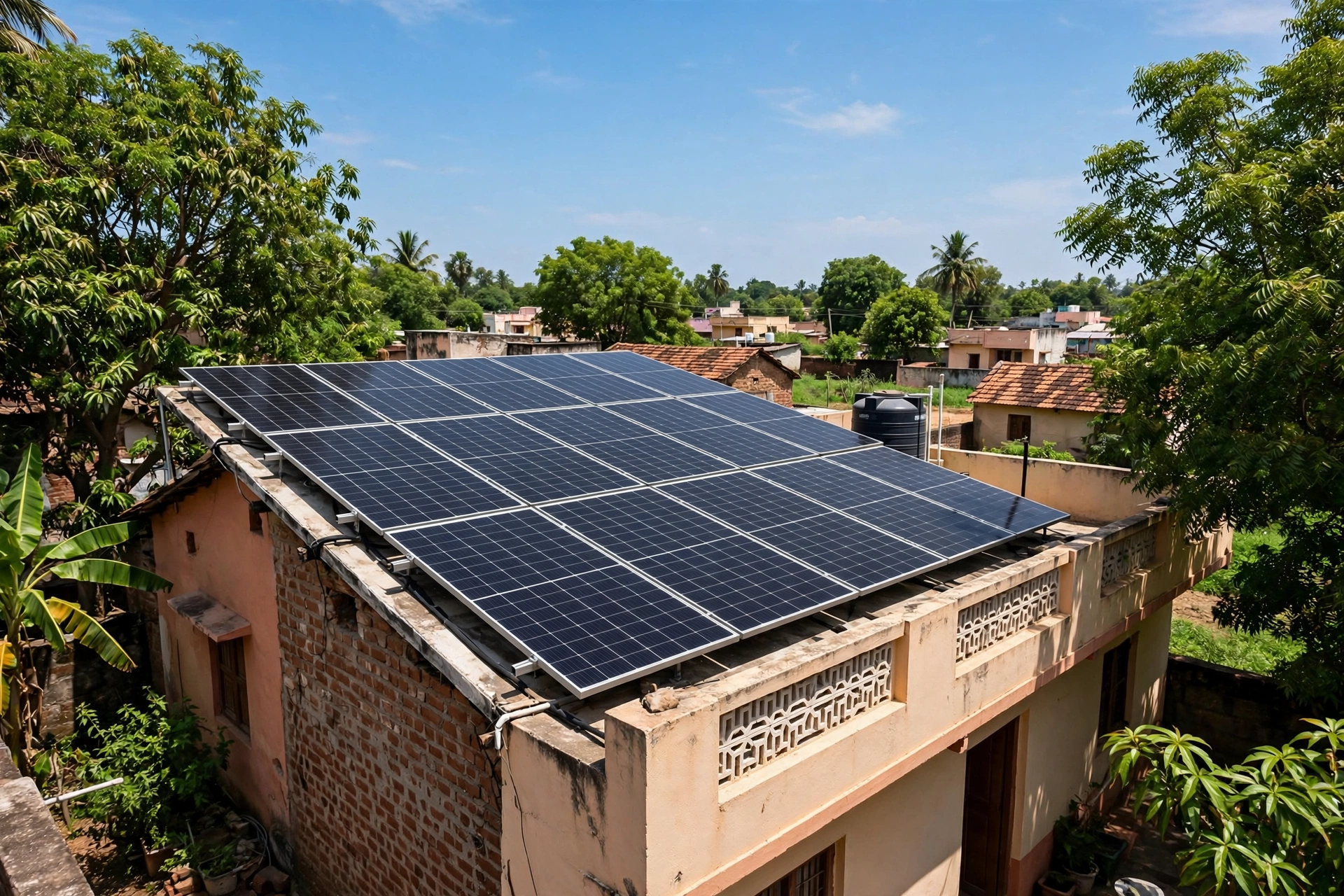
Electricity bills eat into your pocket every month — run the AC in summer and the bill doubles. PM Surya Ghar Muft Bijli Yojana is the permanent fix: install solar panels on your roof, get up to ₹78,000 subsidy from the government, and get up to 300 units of free electricity every month. Announced on 13 February 2024, approved by the Cabinet on 29 February 2024 — a ₹75,021 crore scheme targeting 1 crore homes.
This guide covers — how much subsidy, who can apply, how to apply, loan facility, and what net metering is. 30 questions answered at the end. All information from pmsuryaghar.gov.in and MNRE.
PM Surya Ghar Yojana: At a Glance
| Point | Information |
|---|---|
| Scheme | PM Surya Ghar: Muft Bijli Yojana — Central Govt |
| Announced | 13 February 2024 |
| Ministry | MNRE |
| Outlay | ₹75,021 crore |
| Target | 1 crore homes |
| Subsidy | 1kW ₹30,000 / 2kW ₹60,000 / 3kW ₹78,000 |
| Free electricity | 300 units/month |
| Apply at | pmsuryaghar.gov.in |
What Is the Scheme?
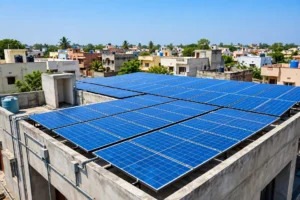
PM Surya Ghar Muft Bijli Yojana is the central government’s rooftop solar scheme. Solar panels on the roof generate electricity, bringing the bill to zero or near-zero. The government does not give 300 units directly — your system generates power from sunlight.
Progress: 28 Sep 2026 — 49.7 lakh systems, 59 lakh homes, ₹32,807 crore subsidy via DBT.
Subsidy Details
- 1 kW: ₹30,000
- 2 kW: ₹60,000
- 3 kW+: ₹78,000 (maximum)
₹30,000/kW for first 2 kW, ₹18,000 for the third. Special-category states get higher rates. Subsidy goes directly to bank account in 15–30 days.
Who Can Apply?
- Indian citizen, own house, valid electricity connection, no prior solar subsidy
How to Apply
- Register on pmsuryaghar.gov.in → upload documents → DISCOM approval → choose vendor → installation → net meter → commissioning certificate → subsidy
The application runs through five gates:
- Gate 1 — Registration: open pmsuryaghar.gov.in, select your state, DISCOM, and consumer number, then verify with a mobile OTP.
- Gate 2 — DISCOM approval: the electricity company does a technical check of your roof and transformer capacity (7–15 days). Installation starts only after this approval.
- Gate 3 — Choose vendor: pick from the portal’s registered vendor list; confirm ALMM-listed, BIS-certified panels.
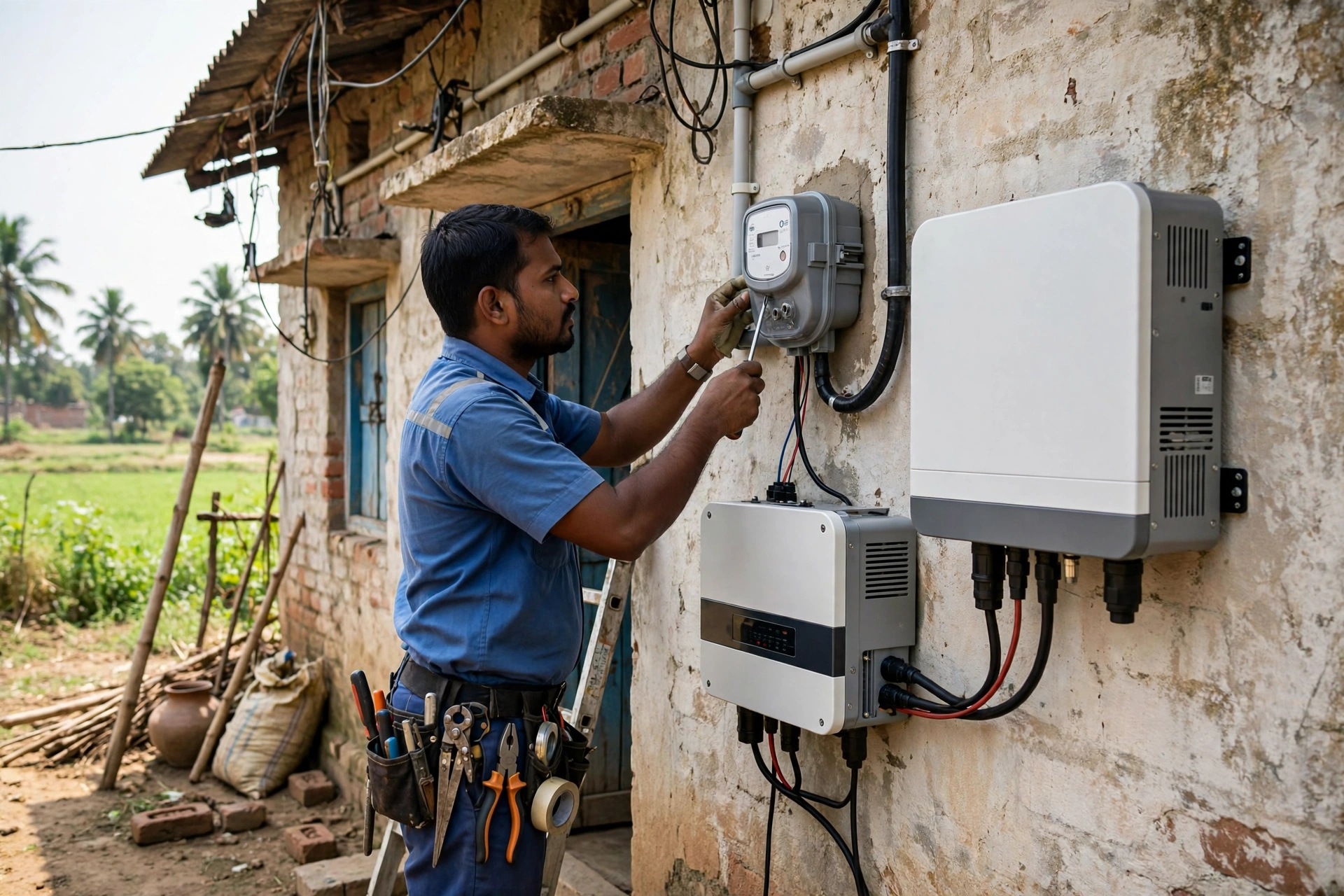
- Gate 4 — Installation + net meter: the vendor installs in 1–3 days; DISCOM inspects, installs the net meter, and issues a commissioning certificate.
- Gate 5 — Subsidy claim: upload bank details + cancelled cheque; the subsidy arrives via DBT in 15–30 days.
Documents: Aadhaar, electricity bill, roof ownership proof, bank details, and roof photos.
Net Metering
Surplus solar power goes to the grid for credit. Your bill = consumption minus generation: a net meter tracks both directions, and surplus units offset your night-time and cloudy-day usage — or earn you money at the DISCOM’s rate.
Loan Facility
Up to ₹2 lakh collateral-free loans at approx. 6.75–7% interest are available through partner banks. With the EMI lower than the average monthly bill, the system effectively pays for itself from day one.
Objectives of the Scheme
The scheme has one headline promise — 300 units of free electricity every month for 1 crore homes — but its objectives run deeper. The central idea is simple: the government does not hand out 300 units; your rooftop system generates them from sunlight, so an average home’s bill falls to zero or near-zero.
- Provide 300 units of free electricity per month to eligible homes
- Promote solar energy and cut household power costs
- Reduce pollution through clean energy
- Support India’s renewable energy transition and energy security
Beyond household savings, rooftop solar cuts peak demand on DISCOMs, reduces fossil-fuel use, and moves India toward its renewable energy commitments. It also creates lakhs of jobs in installation, servicing, and sales of solar systems across districts.
A special objective is the Model Solar Village — one village per district is selected and made fully solar: homes, schools, the panchayat building, and street lights, with ₹1 crore in assistance per village. If your village is selected, bulk installation brings systems to the whole village at lower cost; ask your district administration or DISCOM which village is your district’s Model Solar Village.
The target is ambitious: 1 crore homes. Progress as of 28 September 2026 — 49.7 lakh systems installed in 59 lakh homes, with ₹32,807 crore of subsidy transferred directly to bank accounts via DBT. MNRE is the nodal ministry, and the entire process — from registration to subsidy claim — is fully online on pmsuryaghar.gov.in.
Choosing the Right System Size
The most common question — “how many kW do I need?” — is answered by your monthly electricity bill. Match your average consumption to the right size:
| Monthly bill | Monthly consumption | Right size | Subsidy |
|---|---|---|---|
| Up to ₹1,000 | ~120 units | 1 kW | ₹30,000 |
| ₹1,000–2,000 | ~240 units | 2 kW | ₹60,000 |
| ₹2,000–3,000 | ~360 units | 3 kW | ₹78,000 |
| ₹3,000+ | 500+ units | 5 kW | ₹78,000 (maximum) |
- 0–150 units/month: 1–2 kW (subsidy up to ₹60,000)
- 150–300 units/month: 2–3 kW (subsidy up to ₹78,000)
- Above 300 units: above 3 kW (subsidy capped at ₹78,000)
A 3 kW system generates about 12–15 units daily — over 300 units a month — which covers an average home’s full consumption, and surplus units earn credit through net metering. Check your roof: you need about 100 sq ft of clean, shade-free roof per 1 kW, and your area’s transformer must have load headroom — your DISCOM verifies both in its technical check, which usually takes 7–15 days.

Remember: the subsidy caps at 3 kW (₹78,000) — a 5 kW or 10 kW system still gets only ₹78,000. Bigger systems still pay off for heavy users because the bill savings outweigh the subsidy. The full cost math:
| System | Estimated cost | Subsidy | Your cost | Payback period |
|---|---|---|---|---|
| 1 kW | ₹60,000–70,000 | ₹30,000 | ₹30,000–40,000 | 3–4 years |
| 2 kW | ₹1.1–1.3 lakh | ₹60,000 | ₹50,000–70,000 | 3–4 years |
| 3 kW | ₹1.6–1.9 lakh | ₹78,000 | ₹80,000–1.1 lakh | 4–5 years |
The math: a ₹2,500/month bill = ₹30,000/year saved. A ₹1 lakh net cost pays back in about 4 years — then 21 years of nearly free electricity, since panels last 25+ years. Even on loan, a bank EMI at approx. 6.75% interest is lower than the monthly bill — meaning savings from day one. Install once, and the system keeps paying you back for decades.
State Top-ups
The ₹78,000 central subsidy is only the baseline — some states add extra subsidy on top, so total support can be much higher. For example, Delhi adds a matching amount for a total of ₹1.56 lakh up to 3 kW. Check your state’s renewable agency for the latest state-level top-up before you buy.
State top-ups are announced and revised by state governments and their nodal renewable agencies, and the amounts and conditions differ from state to state — some link the top-up to system size, others to consumer categories. Because these change over time, always verify the current top-up on your state nodal agency’s website or through your DISCOM before finalising a vendor quote. Special-category states already receive higher central subsidy rates, and state additions come over and above that.
When comparing quotes, ask the vendor to show the central subsidy and the state top-up as separate line items, so you can verify both on the official portals. Never trust a vendor’s verbal promise of a top-up — it must appear in the state’s published scheme details.
Common Mistakes to Avoid
- Applying without checking roof suitability (shadow-free area needed)
- Choosing an unregistered vendor — subsidy only through registered vendors
- Not completing Aadhaar authentication — delays subsidy
- Expecting 300 units as a direct handout — it’s generated by your system
Installing before DISCOM approval is the costliest mistake of all. Technical approval before installation is mandatory — install without it and the subsidy claim is cancelled outright. Apply on the portal first, wait for the DISCOM’s go-ahead (usually 7–15 days), and only then let the vendor start work.
Panels not on the ALMM list disqualify the claim. Subsidy is paid only for ALMM-listed, BIS-certified modules installed by a registered vendor — cheap non-listed panels void the entire subsidy, so check the module list before you pay.
Wrong bank details stall the money. The subsidy travels by DBT to your Aadhaar-linked account, so upload a clear cancelled cheque and double-check the account number and IFSC — a small typo can delay payment by weeks.
Paying an agent is never needed — the application and subsidy process are completely free. Anyone demanding a fee for “instant subsidy” is committing fraud. Apply only on pmsuryaghar.gov.in, never share OTPs, and report fraud attempts through the portal’s grievance channel.
Finally, get your roof’s shadow-free area assessed before applying (about 100 sq ft per kW), and size the system to your actual consumption — the 300 units are generated by your panels, not credited as a handout.
Maintenance
Solar systems have no moving parts, so maintenance is light — but a little care protects your generation for the full 25-year panel life.
Cleaning: wash dust off the panels with clean water every 15–20 days — dirty panels lose 15–25% output. In dusty or high-pollution areas, clean more often; early morning is the best time to wash them.
Shade: don’t let tree branches or water-tank shade fall on the panels — even a little shade drops the whole string’s output. Trim nearby growth before it becomes a problem.
Inspection: get connections and wiring checked by the vendor once a year, and look for physical damage after storms or hail.
Monitoring app: the inverter app shows daily generation — if output suddenly drops, call the vendor instead of waiting. Keep the 5–10 year inverter warranty papers safe.
Panels need only occasional cleaning. Authorised vendors typically maintain systems for the first 5 years.
Frequently Asked Questions
Q1: Maximum subsidy?
A: ₹78,000.
Q2: Who can apply?
A: Citizen with own house and electricity connection.
Q3: Where to apply?
A: pmsuryaghar.gov.in.
Q4: Is this a government website?
A: No — GramSuvidha is a private information portal.
Q5: How long do panels last?
A: 25+ years.
Q6: What is net metering?
A: Credit for surplus solar power sent to the grid.
Q7: Is a loan available?
A: Yes, up to ₹2 lakh.
Q8: Can tenants apply?
A: Not without meeting ownership conditions.
Q9: What documents are needed?
A: Aadhaar, electricity bill, bank details, roof photos.
Q10: How is subsidy paid?
A: Directly to Aadhaar-linked bank account via DBT.
Q11: What if DISCOM rejects feasibility?
A: Address the reason (e.g., roof issues) and reapply.
Q12: Can I install more than 3 kW?
A: Yes, but subsidy caps at ₹78,000.
Important Links
- Official portal: pmsuryaghar.gov.in
Disclaimer: GramSuvidha is a private information portal, not a government website.