Updated: 17 November 2026
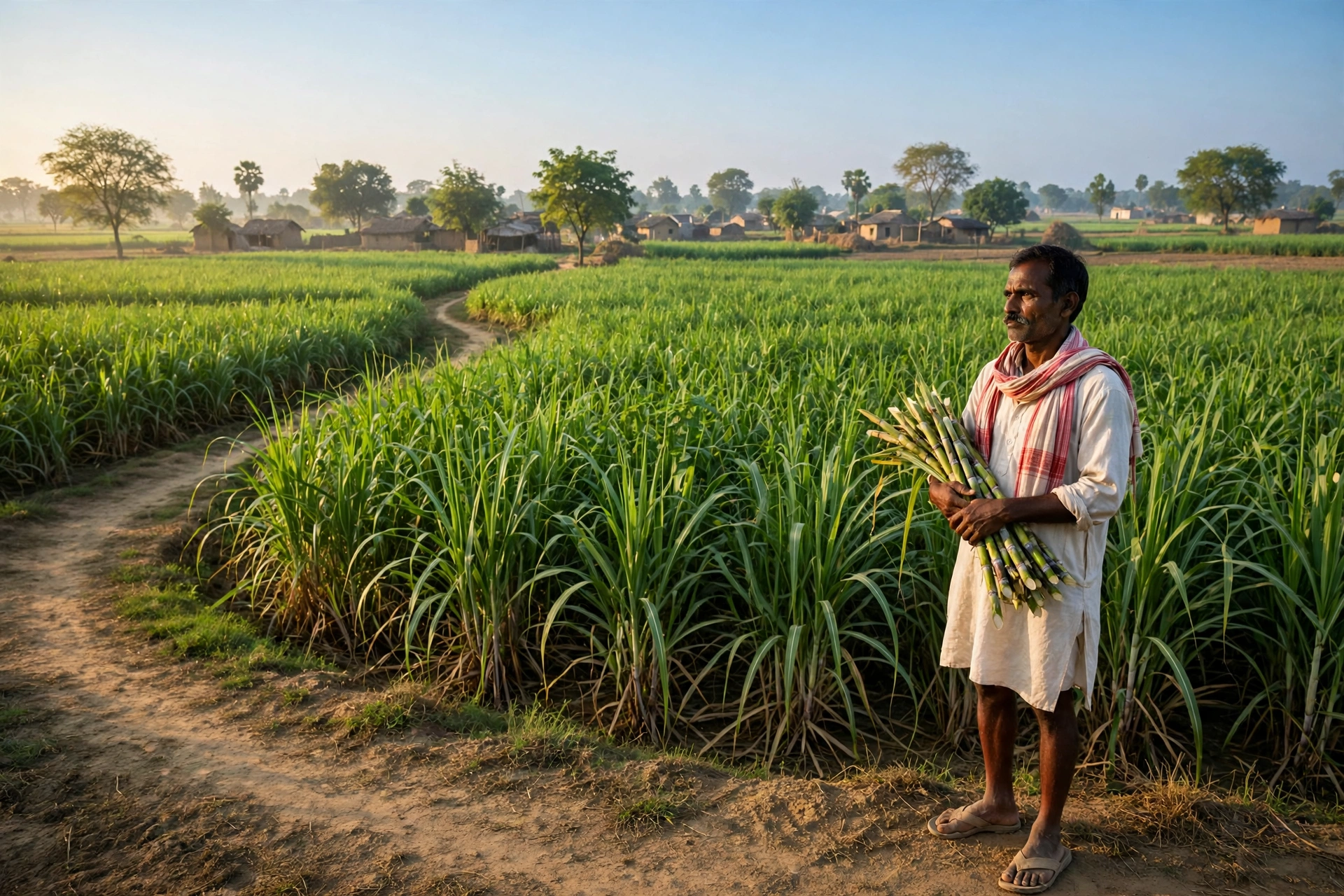
For a sugarcane farmer in Bihar, what is the biggest investment in a season? The land is their own, the labour is their own, but the fate of the crop is decided by the seed. Get good seed and the yield rises, the sugar recovery improves, and the mill pays a fair price for the cane. Get poor or diseased seed and a whole season of hard work goes to waste. That is why, before every sowing season, the biggest worry for farmers is the same: where will good seed come from, and how will it reach the field?
This time, the Bihar government has made a special arrangement to take that worry away. Under a scheme of the Sugarcane Industry Department, farmers are being given improved, disease-free sugarcane seed completely free of cost, and the government is also bearing the cost of delivering that seed to the farmer’s field. In other words, the farmer does not have to pay for the seed, and does not have to pay any fare or labour charges to bring it home either.
But there is so much conflicting news about this scheme on the internet that many farmers are confused. One website says the last date is 16 November, another says it is 25 November. One says seed is available for up to five acres, another says only up to two and a half acres. In this article, we clear up each of these confusions one by one, and explain what the scheme actually is, who is eligible, which villages are covered, which documents are needed, and the complete step-by-step process to apply on the Cane Care portal. Read the article till the end, because the last date is near, and one small mistake can cost you your application.
Bihar Ganna Beej Yojana 2026 at a Glance (Quick Facts)
| Scheme name | Beej Vikas Yojana (Seed Development Scheme) under the Mukhyamantri Ganna Vikas Karyakram |
| Department | Sugarcane Industry Department, Government of Bihar |
| Apply on | Cane Care Portal — ccs.bihar.gov.in |
| Applications opened | 15 July 2026 |
| Last date to apply | 25 November 2026 (for free seed distribution) |
| What you get | Improved, disease-free, certified sugarcane seed completely free |
| Transport cost | The government bears the full cost of loading, unloading and delivering the seed to the field |
| Area covered | Minimum 0.25 acre, maximum 2.5 acres |
| Who can apply | Farmers cultivating their own land and sharecroppers (bataidar) both |
| Applicable areas | Both sugar-mill areas and non-sugar-mill areas |
| Identity needed | Ganna ID (made with the 13-digit DBT ID) |
| Official guidelines | Beej Vikas Yojana Guidelines 2026-27, Sugarcane Industry Department (available on ccs.bihar.gov.in) |
What Is the Free Sugarcane Seed Scheme?
Sugarcane is a major cash crop in Bihar. The livelihood of lakhs of farmers in the state depends on it, and sugarcane is also the raw material for sugar mills and the jaggery and khandsari industries. But good yield starts with good seed. If the seed itself is poor quality or diseased, no amount of hard work in the field can save the crop.
Keeping this problem in mind, the Bihar government has launched the Mukhyamantri Ganna Vikas Karyakram under Nischay-2 “Samriddh Udyog — Sashakt Bihar” of Saat Nischay-3. Its aim is to expand the area under sugarcane in the state, make improved, healthy and disease-free seed easily available to farmers, and increase sugarcane production, productivity and sugar recovery. New sugar mills are also being planned in the state, and for those mills to get enough cane, expanding cultivation is essential.
The Beej Vikas Yojana under this programme has several components. These include the production of breeder seed and foundation seed, incentives for the production of certified seed, and the distribution of certified seed and single-bud plantlets to farmers. This article mainly covers the component under which farmers are given seed free of cost. At present, sugarcane is grown on about 2.37 lakh hectares in Bihar, and the target for the 2026-27 season is 2,55,081 hectares, or about 2.55 lakh hectares. By distributing free seed, the government wants to promote sugarcane cultivation in new areas, especially in villages where cane has never been grown before.
The most special thing about this scheme is that the delivery of the seed is free along with the seed itself. The farmer does not have to go anywhere to collect the seed, and does not have to pay any fare or labour charges. The loading of the seed onto vehicles, its unloading, and its delivery directly to the farmer’s field will all be arranged by the government, and the entire cost will be borne from the government treasury.
Which Villages Are Covered?
This scheme applies to both sugar-mill areas and non-sugar-mill areas. But the eligibility rule is slightly different in the two, so understand it according to your own area.
In sugar-mill areas
In areas served by sugar mills, farmers of those villages can apply where sugarcane is not currently cultivated, or where the total area under sugarcane in the village is five acres or less. Such villages have been identified on the Cane Care portal as “sugarcane-free villages”. In these villages, both farmers cultivating their own land and sharecroppers can apply.
Understand one thing clearly here: the “five acre” rule at the village level and the “two and a half acre” limit for seed given to a farmer are two different things. The village-level five-acre rule decides which village comes under the scheme, while the two-and-a-half-acre limit decides how much land one farmer gets free seed for. Do not mix the two up — this is explained in detail further below.
In non-sugar-mill areas
In areas where no sugar mill is running, all farmers are considered eligible for this scheme. This includes farmers cultivating their own land and farmers cultivating on sharecropping. The government’s aim is clear: sugarcane cultivation should begin even where it has not been grown so far, so that the state’s cane area grows and raw material is ready for the new mills.
Who Is Eligible? Complete Eligibility Conditions
To get free sugarcane seed, the farmer must meet the conditions given below. Read them carefully once before applying, so that you face no problem while filling the form.
- The applicant must be a farmer of Bihar and must have land for sugarcane cultivation.
- At least 0.25 acre of land for sugarcane cultivation is necessary. Seed will not be given for less than this.
- One farmer will get free seed for a maximum of 2.5 acres of land. Even if you have more land, the seed will be given only up to two and a half acres.
- The applicant must have a Ganna ID. The Ganna ID is made by doing sugarcane registration on the Cane Care portal with the 13-digit DBT ID.
- The applicant’s mobile number must be linked with Aadhaar, because an OTP will come on that number during the application.
- Farmers cultivating their own land and sharecroppers are both eligible. A sharecropper will have to give a land document, the details of which are given below.
- One applicant can choose only one variety of seed. More than one variety cannot be filled in the form.
What Else Do You Get Along With the Free Seed?
Under this scheme, the farmer does not get just the seed — several other facilities come along with it. Knowing them will help you understand the full value of the scheme.
- Improved and disease-free seed: Farmers will get improved varieties that give good yield and are disease-free, so that the crop stays healthy and production rises.
- Certified seed: Under the Beej Vikas Yojana, certified and truthfully-labelled seed is distributed, which means the quality of the seed has already been checked.
- Free delivery to the field: The government will bear the full cost of loading the seed onto vehicles, unloading it, and delivering it to the farmer’s field. The farmer does not have to pay a single rupee for this.
- Single-bud plantlets: Along with seed, single-bud plantlets are also distributed under the same scheme. With the single-bud method, a larger area can be sown with less seed.
- No fee: The application is completely online and free. No fee has to be paid to apply on the portal.
Documents Required for the Application
Keep the following papers and details ready while filling the application form. An application with incomplete documents can get stuck.
- Ganna ID: This is the most important identity. If your Ganna ID is not made yet, first get it made by doing sugarcane registration on the Cane Care portal with your 13-digit DBT ID.
- 13-digit DBT ID: The DBT registration number of the Bihar Agriculture Department. It is used for sugarcane registration and for making the Ganna ID.
- Aadhaar-linked mobile number: The OTP will come on this number during the application, so the number must be active and linked with Aadhaar.
- Land details: The location of the field, the area of the land, the address of the farm or field, and the name of the sugarcane variety.
- Land document for tenant (raiyat) farmers: Jamabandi, lagan receipt, land-ownership certificate (LPC) or vanshavali — any one of these documents is required.
- Self-declaration for non-tenant farmers: Farmers who are not tenants should fill and upload the self-declaration form available on the portal.
How to Apply Online on the Cane Care Portal? Complete Process
The complete application process is clearly explained in the official guidelines of the Sugarcane Industry Department. The steps given below follow those guidelines. Use only the official portal ccs.bihar.gov.in to apply.
- Step 1 — Open the portal: On your mobile or computer, open the Cane Care portal of the Sugarcane Industry Department, https://ccs.bihar.gov.in.
- Step 2 — Register: To apply, you must be registered on the Cane Care portal. If you are not registered yet, complete your registration first.
- Step 3 — Get your Ganna ID: Using your 13-digit DBT ID, do sugarcane registration on the portal and get your Ganna ID. Without a Ganna ID, the application cannot move forward.
- Step 4 — Choose the Beej Vikas Yojana tab: On the portal homepage, click the “Beej Vikas Yojana” tab. From the options shown there, select the component you want to apply for. For free seed, choose the “Certified/Truthfully-Labelled Sugarcane Seed Distribution” tab.
- Step 5 — Enter your Ganna ID and OTP: In the application form, enter your Ganna ID and click the SUBMIT button. Then enter the OTP received on your registered mobile number. After entering the correct OTP, your general details will appear on the screen.
- Step 6 — Fill in farming and land details: Then enter the location of the farming, the land details, and choose the sugarcane variety. Remember that one applicant can choose only one variety. Then upload the required documents.
- Step 7 — SUBMIT and save the number: After filling in all the information and uploading the documents, click the SUBMIT button. As soon as you click it, the application reference number will appear on the screen, and an SMS will also arrive on your registered mobile. Keep this number safe — you will need it later.
- Step 8 — Verification will follow: Your application will automatically be sent to the concerned officer’s login for verification. In sugar-mill areas, the supervisor of the concerned sugar mill will verify it, and in non-sugar-mill areas, the Assistant Director, Sugarcane Development will verify it.
After submitting the application, you can also check its status on the Cane Care portal itself. The portal has an “Application Status” option, where you can check the status by entering the application reference number.
What Happens After You Apply?
After the application is submitted, it is verified first. In sugar-mill areas, the mill supervisor, and in non-sugar-mill areas, the Assistant Director, Sugarcane Development, will check your details and documents. After verification is complete, eligible farmers will be given the seed. The supply of seed is decided on the basis of the availability of breeder seed, so applying early is better. After approval, the department will arrange the delivery of the seed to your field, and the loading-unloading cost will also be borne by the government. To keep track of your application, watch out for SMS messages and check the status on the portal from time to time.
2.5 Acres or 5 Acres? 16 November or 25 November? Clear the Confusion
The biggest confusion about this scheme comes from three different “five acres” and two different dates. Several websites have mixed them up, giving farmers wrong information. The table below makes the whole picture clear at a glance.
| Point | Free seed distribution (this article) | Foundation seed component |
| For whom | Farmers taking seed for cultivation | Farmers, mills and Krishi Vigyan Kendras producing foundation seed |
| Land limit | Minimum 0.25 acre, maximum 2.5 acres | Maximum 5 acres |
| Seed quantity | Free seed as per the area | Maximum 25 quintals per acre |
| Last date | 25 November 2026 — applications still open | 16 November 2026 — this date has passed |
| Portal tab | Certified/Truthfully-Labelled Sugarcane Seed Distribution | Foundation Seed Production |
First: under the free seed distribution component, one farmer gets seed for a minimum of 0.25 acre and a maximum of 2.5 acres, and the last date to apply is 25 November 2026. This date has been extended, and applications are still open. Second: under the foundation seed production component, farmers could apply for a maximum of 5 acres, with a provision of up to 25 quintals of seed per acre, but its last date was 16 November 2026, which has now passed. Third: the village-level “five acre” rule is different from both — in sugar-mill areas, only those villages come under the scheme where the total area under sugarcane is five acres or less. In other words, “five acres” appears in three different places in the same scheme with three different meanings. If you want free seed for cultivation, only two figures matter for you: two and a half acres, and 25 November.
Other Components of the Beej Vikas Yojana
Apart from free seed distribution, the Beej Vikas Yojana has some other components too. These are not directly for farmers taking seed, but knowing about them helps you understand the full scheme and saves you from applying under the wrong component.
- Subsidy on seed production: Farmers producing certified sugarcane seed get a subsidy per quintal — Rs 260 per quintal for the general category and Rs 310 per quintal for Scheduled Caste and Scheduled Tribe farmers. For foundation seed production, assistance of up to Rs 70,000 per hectare is provided.
- Sugarcane nursery scheme: This is a separate scheme, under which up to 75 percent subsidy is given for setting up a hi-tech sugarcane nursery, up to a maximum of Rs 11.25 lakh per nursery. The state plans 44 such nurseries. This is not a scheme for giving seed to farmers, but for those setting up nurseries — so its rules and dates are different.
- Sugarcane mechanisation scheme: Subsidy is also available on modern machinery for sugarcane cultivation. Applications for it are made through the Agriculture Department’s DBT portal, not the Cane Care portal.
Things to Keep in Mind While Applying
- The last date to apply is 25 November 2026. Do not wait for the last day, because the portal may get crowded that day and the server may slow down.
- Apply only on the official Cane Care portal ccs.bihar.gov.in. Do not pay any agent to apply on your behalf — this application is completely free.
- Get your Ganna ID made in advance. The application cannot move forward without a Ganna ID, and making it can also take time.
- Choose only one variety in the form. Filling in more than one variety can make the form wrong.
- After submitting the application, keep the application reference number safe and watch out for SMS messages. Information about verification or seed delivery will come on that number.
- Whether your village is in the “sugarcane-free village” list or not can be seen on the portal itself. Filling the village name wrongly can stall the application, so fill the information carefully.
Frequently Asked Questions (FAQ)
Q: What is the last date to apply under Bihar Ganna Beej Yojana 2026?
A: For free sugarcane seed distribution, the last date to apply is 25 November 2026. The last date for the foundation seed production component was 16 November 2026, which has passed. If you want free seed for cultivation, complete your application before 25 November.
Q: For how much land will free seed be given?
A: Free seed will be given for a minimum of 0.25 acre and a maximum of 2.5 acres of land. Even if you have less or more land, the seed will be given only within this limit.
Q: Can sharecropper farmers also apply?
A: Yes, both farmers cultivating their own land and sharecroppers can apply. A sharecropper will have to give a land document — any one of jamabandi, lagan receipt, land-ownership certificate (LPC) or vanshavali.
Q: Who will bear the cost of transporting the seed?
A: The Bihar government will bear the full cost of loading the seed onto vehicles, unloading it, and delivering it to the farmer’s field. The farmer does not have to pay anything for this.
Q: What is a Ganna ID and how is it made?
A: The Ganna ID is the identity number of sugarcane farmers. It is made by doing sugarcane registration on the Cane Care portal with the 13-digit DBT ID. Without a Ganna ID, you cannot apply under the Beej Vikas Yojana.
Q: For whom is the 5-acre and 25-quintal rule?
A: That rule is for the foundation seed production component, not for free seed distribution. Under that component, applications could be made for up to 5 acres, with a provision of up to 25 quintals of seed per acre, and its last date of 16 November 2026 has passed.
Q: Where and how do I apply?
A: Apply only online on the Cane Care portal of the Sugarcane Industry Department, https://ccs.bihar.gov.in. Register on the portal, log in with your Ganna ID, choose the “Beej Vikas Yojana” tab and then “Certified/Truthfully-Labelled Sugarcane Seed Distribution”, verify with OTP, and submit the form.
Q: When and how will I get the seed after applying?
A: After the application is submitted, verification will take place — by the sugar mill supervisor in mill areas and by the Assistant Director, Sugarcane Development in non-mill areas. After verification is complete, the seed will be delivered to your field. The application status can be checked under “Application Status” on the portal.
Official Links
- Cane Care Portal (apply here): https://ccs.bihar.gov.in
- Beej Vikas Yojana Guidelines 2026-27 (PDF): Sugarcane Industry Department, Government of Bihar
- Bihar Agriculture Department DBT Portal (for the 13-digit DBT ID): https://dbtagriculture.bihar.gov.in
Also Read
- Bihar Beej Anudan 2026-27: Rabi Crop Seed Subsidy, Full Process — This is a separate scheme (Rabi seed subsidy under the Bihar State Seed Corporation), do not mix it with the sugarcane seed scheme.
- PM Fasal Bima Yojana 2026: Apply by 15 January 2027 for Rabi Crop Insurance
Note: GramSuvidha is a private information portal, not a government website. Before applying, please confirm the last date and eligibility on the official portal ccs.bihar.gov.in.