
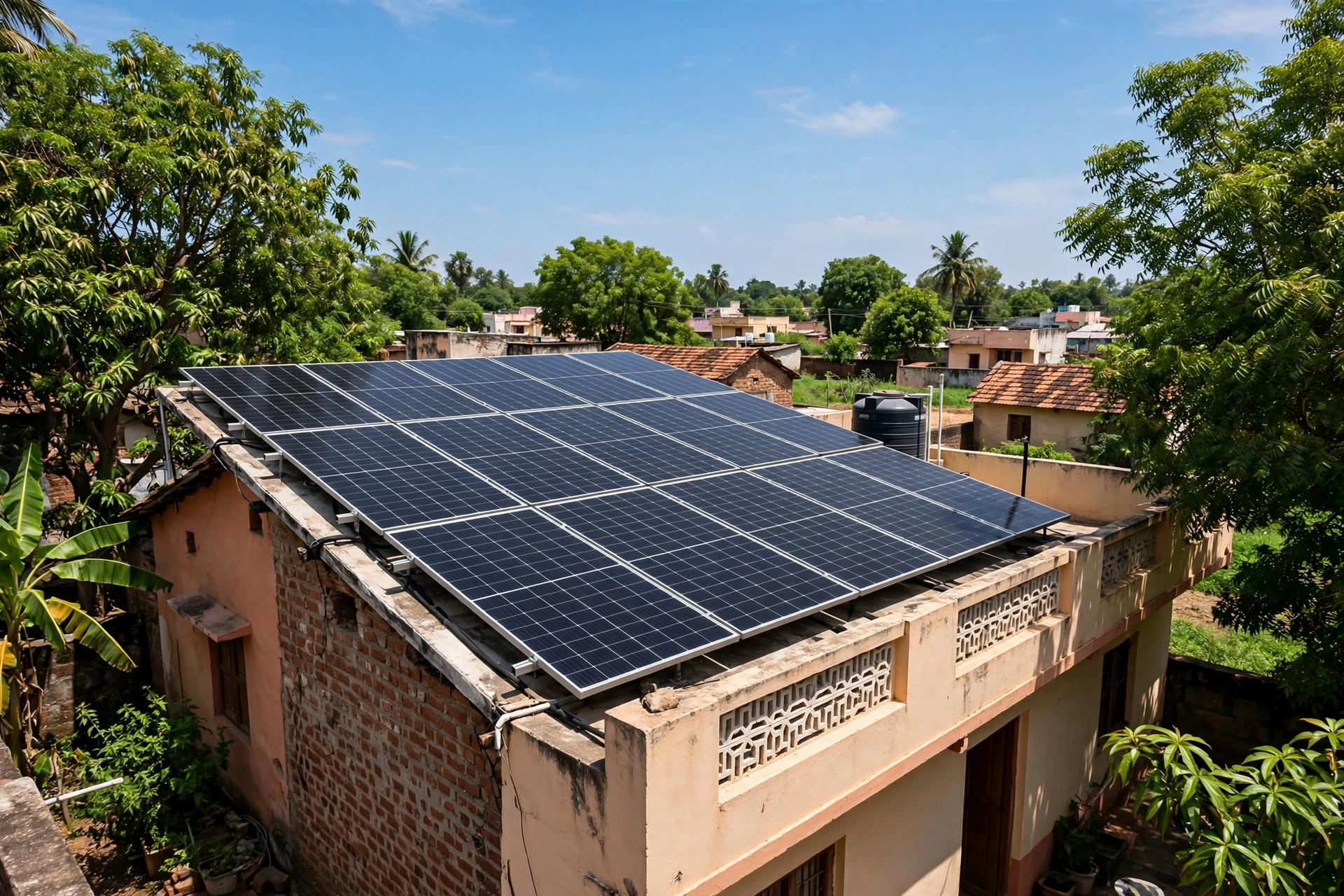
Update (25 November 2026): This article now brings together both PM Surya Ghar guides in one place — the full documents checklist, the step-by-step application process on the portal, state-wise extra subsidies for Delhi, Bihar, Uttar Pradesh and Tamil Nadu, 6 fraud-prevention rules and new FAQs are all added here.
Latest update (25 November 2026): In an office memorandum dated 23 November 2026, the Ministry of New and Renewable Energy (MNRE) said inactive applications will be archived in phases — the first round starts on 30 November 2026, followed by rounds on 10, 20 and 30 December. You must select a vendor within 15 days of submitting your application and complete installation within 45 days of selecting the vendor, or your application will be archived. This applies to non-ULA applications that have not taken a bank loan through the JanSamarth portal. To remain eligible for the central subsidy (CFA), installation must be completed and details submitted on the National Portal by 31 March 2027.
Electricity bills eat into your pocket every month — run the AC in summer and the bill doubles. PM Surya Ghar Muft Bijli Yojana is the permanent fix: install solar panels on your roof, get up to ₹78,000 subsidy from the government, and get up to 300 units of free electricity every month. Announced on 13 February 2024, approved by the Cabinet on 29 February 2024 — a ₹75,021 crore scheme targeting 1 crore homes.
This guide covers — how much subsidy, who can apply, which documents you need, how to apply, loan facility, what net metering is, state-wise extra subsidies and how to stay safe from fraud. 15 questions answered at the end. All information from pmsuryaghar.gov.in and MNRE.
Latest Update – 22 November 2026: The Ministry of New and Renewable Energy (MNRE) said on 19 November 2026 that residential rooftop solar capacity under the scheme has reached 19,744 MW (about 19.7 GW), with 56.97 lakh operational installations and 67.17 lakh households now drawing power from rooftop solar. Central subsidy of ₹37,533 crore has been disbursed so far. The target of 1 crore households by 31 March 2027 remains.
PM Surya Ghar Yojana: At a Glance
| Point | Information |
|---|---|
| Scheme | PM Surya Ghar: Muft Bijli Yojana — Central Govt |
| Announced | 13 February 2024 (Cabinet approval 29 February 2024) |
| Ministry | MNRE |
| Outlay | ₹75,021 crore |
| Target | 1 crore homes |
| Subsidy | 1kW ₹30,000 / 2kW ₹60,000 / 3kW ₹78,000 |
| Free electricity | 300 units/month |
| Apply at | pmsuryaghar.gov.in |
| Toll-free helpline | 15555 |
What Is the Scheme?
PM Surya Ghar Muft Bijli Yojana is the central government’s rooftop solar scheme. Solar panels on the roof generate electricity, bringing the bill to zero or near-zero. The government does not give 300 units directly — your system generates power from sunlight. Surplus electricity can be sold back to the grid, creating an extra source of income.
The biggest advantage is that the government transfers a large part of the installation cost directly into your bank account as a subsidy. A collateral-free loan facility at around 7% interest is also available, so you do not need a large upfront payment. Net metering records both the electricity your home consumes from the grid and the surplus it exports, and the difference becomes your bill.
Progress: 28 Sep 2026 — 49.7 lakh systems, 59 lakh homes, ₹32,807 crore subsidy via DBT. According to a government factsheet dated 13 November 2026, over 21 lakh households now receive zero electricity bills, and 90.58 lakh applications had been received by 14 November 2026. This is considered the world’s largest domestic rooftop solar scheme.
Objectives of the Scheme
The scheme has one headline promise — 300 units of free electricity every month for 1 crore homes — but its objectives run deeper. The central idea is simple: the government does not hand out 300 units; your rooftop system generates them from sunlight, so an average home’s bill falls to zero or near-zero.
– Provide 300 units of free electricity per month to eligible homes, especially middle and lower-income families.
– Give permanent relief from electricity bills — invest once, save for years.
– Energy self-reliance: every home generates its own power, reducing dependence on the grid in villages and cities alike.
– Promote clean energy: solar power protects the environment and cuts carbon emissions — a big step towards India’s climate goals.
– Create new jobs: solar installation, maintenance, vendor networks and servicing create lakhs of direct jobs.
Beyond household savings, rooftop solar cuts peak demand on DISCOMs, reduces fossil-fuel use, and moves India toward its renewable energy commitments. A special objective is the Model Solar Village — one village per district is selected and made fully solar: homes, schools, the panchayat building, and street lights, with ₹1 crore in assistance per village. If your village is selected, bulk installation brings systems to the whole village at lower cost; ask your district administration or DISCOM which village is your district’s Model Solar Village.
Subsidy Details
The Central Financial Assistance (CFA) is fixed according to the capacity of the solar system. You receive ₹30,000 per kW for the first 2 kW, and ₹18,000 per kW for the additional capacity between 2 kW and 3 kW.
| System capacity | Approximate roof space needed | Central subsidy |
|---|---|---|
| 1 kW | 10 square metres | ₹30,000 |
| 2 kW | 20 square metres | ₹60,000 |
| 3 kW | 30 square metres | ₹78,000 |
| Above 3 kW (e.g. 4, 5 or 10 kW) | More than 40 square metres | ₹78,000 (capped) |
Note the cap: the subsidy stops at ₹78,000 whether you install 3 kW or 10 kW. That is why a 3 kW system is considered the sweet spot for most households. The subsidy is credited to your bank account after net metering and the DISCOM’s inspection are complete and the commissioning certificate is issued — generally within 15–30 days (in some cases up to 30 working days).
Special-category states (Uttarakhand, Himachal Pradesh, Jammu & Kashmir, Ladakh, the North-Eastern states including Sikkim, Andaman & Nicobar Islands and Lakshadweep) get higher rates — ₹33,000 per kW for the first 2 kW and ₹19,800 for the third kW, up to a maximum of ₹85,800.
Who Can Apply?
Before applying, make sure you meet these conditions:
– You must be an Indian citizen.
– You must own a house with a roof suitable for solar panels — strong and shadow-free.
– Your home must have a valid electricity connection.
– You must not have availed any other central solar subsidy for the same premises earlier.
– The electricity connection and the bank account must be in the applicant’s name (a name mismatch is one of the most common reasons for rejection or delay).
– Tenants and commercial buildings are not covered under this scheme.
– Group Housing Societies and RWAs can apply for common areas up to 500 kW.
There is no strict income cap, but the scheme is primarily designed to benefit low and middle-income families. Only residential consumers are eligible.
Documents Required for PM Surya Ghar Yojana
Keep these documents and details ready before you begin, so you do not get stuck midway:
– Aadhaar card (for identity proof)
– Recent electricity bill — with the consumer number clearly visible
– Proof of property ownership (property documents)
– Bank account details — passbook or a cancelled cheque
– Passport-size photograph
– PAN card
– Mobile number and email ID — your own, not the vendor’s
– Details of the rooftop or proposed installation site
One important rule: always register on the portal with your own mobile number and email ID. Applications filed with a vendor’s contact details can be rejected, and such vendors can be blacklisted.
How to Apply
The entire process happens digitally on the national portal pmsuryaghar.gov.in — no visits to government offices are needed.
– Open the portal: Go to pmsuryaghar.gov.in and click “Apply for Rooftop Solar” or “Apply Now”.
– Start registration: Select your state, district and electricity distribution company (DISCOM).
– Enter consumer details: Fill in your electricity consumer number, mobile number and email ID, complete the captcha and click “Next”.
– OTP verification: Enter the OTP sent to your mobile and verify it to create your login.
– Log in: Log in to the portal with your consumer number and mobile number.
– Fill the application form: Enter all required details in the rooftop solar form — consumer name, address, PIN code and so on — then submit.
– DISCOM feasibility approval: Your DISCOM will now carry out a technical check — roof area, shading, transformer capacity and so on. Approval usually takes 7–15 days; in some DISCOMs it can take 15 to 30 working days.
– Choose a registered vendor: After approval, select one of your DISCOM’s registered vendors from the portal’s list. Warning: if installation begins before approval, your subsidy claim can be rejected.
– Get the system installed: The vendor will visit your home and install the solar panels, inverter, wiring and mounting structure. Only India-made, ALMM-listed and BIS-certified panels qualify for the subsidy.
– Apply for a net meter: After installation, submit the plant details on the portal and apply for net meter installation.
– DISCOM inspection and commissioning: DISCOM officials will inspect the system. If everything is in order, the commissioning certificate is generated on the portal.
– Submit bank details: After receiving the commissioning report, upload your bank account details and cancelled cheque on the portal. The subsidy usually reaches your account within 15–30 days (in some cases up to 30 working days).
The application runs through five gates: Gate 1 — Registration (portal, state, DISCOM, consumer number, mobile OTP); Gate 2 — DISCOM approval (technical check of roof and transformer capacity, 7–15 days); Gate 3 — Choose vendor (from the portal’s registered vendor list; confirm ALMM-listed, BIS-certified panels); Gate 4 — Installation + net meter (vendor installs in 1–3 days; DISCOM inspects, installs the net meter, and issues a commissioning certificate); Gate 5 — Subsidy claim (upload bank details + cancelled cheque; subsidy arrives via DBT in 15–30 days).
Choosing the Right System Size
The most common question — “how many kW do I need?” — is answered by your monthly electricity bill. Match your average consumption to the right size:
| Monthly bill | Monthly consumption | Right size | Subsidy |
|---|---|---|---|
| Up to ₹1,000 | ~120 units | 1 kW | ₹30,000 |
| ₹1,000–2,000 | ~240 units | 2 kW | ₹60,000 |
| ₹2,000–3,000 | ~360 units | 3 kW | ₹78,000 |
| ₹3,000+ | 500+ units | 5 kW | ₹78,000 (maximum) |
As a general guide: 1 kW for small families with low consumption (fans, lights, TV, refrigerator and other basic appliances); 2 kW for families with moderate consumption — also a good choice for homes with limited roof space; 3 kW for families with higher consumption — this is the capacity that unlocks the maximum ₹78,000 subsidy. The portal also has a calculator that estimates the right capacity, cost, subsidy and savings based on your consumption.
Remember: the subsidy caps at 3 kW (₹78,000) — a 5 kW or 10 kW system still gets only ₹78,000. Bigger systems still pay off for heavy users because the bill savings outweigh the subsidy. A 3 kW system generates about 12–15 units daily — over 300 units a month — which covers an average home’s full consumption, and surplus units earn credit through net metering. Check your roof: you need about 100 sq ft (10 square metres) of clean, shade-free roof per 1 kW, and your area’s transformer must have load headroom — your DISCOM verifies both in its technical check.
The full cost math:
| System | Estimated cost | Subsidy | Your cost | Payback period |
|---|---|---|---|---|
| 1 kW | ₹60,000–70,000 | ₹30,000 | ₹30,000–40,000 | 3–4 years |
| 2 kW | ₹1.1–1.3 lakh | ₹60,000 | ₹50,000–70,000 | 3–4 years |
| 3 kW | ₹1.6–1.9 lakh | ₹78,000 | ₹80,000–1.1 lakh | 4–5 years |
The math: a ₹2,500/month bill = ₹30,000/year saved. A ₹1 lakh net cost pays back in about 4 years — then 21 years of nearly free electricity, since panels last 25+ years. Even on loan, a bank EMI at approx. 6.75% interest is lower than the monthly bill — meaning savings from day one. Install once, and the system keeps paying you back for decades.
Net Metering
Surplus solar power goes to the grid for credit. Your bill = consumption minus generation: a net meter tracks both directions, and surplus units offset your night-time and cloudy-day usage — or earn you money at the DISCOM’s rate. Net metering uses a two-way meter that records both the electricity drawn from the grid and the surplus exported to it. A net meter and the DISCOM inspection are mandatory for the subsidy. Surplus solar power sent to the grid can save up to ₹17,000–18,000 a year.
Loan Facility
Up to ₹2 lakh collateral-free loans at approx. 6.75–7% interest are available through partner banks. The government has stated that collateral-free, low-interest loans at around 7% are available for residential systems up to 3 kW. The cost remaining after the subsidy can therefore be repaid in easy instalments. Several banks and NBFCs also offer digital loan options linked with the portal’s registered vendors. With the EMI lower than the average monthly bill, the system effectively pays for itself from day one.
State Top-ups
The ₹78,000 central subsidy is only the baseline — some states add extra subsidy on top, so total support can be much higher. According to media reports:
– Delhi: In September 2026, the “Delhi PM Surya Ghar” portal (solar.delhi.gov.in) was launched. Alongside the Centre’s ₹78,000, the Delhi government adds another ₹78,000 — a total of up to ₹1.56 lakh. As on 16 November 2026, 1,27,273 applications have been received; applications stay open till 27 February 2027 on a first-come, first-served basis (benefits for the first 2.20 lakh eligible applicants). Vendor selection is still pending, so home surveys and installations have not started yet. The target is 2.30 lakh families; homes using up to 400 units a month can get systems installed without upfront payment.
– Bihar: Media reports indicate that for a 3 kW system, the state adds up to ₹20,000 on top of the Centre’s ₹78,000 — total assistance of up to ₹98,000. The Bihar Cabinet approved ₹10,000 per kW (up to ₹20,000 per consumer) as additional subsidy on 12 August 2026.
– Uttar Pradesh: Reports suggest a state top-up of around ₹30,000 for a 3 kW system (₹15,000 per kW, UPNEDA) — a total of up to ₹1,08,000.
– Tamil Nadu: According to media reports from November 2026, the state government adds ₹5,000 for 1 kW, ₹10,000 for 2 kW and ₹22,000 for 3 kW and above — taking the total subsidy for a 3 kW system to ₹1 lakh.
State top-ups are announced and revised by state governments and their nodal renewable agencies, and the amounts and conditions differ from state to state — some link the top-up to system size, others to consumer categories. Because these change over time, always verify the current top-up on your state nodal agency’s website or through your DISCOM before finalising a vendor quote. Special-category states already receive higher central subsidy rates, and state additions come over and above that.
When comparing quotes, ask the vendor to show the central subsidy and the state top-up as separate line items, so you can verify both on the official portals. Never trust a vendor’s verbal promise of a top-up — it must appear in the state’s published scheme details.
Common Mistakes to Avoid
– Applying without checking roof suitability (shadow-free area needed)
– Choosing an unregistered vendor — subsidy only through registered vendors
– Not completing Aadhaar authentication — delays subsidy
– Expecting 300 units as a direct handout — it’s generated by your system
– Installing before DISCOM approval is the costliest mistake of all. Technical approval before installation is mandatory — install without it and the subsidy claim is cancelled outright. Apply on the portal first, wait for the DISCOM’s go-ahead (usually 7–15 days), and only then let the vendor start work.
– Panels not on the ALMM list disqualify the claim. Subsidy is paid only for ALMM-listed, BIS-certified modules installed by a registered vendor — cheap non-listed panels void the entire subsidy, so check the module list before you pay.
– Wrong bank details stall the money. The subsidy travels by DBT to your Aadhaar-linked account, so upload a clear cancelled cheque and double-check the account number and IFSC — a small typo can delay payment by weeks.
– Paying an agent is never needed — the application and subsidy process are completely free. Anyone demanding a fee for “instant subsidy” is committing fraud. Apply only on pmsuryaghar.gov.in, never share OTPs, and report fraud attempts through the portal’s grievance channel.
Finally, get your roof’s shadow-free area assessed before applying (about 100 sq ft per kW), and size the system to your actual consumption — the 300 units are generated by your panels, not credited as a handout.
Fraud Prevention: 6 Things to Remember
Fraud cases in the name of solar subsidies keep surfacing. Stay alert:
– Apply only on pmsuryaghar.gov.in — do not trust agents, WhatsApp messages or fake websites.
– No government officer or vendor asks for an application fee — if someone demands money, it is fraud.
– Get the installation done only through a portal-registered vendor — installations from outside vendors will not get the subsidy.
– Always register with your own mobile number and email ID — applications filed with a vendor’s contact details can be rejected.
– Keep the name identical on your electricity bill, Aadhaar and bank account — a name mismatch is the biggest cause of subsidy delays or rejection.
– The subsidy goes only to your bank account — stay away from anyone who says they will “get your subsidy released first”.
Subsidy Timeline: When Will the Money Arrive?
– Registration and DISCOM approval: technical approval usually comes in 7–15 days; in some DISCOMs it can take 15 to 30 working days.
– Installation: a registered vendor installs the system in 1–3 days.
– Net meter and inspection: DISCOM installs the net meter and inspects the system.
– DBT after commissioning certificate: once the certificate is issued, the subsidy usually reaches your bank account in 15–30 days (in some cases up to 30 working days).
Maintenance
Solar systems have no moving parts, so maintenance is light — but a little care protects your generation for the full 25-year panel life.
Cleaning: wash dust off the panels with clean water every 15–20 days — dirty panels lose 15–25% output. In dusty or high-pollution areas, clean more often; early morning is the best time to wash them.
Shade: don’t let tree branches or water-tank shade fall on the panels — even a little shade drops the whole string’s output. Trim nearby growth before it becomes a problem.
Inspection: get connections and wiring checked by the vendor once a year, and look for physical damage after storms or hail.
Monitoring app: the inverter app shows daily generation — if output suddenly drops, call the vendor instead of waiting. Keep the 5–10 year inverter warranty papers safe.
Panels need only occasional cleaning. Authorised vendors typically maintain systems for the first 5 years.
Frequently Asked Questions (FAQs)
Q1. Maximum subsidy?A. ₹78,000.
Q2. Who can apply?A. Citizen with own house and electricity connection.
Q3. Where to apply?A. pmsuryaghar.gov.in.
Q4. Is this a government website?A. No — GramSuvidha is a private information portal.
Q5. How long do panels last?A. 25+ years.
Q6. What is net metering?A. Credit for surplus solar power sent to the grid.
Q7. Is a loan available?A. Yes, up to ₹2 lakh.
Q8. Can tenants apply?A. No — only homeowners can apply.
Q9. What documents are needed?A. Aadhaar, electricity bill, bank details, roof photos.
Q10. How is subsidy paid?A. Directly to Aadhaar-linked bank account via DBT.
Q11. What if DISCOM rejects feasibility?A. Address the reason (e.g. roof issues) and reapply.
Q12. Can I install more than 3 kW?A. Yes, but subsidy caps at ₹78,000.
Q13. What is the last date to apply under pm surya ghar yojana apply online 2026?A. MNRE has not announced a last date for consumers. Reports indicate the scheme’s implementation period runs till 31 March 2027. State quotas can fill up, so applying early is the safer option.
Q14. Is there any option without an online application?A. The application process is fully digital and happens on pmsuryaghar.gov.in. If you face difficulty with the online form, call the toll-free helpline 15555 for help.
Q15. Will old solar panel owners get the subsidy again?A. No. If you have already availed a central solar subsidy for the same premises, you are not eligible.
Important Links
– Official portal: pmsuryaghar.gov.in
– Ministry of New and Renewable Energy (MNRE): mnre.gov.in
– Toll-free helpline: 15555
– Delhi state portal: solar.delhi.gov.in
Last updated: 25 November 2026
Disclaimer: GramSuvidha is a private information portal and not a government website. The information in this article is based on publicly available scheme guidelines and is for general awareness only. Scheme rules, budgets and figures may change — always verify current details on the official portal pmsuryaghar.gov.in or by calling the helpline before applying.
private information portal, not a government website




1 thought on “PM Surya Ghar Yojana 2026: ₹78,000 Subsidy, 300 Units Free Electricity, How to Apply”
Comments are closed.