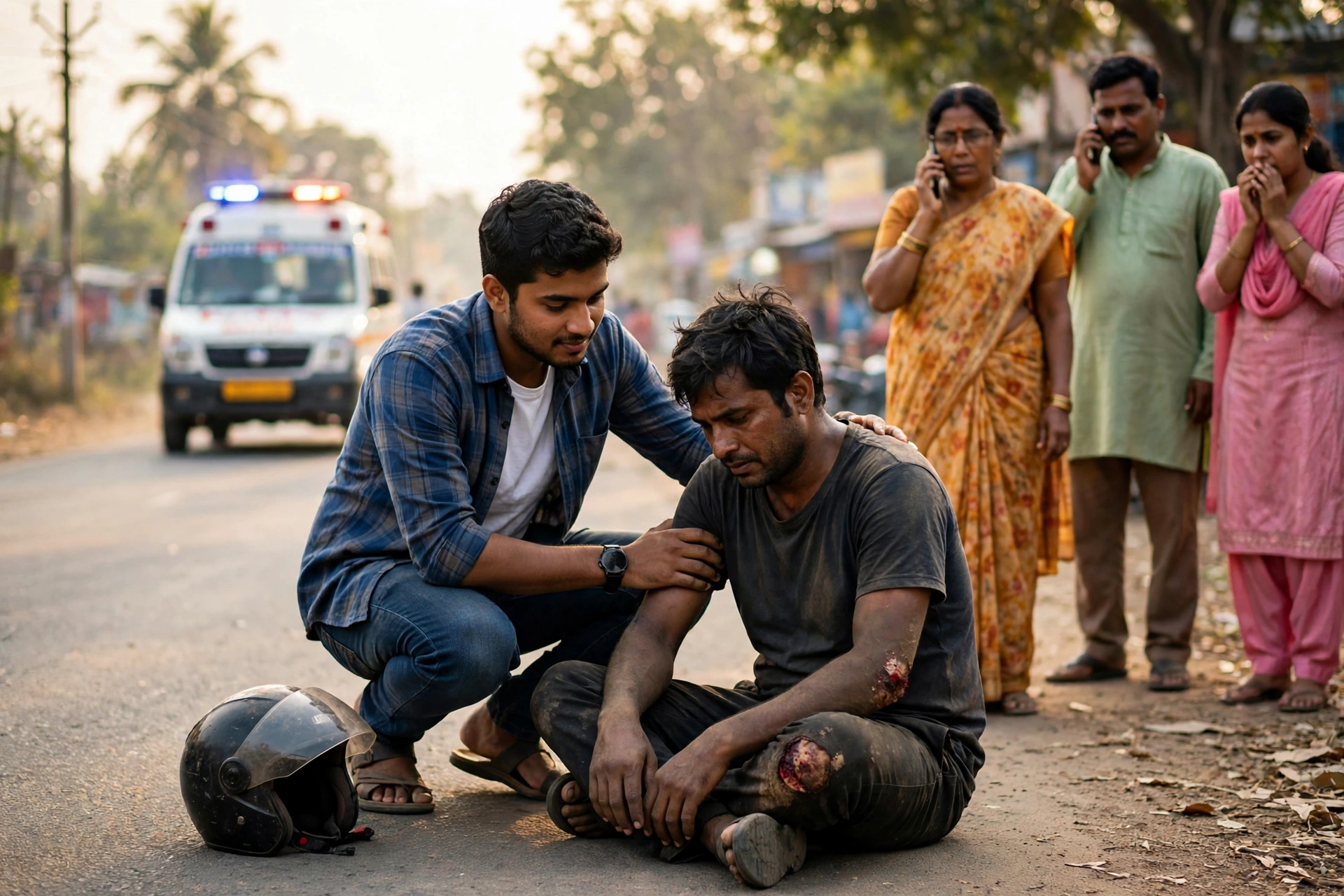
Imagine this: you are driving home in the evening and you see a motorcycle accident on the roadside. A stranger is lying injured on the road. Most people slow down, look, and drive on. Some worry: what if the police question me for hours? What if the hospital asks me to pay? What if I get trapped in a court case? Because of these fears, precious minutes are lost — and in road accidents, minutes decide whether a person lives or dies.
This article answers one question that thousands of people in India are searching for right now: which government scheme recognises and rewards an ordinary citizen who steps forward to help a road accident victim? The answer is a national scheme with a special name, a cash reward, a certificate of honour, and full legal protection for the helper. Read the full guide below to know who qualifies, how much is given, what protection the law gives you, and how the reward actually reaches you.
Rah-Veer Yojana 2026: Quick Facts Table
| Point | Detail |
|---|---|
| Scheme name | Rah-Veer Yojana (Good Samaritan Scheme) |
| Started by | Ministry of Road Transport and Highways (MoRTH), Government of India |
| Original scheme | Good Samaritan Scheme, launched 3 October 2021 |
| New form | Relaunched as Rah-Veer Yojana on 21 April 2025 |
| Cash reward | Rs 25,000 per incident, plus a Certificate of Appreciation |
| Repeat limit | Up to 5 times in one year for repeated acts |
| National honour | 10 best Rah-Veers every year get Rs 1,00,000, a trophy and a certificate during National Road Safety Month |
| Shared reward | If more than one person helps the same victim, the Rs 25,000 is shared equally among them |
| Legal basis | Good Samaritan Rules, 2020, under Section 134A of the Motor Vehicles (Amendment) Act, 2019 |
| Who can claim | Any citizen who helps a seriously injured road accident victim get medical care within the Golden Hour |
| Application mode | No single central online form — claim moves through the hospital and the district transport / road safety authorities of your state |
| Official ministry | morth.nic.in (Ministry of Road Transport and Highways) |
Which scheme rewards people who help road accident victims?
The scheme is called Rah-Veer Yojana. The word “Rah-Veer” means a brave traveller of the road — an ordinary person who shows courage on the road. Under this scheme, any citizen who helps a person seriously injured in a road accident to reach a hospital or get medical treatment within the first hour after the accident is recognised as a “Rah-Veer” and rewarded.
The scheme began as the Good Samaritan Scheme on 3 October 2021. In its first cycle, helpers received Rs 5,000 each. On 21 April 2025, the Ministry of Road Transport and Highways relaunched it in a new form as Rah-Veer Yojana and raised the reward to Rs 25,000 per incident, along with a Certificate of Appreciation. The ministry has continued the scheme into further financial cycles, and state governments are actively rolling it out — Uttar Pradesh, Bihar, Uttarakhand, Odisha, Madhya Pradesh, Jharkhand, Nagaland and Delhi are among the states following these central rules.
What is the Golden Hour, and why does it matter?
The “Golden Hour” is the first 60 minutes after a serious injury. Doctors say this is the most critical window: if a seriously injured person gets medical attention within this hour, the chance of survival rises sharply. After this window, even good treatment may come too late. That is why the entire Rah-Veer scheme is built around this one hour — the reward is for people who act fast, not for people who arrive late.
To qualify, the helper must ensure that the victim receives medical assistance within the Golden Hour. This usually means taking the injured person to the nearest hospital or trauma centre, or calling an ambulance and staying with the victim until help arrives. The point of the scheme is simple: no injured person on an Indian road should wait for help only because bystanders are afraid.
How much money does a Rah-Veer get?
A recognised Rah-Veer receives Rs 25,000 in cash and a Certificate of Appreciation for each incident. There are three important details that most short articles miss:
- Repeated acts are rewarded: If the same person saves lives in different incidents, the reward can be given up to five times in a single year. That means a repeat helper can receive up to Rs 1,25,000 in a year through this scheme.
- Shared help means shared reward: If two or three people together help the same victim, the Rs 25,000 is divided equally among all of them. Nobody is left out because someone else also helped.
- National-level honour: Every year, the ten most courageous or outstanding Rah-Veers in the country are selected for a national award of Rs 1,00,000 each, along with a trophy and a certificate, presented during National Road Safety Month.
The reward is a recognition of bravery, not a payment for a service. It is given after the case is verified by the authorities, and it is subject to the eligibility conditions and rules prescribed under the scheme.
Legal protection: the fear that stops most people
The biggest reason people do not help accident victims is fear — fear of police questioning, fear of being made a witness in a long court case, fear of hospital bills. The Good Samaritan Rules, 2020, notified under the Motor Vehicles (Amendment) Act, 2019, directly remove these fears. Here is what the law guarantees a helper:
- No detention: A Good Samaritan cannot be detained by police for helping a victim, and there is no requirement to disclose personal details against your will.
- No forced witness duty: You cannot be forced to become a witness or to appear repeatedly in legal proceedings only because you helped.
- Identity protection: If you wish, your identity can be kept confidential.
- No hospital harassment: Hospitals cannot refuse emergency treatment to an accident victim, and they cannot demand payment from the person who brings the victim in.
- Protection from civil or criminal liability: A person who helps in good faith is protected from legal action for the help given.
Union Road Transport Minister Nitin Gadkari has repeatedly pointed out that road accidents cost India nearly 3 percent of its GDP, according to an IIT Delhi study — and that bystander hesitation is one of the reasons so many accident victims die before reaching a hospital. The legal protection in this scheme exists precisely to end that hesitation.
What to do at the scene: step-by-step guide
If you ever come across a road accident, follow these steps. They protect the victim, protect you, and also create the record you will need for the reward claim later.
- Stop safely: Park your vehicle at a safe distance with hazard lights on so that you do not cause a second accident.
- Call for emergency help immediately: Dial 112 (the national emergency number) or 108 for an ambulance. Tell them the exact location, the number of injured people, and the nature of injuries.
- Do not move a seriously injured person carelessly: Unless there is immediate danger like fire, avoid dragging the victim. Keep them still and comfortable while help arrives.
- Take the victim to the nearest hospital: If an ambulance will take too long, take the victim to the nearest hospital or trauma centre yourself. Remember the Golden Hour — the first 60 minutes count.
- Inform the hospital it is a road accident case: Tell the hospital staff clearly that this is a road accident victim brought in during the Golden Hour. This creates the medical record of timely help.
- Keep proof of your help: Keep the hospital papers, the ambulance or call record, and the names of any police or hospital staff you spoke to. Note the date, time and place. These documents support your reward claim.
- Do not demand anything from the victim’s family: Your help must be voluntary and in good faith. The reward comes from the government, not from the victim.
How to claim the Rs 25,000 Rah-Veer reward
There is no single central website where you fill one online form for the whole country. The claim moves through your state’s own system, and the steps are broadly the same everywhere:
- Hospital record: The hospital where the victim was treated records that the victim was brought in within the Golden Hour and notes who brought them.
- District recommendation: The case is placed before the District Road Safety Committee (or the district transport authority), which verifies the facts and recommends the helper’s name.
- State transport department: The state transport department forwards the verified names to the Ministry of Road Transport and Highways, and the reward amount is released.
- Payment and certificate: The approved helper receives Rs 25,000 and a Certificate of Appreciation.
If you helped a victim and nobody contacted you, you can approach your district transport office (RTO / District Transport Officer) with your hospital papers and a written account of what happened, and ask about the Rah-Veer claim process in your district. Do not pay any agent or middleman for this — the claim process is free, and anyone demanding money to “get” your reward is cheating you.
Rah-Veer in the states: latest 2026 updates
The scheme is not only on paper. In 2026, states have been actively identifying and rewarding Rah-Veers:
- Uttar Pradesh: In October 2026, the state transport department prepared proposals to honour 27 Rah-Veers with Rs 25,000 each, recommended by District Road Safety Committees. The ministry released Rs 10 lakh to Uttar Pradesh for reward distribution through a letter dated 21 September 2026.
- Bihar: In October 2026, the Katihar district transport office publicly informed citizens that helpers under Rah-Veer Yojana will receive Rs 25,000 cash and a certificate, with the amount shared equally if several people helped one victim.
- Uttarakhand: The state is running the Good Samaritan / Rah-Veer scheme with the same Rs 25,000 reward, a maximum of five rewards per person per year, and identity protection for helpers.
- Punjab: In October 2026, district authorities in Hoshiarpur appealed to citizens to come forward without fear and explained that eligible helpers receive Rs 25,000 plus a certificate, subject to the scheme’s conditions.
- Chhattisgarh: Police and transport departments are jointly spreading awareness of Rah-Veer in workshops, alongside the separate PM RAHAT scheme for victims.
Because implementation runs through states, the exact local office you contact can differ — but the reward amount, the Golden Hour rule and the legal protection are the same national rules everywhere.
Rah-Veer vs PM RAHAT: do not confuse the two
Two road-accident schemes are often mentioned together, and readers confuse them. They are different:
- Rah-Veer Yojana rewards the helper — Rs 25,000 to the citizen who saves the victim in the Golden Hour.
- PM RAHAT (Prime Minister’s Road Accident Victims’ Hospitalisation and Assured Treatment) helps the victim — cashless treatment for the injured person, reported up to Rs 1.50 lakh, so that no victim is refused treatment for inability to pay upfront.
One scheme protects the person who stops to help; the other protects the person who is hurt. Both exist so that fear — of police, of hospital bills, of courts — never becomes the reason a life is lost on the road.
Frequently Asked Questions (FAQ)
1. Which government scheme gives money to people who help road accident victims?
Rah-Veer Yojana, run by the Ministry of Road Transport and Highways. It is the new form of the Good Samaritan Scheme and gives Rs 25,000 per incident to helpers.
2. Who is called a Rah-Veer?
Any citizen who, with courage and good faith, helps a person seriously injured in a road accident to get medical assistance within the Golden Hour (the first 60 minutes) is recognised as a Rah-Veer.
3. How much is the Rah-Veer reward, and how many times can one person get it?
Rs 25,000 cash plus a Certificate of Appreciation per incident, up to five times in a year. The ten best Rah-Veers nationally get Rs 1,00,000 each every year.
4. What if several people help the same victim?
The Rs 25,000 reward is shared equally among all the helpers of that victim.
5. Will the police detain me or force me to be a witness if I help?
No. Under the Good Samaritan Rules, 2020, a helper cannot be detained for helping, cannot be forced to disclose personal details, and your identity can be kept confidential.
6. Is there an online form to apply for the Rah-Veer reward?
There is no single central online form. The claim is verified through the hospital record and the District Road Safety Committee / district transport authority, and then the state transport department releases the reward. Contact your district transport office with your hospital papers.
7. Do I need to pay anyone to claim the reward?
No. The process is free. Anyone asking for money to arrange your Rah-Veer reward is a fraud — report them and do not pay.
8. Does the scheme apply in my state?
Yes, it is a national scheme of the central ministry, implemented through state transport departments. States including Uttar Pradesh, Bihar, Uttarakhand, Odisha, Madhya Pradesh, Jharkhand, Nagaland and Delhi follow these rules.
Official links
- Ministry of Road Transport and Highways — morth.nic.in
- Parivahan Sewa (transport services portal) — parivahan.gov.in
- National emergency number — 112; Ambulance — 108
Disclaimer: GramSuvidha is a private information portal, not a government website. This article is an information guide only; the final decision on any reward rests with the concerned government authorities under the scheme rules. For the latest local process, contact your district transport office.