Sardar Patel Skill Zone UP 2026 is big news today for the youth of Uttar Pradesh. If you live in Uttar Pradesh, have finished school, and are looking for a job — or if you want to learn a practical skill that can get you work in India and even abroad — then this article is for you. In this article, we will walk you through everything about this new scheme: what it is, who it is for, how enrolment works, how the training works, how placement works, which cities are getting centres in the first phase, and how the state has been divided into zones. We will also tell you honestly which facts are confirmed by official statements and news reports, and which details are still awaited — so that you do not fall for a fake link or a false claim. Read till the end, because we have also answered the most common questions at the bottom of this article.
Uttar Pradesh is India’s largest state, and it also has the largest number of young people. Every year, lakhs of young people leave school and college, but many of them do not have the practical skill that companies actually need. Companies often say they want workers but cannot find people with the right skills. Young people, on the other hand, say they cannot find jobs. The real gap is a skills gap — the distance between a degree and a job. Skill training is what fills that gap. Keeping this need in mind, the Uttar Pradesh government has launched a new scheme called the Sardar Vallabhbhai Patel Skill Training and Employment Zone Development Scheme. It was launched on 31 October 2026 in Lucknow by Chief Minister Yogi Adityanath, on the birth anniversary of Sardar Vallabhbhai Patel. According to Daily Kiran, it was his 151st birth anniversary, and the scheme was launched to mark the occasion.
Sardar Patel Skill Zone UP 2026: What Is This Scheme?
Sardar Patel Skill Zone UP 2026 is a large skill-development scheme of the Uttar Pradesh government. Its aim is simple and direct: give the youth of the state training that makes them ready for jobs, and turn Uttar Pradesh into a global sourcing hub of skilled manpower — a place from which companies in India and abroad can hire trained workers with confidence. The scheme will cover the whole state, organised into zones. Each zone will have a main centre, called a hub, with smaller centres, called spokes, around it. This is known as the hub-and-spoke model. The advantage is that a young person will not have to travel very far for good training; a centre in their own zone should be able to serve them.
Another important feature of this scheme is that it does not stop at training. It connects the full journey — from enrolment to placement — into one process. A young person will enrol at a centre, receive skill training based on their interest, and then get help in finding a job. Each centre will have a placement cell whose job is to connect trained youth with employers. In other words, this is not just a certificate scheme; it is a scheme that aims to take you all the way to employment. That is why it matters especially for young people who are looking for work right after their studies.
Quick Facts Table
| Point | Detail |
|---|---|
| Scheme name | Sardar Vallabhbhai Patel Skill Training and Employment Zone Development Scheme |
| Launch date | 31 October 2026, Lucknow |
| Launched by | Chief Minister Yogi Adityanath |
| Occasion | Birth anniversary of Sardar Vallabhbhai Patel (151st, per Daily Kiran) |
| Cabinet approval | Reported 9 October 2026; ₹1,725 crore over the next 3 years |
| Coverage | All 75 districts of Uttar Pradesh, organised into 9 zones |
| Model | Hub-and-spoke model |
| Goal | Make Uttar Pradesh a global sourcing hub of skilled manpower, for jobs in India and abroad |
| Minimum qualification | Class 10 (high school) pass |
| Degree or experience | Not required for enrolment |
| Training | Interest-based skill training, including Indian and foreign languages |
| Placement | A placement cell in each centre; help in getting a job after training |
Cabinet Approval and the ₹1,725 Crore Budget
This scheme was not launched suddenly. The Uttar Pradesh Cabinet had already approved it, and the approval was reported on 9 October 2026. According to reports, ₹1,725 crore will be spent on the scheme over the next 3 years. This is a large amount, and it signals that the government wants to run this scheme at scale — not as a small pilot. Over three years, this money would go towards building centres, arranging trainers, preparing training material, facilities such as hostels, and the placement system, in a phased manner. It is important to note, however, that this budget figure comes from news reports. A district-wise or centre-wise break-up of the budget has not yet been published in detail, so we are not inventing one here. As official details emerge, this article will be updated.
Who Can Enrol? Eligibility Explained
The best news about eligibility is how simple it is. The Chief Minister himself stated that passing Class 10 — high school — is enough. No big degree is needed, and no prior work experience is required for enrolment. Enrolment will be on the spot, meaning interested youth will be able to enrol directly at the centre without waiting through a long paperwork process. This is a deliberately low barrier: the scheme is meant for ordinary young people who want to learn a trade and start working, not only for those who already hold degrees.
Still, a few cautions are in order. First, different trades or courses may have their own specific requirements — for example, a technical trade might have age or physical-fitness conditions — but these have not been confirmed in an official notification yet. Second, the full list of documents needed at enrolment has not been published either. In such schemes, an Aadhaar card, educational certificates and passport-size photographs are commonly asked for, but we are not presenting a guessed list as fact. The correct document list should be confirmed from the nearest centre or the official announcement. Third, the scheme covers all 75 districts of Uttar Pradesh, so youth from any district of the state can connect with it.
Enrol, Train, Place: The Full Journey, Step by Step
The process of this scheme can be understood in three simple steps — enrol, train and place. Let us look at each step in detail.
Step 1: Enrol — Register at Your Nearest Centre
The first step is to visit your nearest centre and enrol. According to the Chief Minister’s statement, enrolment will be on the spot. At the centre, you will be asked about your interest — which field you want to work in, what you like doing, and what your background is. Based on this, you will be guided towards a suitable trade or course. This step matters more than it looks, because choosing the right trade is the foundation of everything that follows. If you rush into a trade you have no interest in, there is a real risk of dropping out midway. So answer the centre’s questions honestly and state your interest clearly.
Step 2: Train — Skill Training Based on Your Interest
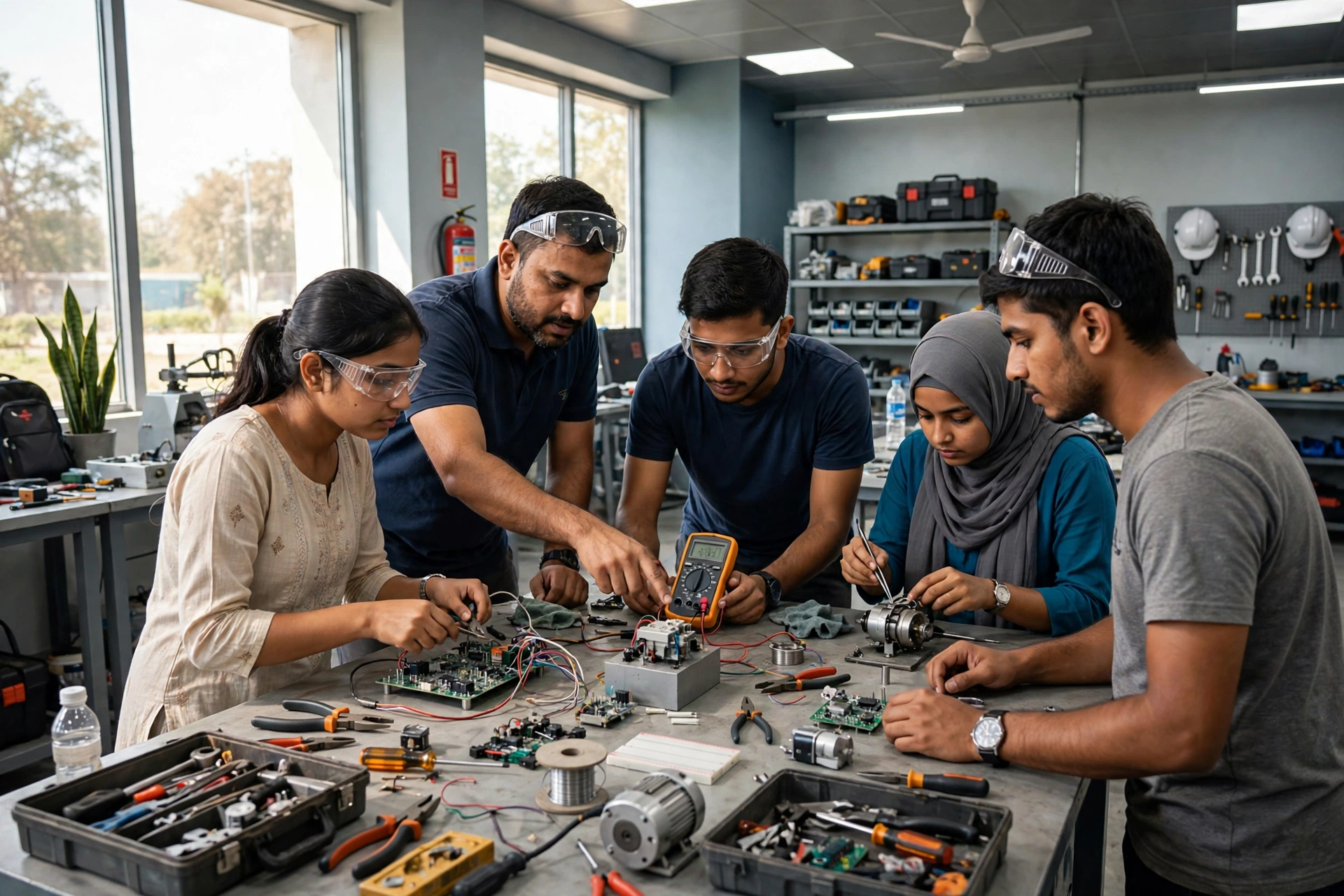
After enrolment comes training. You will be taught a skill based on your interest, with an emphasis on practical work rather than only bookish knowledge, so that you can work directly at a workplace. One notable feature is that training will include Indian and foreign languages. This matters because language is a major requirement for jobs abroad. A young person who wants to work in another country needs at least basic knowledge of that country’s language, and language skills also help within India, where different states have different working languages. Including language training in the scheme is therefore a thoughtful step. The duration of training will vary by trade, and the exact duration for each trade will be confirmed by the centre.
Step 3: Place — Get a Job Through the Placement Cell
The third and most important step is placement. Each centre will have a placement cell that connects trained youth with companies. The placement cell will contact employers, share information about job openings, and prepare youth for interviews or selection processes. This means that after finishing your training, you will not have to search for a job entirely alone — the centre’s team will help you. At the same time, it is important to be realistic: the placement cell will help, but getting a job will ultimately also depend on your skill and performance. That is why taking the training seriously is the most important thing you can do.
In addition, reports mention hostels for outstation trainees. Daily Kiran mentions hostels only partially, so we are stating this cautiously as “reported” rather than fully confirmed. If hostel facilities are provided, it would be a big relief for youth coming from distant districts, because they could focus on training without worrying about accommodation. The availability, charges and rules for hostels should be confirmed from the concerned centre.
First-Phase Centres: Which Cities, Run by Whom?
In the first phase, centres are being started in five cities — Lucknow, Kanpur, Gorakhpur, Gautam Buddha Nagar and Jhansi. Each centre has been assigned to a different operating body. The table below shows who runs which centre.
| Centre (city) | Operator / model |
|---|---|
| Lucknow | MSME Dept |
| Kanpur | PPP model (public-private partnership) |
| Gorakhpur | GIDA (Gorakhpur Industrial Development Authority) |
| Gautam Buddha Nagar | Noida / Greater Noida / YEIDA (Yamuna Expressway Industrial Development Authority) |
| Jhansi | BIDA (Bundelkhand Industrial Development Authority) |
The choice of these five cities looks deliberate. Lucknow is the state capital, Kanpur is an industrial city, Gorakhpur is a major centre of eastern Uttar Pradesh, Gautam Buddha Nagar hosts the Noida and Greater Noida industrial and IT hubs, and Jhansi is the key city of Bundelkhand. In other words, the first phase already tries to cover different parts of the state. More centres will follow in other districts, since the scheme aims to reach all 75 districts.
The 9 Zones: How Has the State Been Divided?
Under this scheme, Uttar Pradesh has been divided into 9 zones, each with a hub and surrounding spoke centres. The full district list for all zones has not yet been published in detail in the sources we checked. The table below therefore lists only the zones whose districts were confirmed in the sources, and marks the rest honestly instead of inventing them.
| Zone | Districts / areas (as confirmed) |
|---|---|
| Zone 1 | Gautam Buddha Nagar, Ghaziabad, Hapur |
| Zone 2 | Saharanpur division, plus Bulandshahr, Baghpat, Meerut |
| Zone 3 | Full district list not yet published — check the official announcement |
| Zone 4 | Full district list not yet published — check the official announcement |
| Zone 5 | Full district list not yet published — check the official announcement |
| Zone 6 | Full district list not yet published — check the official announcement |
| Zone 7 | Chitrakoot, Vindhyachal and Jhansi divisions |
| Zone 8 | Full district list not yet published — check the official announcement |
| Zone 9 | Gorakhpur, Basti and Devipatan divisions |
One clarification on Zone 2: the sources mention Saharanpur division, along with Bulandshahr, Baghpat and Meerut. We have not expanded Saharanpur division into a district list on our own, because that would go beyond what the sources confirmed. As soon as the official zone-wise list is released, this table will be updated. If your district does not appear above, that does not mean your district is excluded — the scheme covers all 75 districts; only the complete zone list is still awaited.
Same-Day Launches: Employment Friend Portal and Blue Dot
On 31 October 2026, the skill scheme was not the only launch. Reports also mention two other launches on the same day — the ‘Employment Friend Portal’ and ‘Blue Dot Shared Digital Infrastructure’. MoUs with companies and institutions, including Tata Indian Institute of Skills and the Asian Development Bank, were also mentioned. These MoUs are likely aimed at improving training quality and industry linkage, but detailed information about them has not yet emerged. The same applies to the Employment Friend Portal: its name is known, but no official link has been verified yet. We are therefore not providing any link for it. As soon as an official link is confirmed, it will be added to this article.
How Does This Relate to Skill India Mission?
Any discussion of skill development in India brings up the national Skill India Mission, launched in 2015, whose aim was also to prepare the country’s youth for employment. Uttar Pradesh’s new scheme can be seen as part of that larger thinking, but with its own state-level design — 9 zones, the hub-and-spoke model, and a placement cell in each centre. A direct formal link to the national mission should be confirmed from official documents, but as background it is useful to know that skill development has been a national priority for over a decade. What is new here is the scale and the employment-linked design at the state level.
Honesty Box: Please Read Carefully
No official enrolment portal link for this scheme has been verified yet. We checked multiple sources, and none of them carried a confirmed apply or enrolment link. That is why this article contains no apply link. As per the Chief Minister’s statement, enrolment will take place at the centre in person, so you can visit your nearest first-phase centre for information, or watch the announcements on up.gov.in and from the UP Skill Development Mission. Beware of fraud: if any website, WhatsApp message or person asks you for money in the name of this scheme, charges a “fee” for registration, or sends you a registration link asking for payment, stay away. Such links may be fake. Government scheme names are commonly misused by fraudsters. For correct information, rely only on official announcements.
Official Links
- Uttar Pradesh government official portal: up.gov.in
- No separate official portal link for this scheme has been verified yet. This article will be updated as soon as one is confirmed.
Note: up.gov.in above is the general official portal of the Uttar Pradesh government, not a dedicated portal for this scheme. The scheme-specific link is unverified, so it is not listed here.
Frequently Asked Questions (FAQ)
What is Sardar Patel Skill Zone UP 2026?
It is a skill-training and employment scheme of the Uttar Pradesh government, launched on 31 October 2026 in Lucknow by Chief Minister Yogi Adityanath. Its aim is to train youth for jobs and to make Uttar Pradesh a global sourcing hub of skilled manpower.
Who is eligible for this scheme?
Youth who have passed Class 10 (high school) are eligible. No degree or prior work experience is required for enrolment, and enrolment will be on the spot, as stated by the Chief Minister.
Which centres are opening in the first phase?
Lucknow, Kanpur, Gorakhpur, Gautam Buddha Nagar and Jhansi. Lucknow will be run by the MSME Dept, Kanpur under the PPP model, Gorakhpur by GIDA, Gautam Buddha Nagar by Noida / Greater Noida / YEIDA, and Jhansi by BIDA.
Will I get a job after training?
Each centre will have a placement cell that helps trained youth connect with employers. However, getting a job will also depend on your skill and performance, so take the training seriously.
Is there an online apply link for this scheme?
No. No official enrolment portal link has been verified yet. Enrolment will take place at the centre in person, according to the Chief Minister’s statement. Do not pay money on any unverified link, and wait for the official announcement.
Can this scheme lead to a job abroad?
The scheme’s goal includes preparing skilled manpower for jobs in India and abroad, and training includes foreign languages. But no specific country or company-wise job guarantee has been confirmed yet, so beware of anyone making such promises.
Which zone does my district fall in?
Only Zones 1, 2, 7 and 9 have confirmed district details in the sources so far. The full lists for Zones 3, 4, 5, 6 and 8 are not yet published. The scheme covers all 75 districts, so your district is not excluded — the complete zone list is simply still awaited, and this article will be updated when it is released.
Finally, one thing must be said clearly: this scheme has only just been launched. That means more information will emerge in the coming days and weeks — the list of trades, centre addresses, enrolment dates, and possibly an official portal. Until then, the wisest steps are to seek information from your nearest first-phase centre, watch official announcements, and stay away from any fake link or person asking for money. If you have passed Class 10 and want to learn a skill and start working, this scheme could be a genuine opportunity — but only with correct information, and without haste.
Disclaimer: GramSuvidha is a private information portal, not a government website. This article is based on news reports. For final and official information, please rely on the official announcements of the Government of Uttar Pradesh.