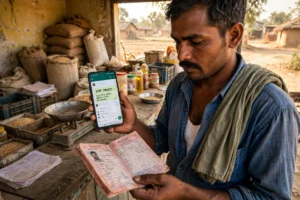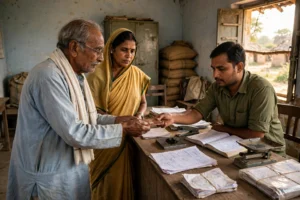
Applying for a government loan used to mean long queues, confusing paperwork and visits to several offices. Different schemes lived on different portals, each with its own form and its own process. To fix this, the Government of India built one portal where many government loan schemes are available in a single place — with eligibility checks, online applications and status tracking built in. This guide explains that portal in full: what it is, which schemes it covers, how to apply, which documents you need, and how to track your application.
Whether you want to start a small business, need a farm loan, plan to buy a house or install solar panels on your roof, this article will help you understand the process. Read till the end — we also explain which schemes are NOT on this portal and how to stay safe from fake websites.
What is the JanSamarth Portal?
The JanSamarth Portal is the Government of India’s national portal for credit-linked government schemes. In simple words, it is a single-window digital platform where many government loan schemes are available in one place. Applicants can check their eligibility, apply online and receive digital approval from a bank — all through the same portal.
The portal was launched on 6 June 2022 by Prime Minister Narendra Modi during the Iconic Week Celebrations of the Ministry of Finance. It runs under the Department of Financial Services (DFS), Ministry of Finance. It was created with two main objectives: to expand the reach of government-sponsored schemes, and to streamline the credit delivery process for everyone involved.
The most important feature of JanSamarth is that it directly connects the borrower with the lender. Earlier, an applicant had to figure out which bank to visit for which scheme. Now the portal itself suggests the right scheme based on a few simple questions and forwards the application to the selected bank branch.
One thing must be clear: the JanSamarth Portal does not give loans itself. It is not a lending institution. It is a connecting platform. Sanctioning the loan and disbursing the money is the bank’s job. The portal only makes the application, eligibility check and tracking process digital.
JanSamarth Portal at a Glance (Quick Facts)
| Portal name | JanSamarth Portal |
| Official website | jansamarth.in |
| Launch date | 6 June 2022 |
| Launched by | Prime Minister Narendra Modi |
| Run by | Department of Financial Services (DFS), Ministry of Finance, Government of India |
| Total schemes | 16 credit-linked Central Government schemes |
| Loan categories | 8 categories |
| Languages | 8 languages (English, Hindi, Gujarati, Telugu, Tamil, Marathi, Bengali, Kannada) |
| Banks and financial institutions onboard | 269 Member Lending Institutions |
| Availability | 24×7 online; website and mobile app (Android and iOS) |
| Applications (as on 1 June 2026) | About 54.10 lakh applications, worth about Rs 3,00,951 crore |
| Digital approvals (as on 1 June 2026) | 49.55 lakh beneficiaries, worth about Rs 2,76,493.78 crore |
| Fee | No fee is charged for applying on the portal |
The figures above are from the Press Information Bureau (PIB) release of June 2026, issued when the portal completed 4 years.
Which 16 Schemes Are Available on JanSamarth?
As of June 2026, the JanSamarth Portal offered 16 credit-linked Central Government schemes across 8 loan categories. The list can change over time, so always check the current list on the portal before applying.
1. Business Activity Loan
- Pradhan Mantri Mudra Yojana (PMMY): Loans for small businesses and self-employment, in Shishu, Kishore and Tarun categories. Full guide: PM Mudra Loan Yojana 2026
- Prime Minister’s Employment Generation Programme (PMEGP): Subsidy-linked loan for starting a new business. Note: from 27 June 2026, new PMEGP applications are taken on the PMEGP 2.0 portal (pmegp.msme.gov.in); the bank-side processing still runs through JanSamarth. Full guide: PMEGP Loan 2026
- Pradhan Mantri Street Vendor Aatmanirbhar Nidhi (PM SVANidhi): Collateral-free working capital loan for street vendors. Full guide: PM SVANidhi Yojana 2026
- Weaver Mudra Scheme (WMS): Mudra loans for weavers.
- Loan for Startups (START): Loan facility for people starting a startup.
- Credit Card for Micro Enterprises (CCME): Credit card facility for micro enterprises.
- National Action for Mechanized Sanitation Ecosystem (NAMASTE): Scheme for sanitation workers and people engaged in sanitation work.
2. Agri Loan
- Kisan Credit Card (KCC): Short-term loan for farmers for crop and allied activities.
- Kisan Credit Card – Fisheries (KCC Fisheries): KCC for fish farmers and fishermen.
3. Agri Infrastructure Loan
- Agri Clinics and Agri Business Centres Scheme (ACABC): Loan for agriculture graduates to open agri clinics and agri business centres.
- Agriculture Infrastructure Fund (AIF): Loan for warehouses, cold storage and post-harvest facilities.
4. Home Loan
- Home Loan for EWS, LIG and MIG in Urban Areas: Home loans for economically weaker section, lower income group and middle income group families in urban areas.
5. Renewable Energy
- Roof Top Solar Installation Financing (SOLAR): Loan for installing solar panels on the roof of a home or institution.
6. Livelihood Loan
- Deendayal Antyodaya Yojana – National Rural Livelihoods Mission (DAY-NRLM): Loans for self-help groups (SHGs) and their individual members.
7. Other Categories
- Emergency Credit Line Guarantee Scheme 5.0 (ECLGS): Under the credit guarantee coverage category.
- e-Kisan Upaj Nidhi (eKUN): Loan against electronic Negotiable Warehouse Receipts (e-NWR) — farmers can pledge their produce stored in a warehouse and get a loan.
Note that this list follows the June 2026 PIB release. The March 2026 PIB release listed 15 schemes, and by June 2026 the number had grown to 16. The list keeps changing, so the live list on jansamarth.in is the most reliable source.
Key Features of the JanSamarth Portal
- Everything in one place: 16 schemes, eligibility check, application and status tracking — all on one portal.
- Automatic eligibility check: Answer a few questions and the portal tells you which schemes you are eligible for.
- Digital approval: Banks give in-principle sanction digitally, which saves time.
- Available in 8 languages: English, Hindi, Gujarati, Telugu, Tamil, Marathi, Bengali and Kannada.
- 269 banks and financial institutions: 12 public sector banks, 20 private banks, 19 NBFCs, 28 regional rural banks, 7 small finance banks, 180 district central cooperative banks, 2 scheduled state co-operative banks and 1 all-India financial institution.
- Available 24×7: Apply anytime through the website or the mobile app.
- Real-time status: You can see every stage of your application on the portal, without repeated bank visits.
- Assisted mode: People who cannot apply online themselves can get help from bank business correspondents or assisted partners.
- Linked to government databases: Real-time checks with Aadhaar (UIDAI), PAN (CBDT), GST, UDYAM, CIBIL, AgriStack, the DPIIT Startup portal and other databases make processing faster.
Eligibility to Apply on JanSamarth
There is no single eligibility rule for the JanSamarth Portal — every scheme has its own conditions. Still, some general requirements apply to almost all schemes:
- The applicant must be an Indian citizen.
- The applicant’s age is usually 18 years or more. Some schemes also have an upper age limit.
- Aadhaar card and PAN card are required, because the portal verifies identity through them.
- A bank account is needed, so that the loan amount can be credited.
- For business loans, a business plan or proof of an existing business is required.
- For farmer schemes, agriculture-related documents such as land records may be asked for.
- The bank also looks at the applicant’s CIBIL score and previous loan record.
The easiest way is to answer the eligibility questions on the portal. The portal will tell you which schemes you qualify for and which you do not, so you do not waste time applying for the wrong scheme.
Documents Required for Application
The document list changes by scheme and by bank, but these documents are commonly asked for:
- Identity proof: Aadhaar card, PAN card
- Address proof: Aadhaar card, electricity bill, ration card or rent agreement
- Photograph: Passport-size photo
- Bank details: Bank account number, passbook or bank statement
- Income proof: Income tax return (ITR), salary slip or income certificate (as per the scheme)
- Business proof (for business loans): UDYAM registration, GST registration (if applicable), project report of the business
- Agriculture documents (for farmer schemes): Land records, khasra-khatauni, crop details
- Others: Caste or category certificate — only for schemes that offer reservation or special benefits
Keep scanned copies or clear photos of these documents ready before you start filling the form, so you do not have to stop midway.
How to Apply on JanSamarth Portal: Step-by-Step Process
The application process on JanSamarth has four main stages. Each stage is explained below:
Step 1: Open the official website
First, open the official website jansamarth.in in your mobile or computer browser. You can also download the JanSamarth mobile app from the Google Play Store or the Apple App Store. Make sure the website address is exactly right — jansamarth.in. Do not apply on any lookalike website with a similar name.
Step 2: Check your eligibility
On the homepage you will find the Check Eligibility option. You will be asked a few simple questions, such as what you need the loan for, your age, and details of your business or farming. Based on your answers, the portal will suggest the most suitable scheme. You can also browse the full list of schemes yourself and choose one that fits your need.
Step 3: Register and log in
After choosing a scheme, register on the portal. Enter your mobile number and complete the OTP verification. This will create your login. If you are already registered, simply log in.
Step 4: Fill the application form
After logging in, fill the online application form for your chosen scheme. You will be asked for personal details, business or farming details, and the loan amount. Many details are auto-filled from databases such as Aadhaar, PAN and GST. Upload the required documents with the form. Before submitting, read all the information once again carefully — wrong information can delay your application.
Step 5: Choose a bank and get digital approval
After submitting the form, the portal shows offers from the onboarded banks. You can choose the bank of your choice. The bank checks your application and gives in-principle sanction. Your application is then sent to the selected bank branch.
Step 6: Track your application status
After submitting, you will receive an application number. Keep it safe. Log in to the portal and open the “My Applications” section to see the real-time status of your application. If the bank needs any more documents, you will be informed on the portal. Final sanction and disbursement follow the bank’s rules and may take some time.
How to Check Application Status
- Open jansamarth.in and log in with your registered mobile number / login details.
- On the dashboard, click on the “My Applications” tab.
- You will see the list of all your applications and their current status — such as submitted, pending with bank, approved, or documents required.
- If any shortcoming is shown, complete it as soon as possible to avoid delay.
Grievance and Helpline
The JanSamarth portal has a dedicated grievance redressal system. Complaints made on the portal are recorded, tracked and resolved within specified time frames.
- Grievance portal: jansamarth.in/grievances
- Grievance email (applicants): grievance@jansamarth.in
- Customer support email: customer.support@jansamarth.in
- Helpline (applicants): 07969076111
Note: the phone number and email addresses above are as reported in various sources; it is best to verify them on the portal’s contact page before use. For questions about loan sanction, interest rates, instalments and documents, contact the bank you selected, because those decisions are made by the bank, not the portal.
Which Schemes Are NOT on JanSamarth? (Common Confusions)
There are some common misunderstandings about JanSamarth. Clearing them will save you from applying at the wrong place:
- PM Vidyalaxmi (education loan): This education loan scheme is NOT on JanSamarth. It has a separate portal — pmvidyalaxmi.co.in. It runs under the Department of Higher Education and its portal is operated by Canara Bank. Full guide: PM Vidyalaxmi Yojana 2026
- Stand-Up India: This scheme is not among the 16 schemes in the June 2026 PIB list. For this scheme, contact your bank branch or use the scheme’s own official channel. Full guide: Stand-Up India Yojana 2026
- New PMEGP applications: From 27 June 2026, new PMEGP applications are taken on the PMEGP 2.0 portal (pmegp.msme.gov.in). A new PMEGP application is not filed directly on JanSamarth, although the bank-side processing runs through JanSamarth.
- JanSamarth does not lend money itself: It is only a platform that connects applicants with banks. Loan sanction, interest rate and disbursement are the bank’s decisions.
- It is not a subsidy or cash-assistance scheme: The schemes on JanSamarth are loan (credit) schemes. It is not a portal that gives money or grants directly.
- There is no “Aadhaar card loan” scheme: Advertisements claiming a loan on the basis of Aadhaar card alone are fake. The real process involves eligibility checks, documents and bank verification.
How to Stay Safe from Fake Websites and Fraud
- Apply only on the official website jansamarth.in. Avoid websites with similar-looking names.
- No fee is charged for applying on JanSamarth. If anyone asks for money to get you a loan, it is fraud.
- Never share your OTP, password, bank PIN or CVV with anyone. Banks and government portals never ask for these on a phone call.
- Do not trust claims like “instant loan without documents” or “100% loan guarantee”.
- There is no need to pay an agent to apply — you can apply yourself on the portal, and help from bank business correspondents is also available.
Benefits and Limitations of JanSamarth
Benefits
- 16 schemes in one place, making it easy to find the right scheme.
- Online eligibility check saves time wasted on wrong applications.
- Digital approval and real-time status mean fewer bank visits.
- Available in 8 languages, which helps people in rural areas and small towns.
Limitations
- Final approval rests with the bank — applying on the portal is not a guarantee of a loan.
- The bank may ask for physical verification of documents or a branch visit.
- Not every scheme is for everyone — each scheme has its own conditions.
- People without internet access or digital knowledge may need help from someone else.
Frequently Asked Questions (FAQ)
1. What is the JanSamarth Portal?
The JanSamarth Portal is the Government of India’s national portal that works as a single window for 16 credit-linked government schemes. It runs under the Department of Financial Services, Ministry of Finance, and was launched on 6 June 2022.
2. Is there any fee for applying on the JanSamarth Portal?
No, there is no fee for applying on the portal. If anyone asks for money in the name of getting you a loan, it is fraud — do not pay and report it.
3. Does applying on JanSamarth guarantee a loan?
No. After you apply, the bank gives in-principle sanction and then checks your application as per its rules. Final sanction and disbursement are the bank’s decision. Applying on the portal is not a guarantee of a loan.
4. Which schemes are available on the JanSamarth Portal?
As of June 2026, there were 16 schemes on the portal, including PM Mudra Yojana, PMEGP, PM SVANidhi, Kisan Credit Card, Rooftop Solar, Agriculture Infrastructure Fund, DAY-NRLM and Home Loan. The full list is given above.
5. How do I check my application status?
Log in at jansamarth.in and open the “My Applications” tab on the dashboard. You will see the current status of your application there.
6. Is the PM Vidyalaxmi education loan available on JanSamarth?
No. PM Vidyalaxmi has a separate portal — pmvidyalaxmi.co.in. Apply for education loans there.
7. In which languages is the JanSamarth Portal available?
The portal is available in 8 languages: English, Hindi, Gujarati, Telugu, Tamil, Marathi, Bengali and Kannada.
8. What should I do if I face a problem with my application?
For portal-related problems, file a complaint at jansamarth.in/grievances or email grievance@jansamarth.in. For questions about loan sanction or interest rates, contact the bank you selected.
Conclusion
The JanSamarth Portal has made access to government loan schemes much easier than before. 16 schemes, 269 banks, 8 languages and digital approval together make the loan process simpler for small business owners, farmers and ordinary citizens. About 54.10 lakh applications and 49.55 lakh digital approvals as of 1 June 2026 show that people are actively using this portal.
Even so, it is important to remember that the portal is only a medium — the final decision is the bank’s. So choose the right scheme, keep your documents ready, apply only on the official website, and never share money or OTPs with anyone. With the right information and care, the JanSamarth Portal can be a reliable route to getting a government loan.
Official Links
- JanSamarth Portal (official website): https://www.jansamarth.in
- Grievance portal: https://www.jansamarth.in/grievances
- PIB release — JanSamarth completes 4 years (June 2026): https://www.pib.gov.in/PressReleasePage.aspx?PRID=2269253
- PIB release — National Portal for Credit Linked Government Schemes (March 2026): https://www.pib.gov.in/PressReleasePage.aspx?PRID=2247026
- PM Vidyalaxmi portal (education loan): https://pmvidyalaxmi.co.in
- PMEGP 2.0 portal: https://pmegp.msme.gov.in
Disclaimer: This article is for information only. GramSuvidha is a private information portal, not a government website. Before applying, please check the latest information and conditions of the scheme on the official website jansamarth.in.