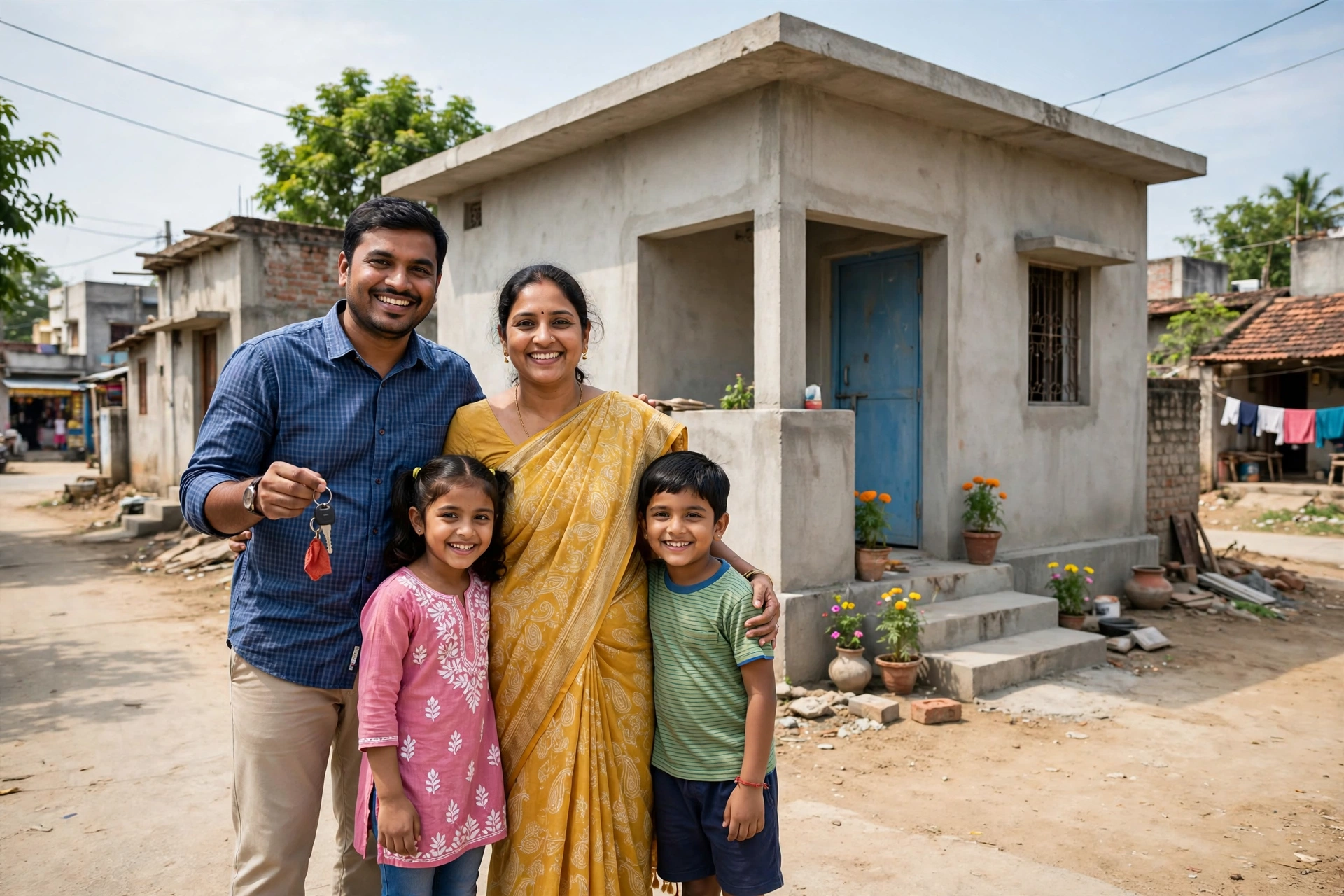
If you live in a city and dream of owning your own pucca house, but home loan interest is eating into your budget, this article is for you. The central government runs a scheme that gives you a direct discount on your home loan interest — and this discount can run into lakhs of rupees.
But the real questions are: how do you apply for PMAY 2.0? Who is eligible? How much subsidy do you get and how is it calculated? How do you check your application status online? You will find detailed answers to all these questions in this article — step by step, in simple language. Read till the end.
Note: This is a private information portal, not a government website. For the latest updates, always check the official portals pmay-urban.gov.in or pmaymis.gov.in.
PMAY 2.0 2026: Key Details at a Glance
| Detail | Information |
|---|---|
| Scheme Name | Pradhan Mantri Awas Yojana – Urban 2.0 (PMAY-U 2.0) |
| Ministry | Ministry of Housing and Urban Affairs (MoHUA) |
| Target | 1 crore urban families to get pucca houses |
| Interest Subsidy (ISS) | 4% per year on first ₹8 lakh loan, max ₹1.8 lakh |
| Eligible Income Groups | EWS (up to ₹3 lakh), LIG (₹3–6 lakh), MIG (₹6–9 lakh) |
| Applicable From | Loans sanctioned and disbursed on or after 1 September 2024 |
| Official Portals | pmay-urban.gov.in, pmaymis.gov.in |
| Application Mode | Online (portal), CSC centre, or through your bank |
What is PMAY 2.0? Understanding the Four Verticals
PMAY Urban 2.0 was launched by the central government under the “Housing for All” mission. Its goal is to provide pucca houses to Economically Weaker Section (EWS), Low Income Group (LIG) and Middle Income Group (MIG) families living in cities. The scheme runs through four separate verticals:
1. Interest Subsidy Scheme (ISS): The most popular vertical. The government pays a part of your home loan interest. If you have taken a bank loan to buy, build, or repurchase a house, the government covers part of the interest cost.
2. Beneficiary Led Construction (BLC): EWS families get up to ₹2.5 lakh in central assistance to build a house on their own land.
3. Affordable Housing in Partnership (AHP): Affordable housing projects for EWS built in partnership with the public or private sector.
4. Affordable Rental Housing (ARH): Rental housing near workplaces for urban migrants and poor families.
This article focuses mainly on the ISS vertical, because that is where most people apply — and where the most confusion exists.
PMAY 2.0 Eligibility: Income Slabs and Conditions
Before applying, check whether you qualify. The table below shows the income limits for all three categories:
| Income Group | Annual Family Income | Main Benefit |
|---|---|---|
| EWS (Economically Weaker Section) | Up to ₹3 lakh | 4% interest subsidy + up to ₹2.5 lakh under BLC |
| LIG (Low Income Group) | ₹3 lakh to ₹6 lakh | 4% interest subsidy (on first ₹8 lakh loan) |
| MIG (Middle Income Group) | ₹6 lakh to ₹9 lakh | 4% interest subsidy (on first ₹8 lakh loan) |
Beyond income, these conditions must also be met:
- Age: The applicant must be at least 18 years old.
- No pucca house: No member of the family (husband, wife, unmarried children) should own a pucca house anywhere in India.
- No prior benefit: No family member should have availed a central government housing scheme benefit earlier.
- Female ownership: For EWS/LIG, the house should be registered in the name of the female head of the family, or jointly with her.
- Loan date: The home loan must be sanctioned and disbursed on or after 1 September 2024. Earlier loans do not qualify.
- Loan and property caps: Loan amount must not exceed ₹25 lakh, property value must not exceed ₹35 lakh, and carpet area must not exceed 120 sqm.
PMAY 2.0 Subsidy Calculation: Worked Example
This is the section most websites explain poorly. Let us break down the interest subsidy math with a practical example.
The formula: The government gives a 4% per year interest subsidy on the first ₹8 lakh of your home loan. The subsidy can apply for a loan tenure of up to 12 years, but the total subsidy is capped at ₹1.8 lakh.
Example: Suppose you take a ₹20 lakh home loan.
- Subsidy applies only on the first ₹8 lakh (the remaining ₹12 lakh carries the normal bank interest rate).
- At 4%, the first-year subsidy = ₹8,00,000 × 4% = ₹32,000.
- The subsidy is credited to your loan account in 5 equal yearly installments via DBT.
- Total maximum benefit: ₹1.8 lakh (in 5 installments).
- Each installment reduces your outstanding principal, which lowers your future EMIs.
How is this different from the old CLSS? Under the old Credit Linked Subsidy Scheme, the subsidy was credited upfront to your loan account in one go. Under the new ISS, it comes in 5 yearly installments. The old CLSS closed for EWS/LIG on 31 March 2022 and for MIG on 31 March 2021.
Important: The subsidy goes directly into your loan account — not your savings account. The bank deducts it from your principal within 7 days of each installment release.
How to Apply for PMAY 2.0 Online: Step by Step
The official portal pmaymis.gov.in is in English and looks technical. Here is the full process explained simply:
- Open the portal: Go to pmaymis.gov.in in your browser. This is MoHUA’s official MIS portal.
- Go to Citizen Assessment: Click on “Citizen Assessment” in the top menu bar.
- Select state and city: Choose your state and city (ULB) from the dropdowns.
- Enter Aadhaar details: Fill in your Aadhaar number, name, address, and family information. Aadhaar OTP verification will happen, so keep your Aadhaar-linked mobile number active.
- Enter income and property details: Fill in annual family income, loan amount, and property details.
- Upload documents: Scan and upload all documents from the checklist below.
- Submit the form: Review everything and hit submit. An Application Number / Assessment ID will appear on screen — note it down or take a screenshot. You will need it to track your status later.
Offline application: If online is difficult, visit your nearest Common Service Centre (CSC). The fee is ₹25. Carry photocopies of all documents.
Document Checklist
Keep these documents ready before starting your application:
- Identity proof: Aadhaar cards of the applicant and all family members.
- Address proof: Voter ID, electricity bill, or driving licence.
- Income proof: Salary slips, Form 16, or state income certificate.
- Bank details: Active Aadhaar-seeded bank account (required for DBT).
- Property papers: Plot ownership proof, approved map, or sale agreement.
- Loan sanction letter: From your bank/HFC (mandatory for ISS).
- Self-declaration: Signed affidavit stating the family owns no pucca house anywhere in India.
- Photograph: Passport-size photo.
How to Check Your PMAY 2.0 Application Status
After applying, track your status online:
- Open pmaymis.gov.in.
- Click “Track Your Assessment Status” in the top menu.
- Choose one of two methods: by Assessment ID or by Name, Father’s Name and Mobile Number.
- Enter the details, complete the captcha, and submit.
- Your application’s current stage will display on screen.
How to find your name in the beneficiary list: Use the “Search Beneficiary” option on the portal and search by name or Aadhaar number. You can search with just the first three letters of a name.
What each status means:
- Submitted / Under Review: Application received, ULB verification pending.
- Verified: ULB has confirmed your documents.
- Sanctioned: Approved — subsidy/construction process begins.
- Subsidy Processed: Subsidy credited to your loan account.
Common Rejection Reasons (Avoid These)
Many applications get stuck over small errors. Watch out for these:
- Name mismatch: Spelling of your name must match across Aadhaar, PAN, and the PMAY application — even minor differences cause holdups.
- Income certificate pending: ULB or state agency has not completed income verification.
- Female co-ownership missing: For EWS/LIG, the woman’s name must appear in the sale deed.
- Aadhaar-bank seeding incomplete: Your Aadhaar must be linked to your bank account for DBT subsidy credit.
- Existing pucca house: Any family member already owning a pucca house disqualifies the application.
Important Official Links
- Scheme guidelines: pmay-urban.gov.in/pmay-u-2.0-guidelines
- Application portal (MIS): pmaymis.gov.in
- Ministry: mohua.gov.in
- Help: Contact your city’s ULB office or nearest CSC centre.
Beware of fraud: Checking your status on the portal is completely free. If any agent demands a “status fee” or “list fee”, it is a scam. Always use pmaymis.gov.in directly.
Frequently Asked Questions (FAQ)
What is the maximum subsidy under PMAY 2.0?
Under the Interest Subsidy Scheme (ISS), you get 4% per year on the first ₹8 lakh of your home loan, up to a maximum of ₹1.8 lakh, credited in 5 yearly installments to your loan account.
What are the income limits for PMAY 2.0?
EWS: up to ₹3 lakh, LIG: ₹3–6 lakh, MIG: ₹6–9 lakh annual family income.
Will my old home loan qualify for PMAY 2.0?
No. Only loans sanctioned and disbursed on or after 1 September 2024 qualify. The old CLSS scheme has already closed.
Where do I apply for PMAY 2.0?
Online at pmaymis.gov.in (Citizen Assessment), or at your nearest CSC centre (₹25 fee), or through your bank.
How do I check my application status?
On pmaymis.gov.in, use “Track Your Assessment Status” with your Assessment ID or name/father’s name/mobile number.
Can tenants living in rented houses apply?
Yes, if no family member owns a pucca house anywhere in India and the family income falls within the limits, tenants can also apply.
When is the subsidy credited?
The subsidy comes in 5 equal yearly installments via DBT directly into your loan account. Each installment reduces the principal and lowers your EMI.
This article is published by a private information portal, not a government website. All information is based on the Ministry of Housing and Urban Affairs’ official guidelines and portals.