
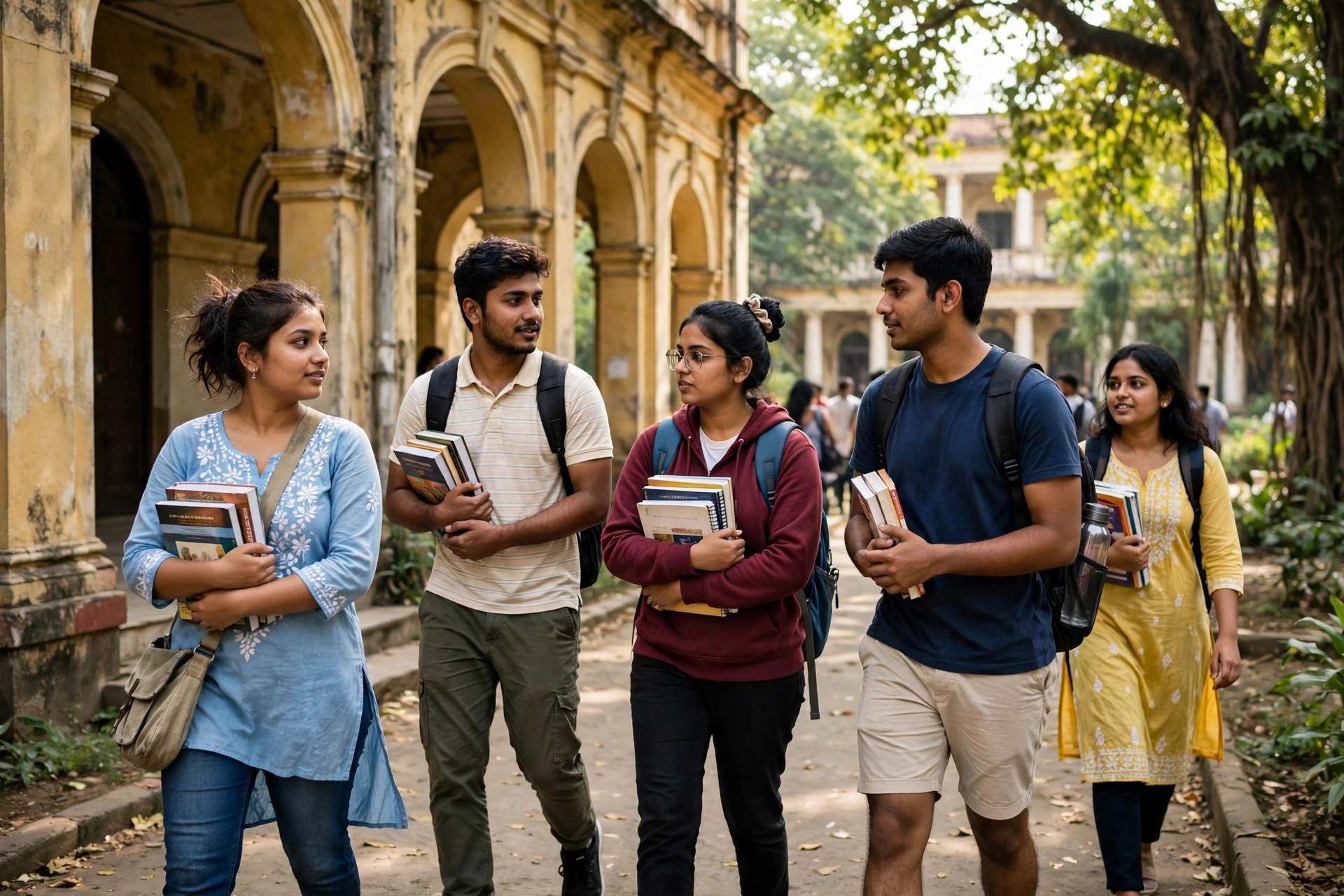
Every year, lakhs of students in West Bengal ask the same question. They score good marks, they get admission to a good college, and then the real worry begins – how will the family pay for the fees, the books, the hostel and the daily travel. For many families, this worry starts in Class 11 and continues right through graduation and post-graduation. It is this worry that the Swami Vivekananda Merit-Cum-Means Scholarship, known in short as the SVMCM Scholarship, was created to reduce. It is one of the biggest state scholarships in West Bengal, and it has helped meritorious students from low-income families continue their higher studies for many years now.
This guide walks you through the scheme step by step, in the right order. First, you will learn who the scholarship is for and which levels of study it covers. Then comes the eligibility rules, the family income limit, the documents you need, the difference between a fresh application and a renewal, the special Kanyashree K3 route for girl students, and finally the complete method to apply online. At the end, you will find answers to the questions students ask most often. Whether you are in Class 11, Class 12, graduation, post-graduation, diploma, engineering, medical or research studies, this guide is written for you.
One thing must be said clearly at the start. While writing this guide, we have not guessed any date or amount. Every figure given here comes from the official portal of the Government of West Bengal. Where the official information for 2026-27 has not yet been released, we have written TBA in plain words, which means the date has not been announced yet. Many blogs on the internet are showing different dates, but none of those dates appear on the official portal. So do not trust any date you see on a blog. Always check the official portal before you apply.
SVMCM Scholarship 2026-27: Key Facts at a Glance
| Detail | Information |
|---|---|
| Scheme name | Swami Vivekananda Merit-Cum-Means Scholarship (SVMCM), also called the Bikash Bhavan Scholarship |
| State | West Bengal |
| Department | Department of Higher Education, Government of West Bengal |
| Academic session | 2026-27 |
| Official portal | svmcm.wb.gov.in (SVMCM V4.2) |
| Fresh application start date | TBA – not announced yet, check the official portal |
| Renewal application start date | TBA – not announced yet, check the official portal |
| Last date to apply | TBA – not announced yet, wait for the official notice |
| Mode of application | Online only, through the official portal |
| Levels covered | Class 11, Class 12, UG, PG, Diploma, Engineering, Medical, M.Phil, Ph.D |
| Minimum marks | 60 percent at HS and UG level, 53 percent at PG level, 45 percent for Kanyashree K3 |
| Family income limit | Not more than Rs 2,50,000 per year |
| Mode of payment | Direct Benefit Transfer (DBT), directly to the bank account |
| Hard copy of application | Not required to be submitted |
2026-27 Dates: What Is the Position Right Now
When we checked the official portal svmcm.wb.gov.in on 5 November 2026, the portal was still showing information for the 2025-26 session. The alert on the home page said that the fresh and renewal application process had started for the session 2025-26. There was no new date, no new notice and no separate alert for the 2026-27 session anywhere on the portal. The official About page also carries the eligibility and rate details written for the 2025-26 session. The plain meaning of this is that the start date and the last date for 2026-27 have not yet been officially announced.
In the last session, fresh applications opened on 28 November 2025. Because of this, many blogs are guessing that the 2026-27 applications may also open in November 2026. But that is only a guess, not an official date. Some blogs are showing 31 December 2026, some are showing January 2027, and some are showing 6 November as the last date. These dates do not match each other, and none of them comes from the official portal. Our advice is simple: do not treat any blog date as the last date. When applications open, the official portal issues an alert, and that is the only source you should trust. In the meantime, you can keep your documents ready so that you can apply as soon as the portal opens.
There is one separate route that minority students must understand. Minority students apply for SVMCM through the NSP-WB portal at nspwb.wbmdfc.org, under the Aikyashree scheme. Applications on that portal for the 2026-27 session opened on 1 August 2026. But that date belongs to the NSP-WB portal, not to the main SVMCM portal at svmcm.wb.gov.in. The two portals are different, and their schedules are different too. So minority students should follow the NSP-WB portal, while other students should follow the main SVMCM portal.
What Is the SVMCM Scholarship
The Swami Vivekananda Merit-Cum-Means Scholarship is a scheme of the Higher Education Department of the Government of West Bengal. Its aim is to help meritorious students from economically backward families pursue higher studies. The scheme was thoroughly revamped in the year 2016 so that more students could be covered and the scholarship amounts could be increased. Since then, it has remained one of the most important state scholarships for students in West Bengal. It is also known as the Bikash Bhavan Scholarship, because the work related to it is handled from Bikash Bhavan.
The scheme benefits students studying in regular mode in Class 11 and Class 12, and at the undergraduate level in Science, Arts, Commerce, Engineering, Medical and Technical or Professional courses. At the post-graduate level, it covers students in Science, Arts, Commerce and Technical or Management courses. Students pursuing M.Phil and Ph.D courses also come under this scheme. The scholarship is sanctioned on merit-cum-means criteria, which means both the marks of the student and the income of the family are considered. Applications are arranged in descending order of marks, and the scholarship is sanctioned as per the availability of funds and strictly on the basis of the merit list.
One special feature of the scheme is that the money is paid by direct beneficiary transfer only, straight into the bank account of the student. For this, the applicant must furnish bank details, that is the account number, the bank name and the IFS code of the bank. There is no need to submit a hard copy of the application, as the entire process is online. But there is also a strict rule: a candidate who receives this scholarship will not be allowed to enjoy any other governmental scholarship or stipend for the same course or stage of study. However, one-time grants or assistance received from any source, or free or partly-free studentship allowed by the host institution, will not debar a student from this scheme.
Who Can Apply: Complete Eligibility Rules
Read every eligibility condition carefully before you apply, because even one unfulfilled condition can lead to rejection. The first condition is that the student must be a domicile of West Bengal, and must be studying in a recognised institution situated in West Bengal. Only students studying in regular mode are eligible. Students in distance or open mode do not come under this scheme.
The second condition is about marks. For the Higher Secondary level and the Undergraduate level scholarship, the student must have at least 60 percent marks in aggregate in the last qualifying examination. This examination must be from the West Bengal Board of Secondary Education, the West Bengal Council of Higher Secondary Education or Madrasa Education. For undergraduate level scholarship through lateral entry into the second year of Engineering, Technology or Pharmacy courses, the student must have 60 percent marks in aggregate in the diploma course from institutes approved by AICTE and affiliated to WBSCT&VE&SD, or affiliated to the State Medical Faculty for the second year Pharmacy course through lateral entry.
For the Post Graduate level, the rule is slightly different. For the PG level scholarship in General Education, the student must have 53 percent marks in aggregate in graduation in the Honours subject from any State University. For the PG level scholarship in Engineering, Technology or Pharmacy, the student must have 55 percent marks in graduate courses from any State University or AICTE approved institute in West Bengal. For training courses like B.Ed, the qualifying percentage is 53 percent for a fresh application and 50 percent for a renewal application. For girl students applying as Kanyashree K3 applicants for PG courses, the minimum is 45 percent marks in aggregate in graduation.
The third condition is about family income. The upper ceiling for family income has been fixed at Rs 2,50,000 per year. This limit does not apply to Board Toppers, Kanyashree K3 applicants or M.Phil and Ph.D applicants. Any deliberate falsification in the income documents is treated as a serious offence. If it is discovered at any stage, it can lead to compulsory and immediate refund of the scholarship amount already enjoyed, complete forfeiture of the right to apply for any governmental scholarship in future, and penal provisions under other laws. So always give correct information in the income certificate.
The fourth condition is about the year of passing. The official About page, written for the 2025-26 session, says that students should have passed in the year 2025, 2024, 2023, 2022 or 2021, and if they were unable to get admission in the year of passing due to an unavoidable reason, admission in the year of advertisement is also accepted. The list of eligible passing years for the 2026-27 session has not yet been officially released. So treat this condition as TBA for 2026-27, and follow only the list given in the official notification when it is released.
How Much Money Do You Get: Full Amount List by Course
The scholarship amount depends on the course and the level of study. The list below is taken from the Allocation and Rate of Scholarship table published on the official portal About page. The rate is given per month, so multiply the monthly rate by 12 to get the yearly amount. If the rates are revised for the 2026-27 session, the new rates will be published on the official portal. Do confirm the rates on the official portal before you apply.
| Course / Level | Amount per Month | Amount per Year |
|---|---|---|
| Higher Secondary (Class 11 and 12) | Rs 1,000 | Rs 12,000 |
| D.El.Ed | Rs 1,000 | Rs 12,000 |
| UG Arts | Rs 1,000 | Rs 12,000 |
| UG Commerce | Rs 1,000 | Rs 12,000 |
| UG Science | Rs 1,500 | Rs 18,000 |
| UG Other Professional Courses (UGC approved) | Rs 1,500 | Rs 18,000 |
| Polytechnic Diploma Courses | Rs 1,500 | Rs 18,000 |
| Medical Diploma Courses | Rs 1,500 | Rs 18,000 |
| PG Arts | Rs 2,000 | Rs 24,000 |
| PG Commerce | Rs 2,000 | Rs 24,000 |
| PG Science | Rs 2,500 | Rs 30,000 |
| PG Other Professional Courses (UGC approved) | Rs 2,500 | Rs 30,000 |
| UG Engineering, PG Engineering and Other Professional Courses (AICTE approved) | Rs 5,000 | Rs 60,000 |
| UG Medical Degree (MBBS etc.) | Rs 5,000 | Rs 60,000 |
| Non-NET M.Phil | Rs 5,000 | Rs 60,000 |
| Non-NET Ph.D | Rs 8,000 | Rs 96,000 |
From this list, it is clear that the lowest amount goes to Higher Secondary and UG Arts or Commerce students, while the highest amount goes to Non-NET Ph.D scholars. UG Engineering and Medical students get Rs 5,000 per month, which is Rs 60,000 per year. PG Science students get Rs 2,500 per month. Girl students under Kanyashree K3 get the same PG rates – Rs 2,000 per month in PG Arts and Commerce, and Rs 2,500 per month in PG Science. For M.Phil and Ph.D, the assistance is admissible only to Non-NET candidates and NET-LS candidates registered as full-time research scholars, within the overall time limit of two years for M.Phil and four years for Ph.D, and only up to the day of submission of the dissertation. NET-LS scholars must stop receiving the assistance from the day they are appointed as teachers.
Documents Required: Keep Them Ready Before You Apply
Missing documents are the most common problem at the time of application. It is better to apply early, without waiting for the last date, so keep your documents ready in advance. Fresh applicants generally need these documents – the marksheet of the last examination, the family income certificate, admission proof or fee receipt, a copy of the bank passbook, the Aadhaar card, the domicile certificate, a passport-size photograph and signature, and a working mobile number and email ID. Girl students applying under Kanyashree K3 do not need to submit an income certificate or an income affidavit. This exemption is clearly written in the official rules.
Renewal applicants must submit the marksheet of the previous year. For general degree and post-graduate degree students under the Directorate of Public Instruction, the first renewal needs the Semester 1 and Semester 2 marksheets, and the second renewal needs the Semester 3 and Semester 4 marksheets. For MBBS students, the first renewal needs the 1st MBBS marksheet, the second renewal needs the 2nd Prof MBBS marksheet, and the third and final renewal needs the 3rd Prof Part 1 MBBS marksheet. All documents must be clear and readable. A blurred or cropped copy can hold up your application. The bank account must be in the name of the student and should be linked with Aadhaar, so that the DBT payment goes through without any problem. For a failed transaction of scholarship money, the last date of correction at the respective Directorate end is 30th June of each year for the previous financial year, as per IFMS norms.
How to Apply for a Fresh Application: Step by Step
A fresh application means you are applying for SVMCM for the first time. The application is done only online, on the official portal svmcm.wb.gov.in. Before you start, choose the correct Directorate, because it matters a great deal which Directorate your course falls under. Students of School Education come under DSE, General Degree students under DPI, Engineering and Technical course students under DTE, Polytechnic students under DTE&T, and Medical course students under DME. Choosing the wrong Directorate will send your application to the wrong place.
- First, open the official portal svmcm.wb.gov.in and check whether fresh applications for the 2026-27 session have started. Always check the alert and the dates on the portal.
- On the home page, choose the Registration or Apply for Fresh Application option.
- Select your Directorate – DSE, DPI, DTE, DTE&T or DME, as applicable to your course.
- Fill the registration form with your name, date of birth, mobile number, email ID and details of your last examination. For students who passed from the West Bengal Board or Council, the marks details are auto-filled in many cases.
- Verify with the OTP sent to your mobile number. After successful verification, an Applicant ID will be generated and sent by SMS and email. Keep this ID and your password safe.
- Log in with the Applicant ID and fill the application form completely – personal details, academic details, bank account details and family income details.
- Upload the required documents. Upload clear copies of the income certificate, marksheet, admission proof, bank passbook and domicile certificate.
- Before you submit the form, check every detail once again. There should be no mistake in the spelling of the name, the marks, the bank account number or the IFSC code.
- After submission, keep the acknowledgement or Application ID safe. You will need it to check your application status later.
- Keep an eye on the verification status from your institution, because the scholarship is sanctioned only after verification at the institution and Directorate level.
How to Apply for Renewal: Rules for Existing Students
If you are already receiving the SVMCM scholarship and you are moving to the next year or the next level of study, you must apply for renewal. For renewal, you do not need to register again. You can log in directly with your old Applicant ID and password and fill the renewal form. The renewal application must be submitted online within one month from the date of admission to the next higher class, after promotion by passing in the first attempt. This rule is clearly written in the official directions, so do not delay your renewal after admission.
There is also a marks condition for renewal. For renewal from Higher Secondary level to Undergraduate level, a minimum of 60 percent marks must be obtained in the promotional examination, combining both semesters. At the Post Graduate level, a minimum of 50 percent marks is needed, combining both semesters. In semester mode, all semester examinations must be cleared in the first attempt. If any semester examination is not cleared in the first attempt, the renewal can face problems. Renewal is concentrated only at a particular level of study. In the renewal form, upload your new marksheet and check that your bank account details are still correct.
Kanyashree K3: Special Route for Girl Students in PG
The Kanyashree Prakalpa has a third level, K3, for girl students who go on to post-graduate studies. As per the official rules, girl students pursuing post-graduate courses in Science, Arts and Commerce from universities of West Bengal, after obtaining an undergraduate degree with 45 percent marks in aggregate from institutions of the state, come under this scheme as Kanyashree K3 applicants. This applies to Kanyashree K2 recipients too, whether married or unmarried, who are pursuing PG courses in these streams.
K3 applicants get two big relaxations. First, the income limit does not apply to them, so they do not need to submit an income certificate or an income affidavit. Second, the minimum marks limit for them is 45 percent instead of 53 percent. K3 girl students get Rs 2,000 per month in PG Arts and Commerce, and Rs 2,500 per month in PG Science. If you are a Kanyashree K2 beneficiary and have now taken admission in PG, choose the Kanyashree option correctly while applying, and keep your Kanyashree ID details ready.
Minority Students, Please Note: The Separate NSP-WB Portal Route
If you belong to a minority community – Muslim, Christian, Sikh, Buddhist, Jain or Parsi – your SVMCM application goes through the NSP-WB portal at nspwb.wbmdfc.org, under the Aikyashree scheme. This portal is run by the West Bengal Minorities Development and Finance Corporation (WBMDFC). For the 2026-27 session, applications on this portal opened on 1 August 2026. This date is different from the main SVMCM portal schedule, so do not mix the two. The eligibility conditions for minority students – 60 percent marks, the Rs 2,50,000 income limit and West Bengal domicile – are the same as the main scheme. Read our Aikyashree Scholarship 2026-27 guide for full details on this route.
Related guides you may also find useful: Aikyashree Scholarship 2026-27: Eligibility and How to Apply, Nabanna Scholarship 2026 West Bengal: Rs 10,000 Assistance, Central Sector Scholarship 2026: Apply Online Guide and National Scholarship Portal 2026-27: Complete Guide.
Common Reasons for Rejection and How to Avoid Them
Every year, many applications are rejected for small mistakes that could have been avoided. The most common mistake is choosing the wrong Directorate. The second common reason is wrong information or an old certificate in the income proof. The third is a mistake in the bank account details – a wrong account number or IFSC code makes the DBT payment fail. The fourth is uploading blurred or incomplete document copies. The fifth is taking two government scholarships for the same course, which is against the rules. The sixth is delaying the renewal or not meeting the marks condition for renewal. The only way to avoid all of these is to check every detail before you submit the form, keep your documents clear, and apply on time without waiting for the last date. If you find a mistake in your application, follow the correction instructions on the portal and contact your institution for help.
SVMCM Scholarship 2026-27: Frequently Asked Questions
When will the SVMCM Scholarship 2026-27 application start?
The start date and the last date for the 2026-27 session have not yet been officially announced. On 5 November 2026, the official portal svmcm.wb.gov.in was still showing information for the 2025-26 session. An alert will be issued on the portal as soon as the dates are released. Always check the official portal for the dates, and do not treat any date given on a blog as final.
How many marks are needed for the SVMCM Scholarship?
For the HS and UG levels, at least 60 percent marks in aggregate are needed in the last qualifying examination. For the PG level, 53 percent marks in the Honours subject at graduation are needed, while for PG in Engineering, Technology or Pharmacy, 55 percent marks are needed. For girl students under Kanyashree K3, the limit is 45 percent. For B.Ed, 53 percent is needed for a fresh application and 50 percent for a renewal application.
What is the family income limit for SVMCM?
The total family income must not be more than Rs 2,50,000 per year. This limit does not apply to Board Toppers, Kanyashree K3 applicants or M.Phil and Ph.D applicants. Always give correct information in the income certificate, because wrong information can lead to a refund of the scholarship and loss of the right to apply for any government scholarship in future.
How much money is given under the SVMCM Scholarship?
The amount depends on the course. Students get Rs 1,000 per month in HS and UG Arts or Commerce, Rs 1,500 per month in UG Science and Polytechnic Diploma, Rs 2,000 per month in PG Arts and Commerce, Rs 2,500 per month in PG Science, Rs 5,000 per month in Engineering, Medical UG and Non-NET M.Phil, and Rs 8,000 per month in Non-NET Ph.D. The yearly amount ranges from Rs 12,000 to Rs 96,000.
How many marks are needed for renewal?
For renewal from the Higher Secondary level to the Undergraduate level, a minimum of 60 percent marks is needed, combining both semesters. At the Post Graduate level, a minimum of 50 percent marks is needed, combining both semesters. All semester examinations must be cleared in the first attempt. The renewal application must be submitted within one month of admission to the next higher class.
Can I take another scholarship along with SVMCM?
No. For the same course or stage of study for which you take SVMCM, you cannot take any other government scholarship or stipend. However, one-time grants or assistance from any source, or free or partly-free studentship allowed by the host institution, will not stop you from getting this scheme.
Where should minority students apply for SVMCM?
Minority students apply for SVMCM through the NSP-WB portal at nspwb.wbmdfc.org, under the Aikyashree scheme. For the 2026-27 session, applications on this portal opened on 1 August 2026. The schedule of the main SVMCM portal at svmcm.wb.gov.in is different from this.
How is the SVMCM money paid?
The scholarship amount is paid by Direct Benefit Transfer (DBT), directly into the bank account of the student. For this, the bank account number, the bank name and the IFSC code must be given in the application. The bank account must be in the name of the student. If a payment fails, the last date for correction at the Directorate end is 30th June of each year for the previous financial year.
Official Links
- SVMCM official portal: https://svmcm.wb.gov.in/
- SVMCM About page – official eligibility and rates: https://svmcm.wb.gov.in/page/about.php
- NSP-WB portal for minority students: https://nspwb.wbmdfc.org/
- West Bengal Higher Education Department: https://wbhed.gov.in/
Apply only on the official portal given above. Do not pay any agent or middleman. There is no fee for the SVMCM application, and anyone who asks you for money in the name of getting you the scholarship is committing fraud. If you have any doubt about the dates, the amount or the eligibility, check the official notification. If any information is not available in the official notification, contact the scholarship department of your institution.
Read also
- Aikyashree Scholarship 2026-27: Scholarship for Minority Students in West Bengal
- Central Sector Scholarship 2026: National Merit Scholarship
Disclaimer: This article is published by a private information portal, not a government website. The information given here is based on the official portal svmcm.wb.gov.in and public information from the West Bengal Higher Education Department. The 2026-27 session dates had not been officially announced at the time of writing, so they are marked TBA. Please check the official notification before applying.

1 thought on “SVMCM Scholarship 2026-27: Eligibility, Amount, Documents and How to Apply Online”
Comments are closed.