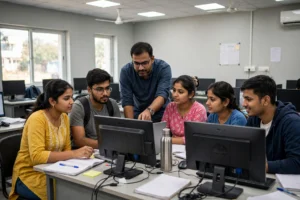
In villages and small towns across India, there are lakhs of young people who are willing to work hard but have no marketable skill. Every job advertisement asks for “experience” and “certificates”. Private training centres charge fees of Rs 20,000 to Rs 30,000 or more for a single course — far beyond what a poor family can afford. So the question arises: does the government offer any free skill training for youth from disadvantaged backgrounds?
The answer is yes. The central government runs a scheme that provides completely free skill training — and even pays a monthly stipend during the training. In this guide, we explain everything about this scheme: who can apply, the four types of courses, how much stipend you get, which documents you need, and the step-by-step online application process. We also share the latest government figures released on 22 October 2026, which reveal how many youth have been trained so far and how many got jobs.
PM DAKSH Yojana 2026: At a Glance
| Information | Details |
|---|---|
| Full name | Pradhan Mantri Dakshata Aur Kushalta Sampann Hitgrahi (PM DAKSH Yojana) |
| Launched | 2020-21 |
| Ministry | Ministry of Social Justice and Empowerment, Government of India |
| Scheme type | Central Sector Scheme (100% centrally funded) |
| Target groups | SC, OBC, EWS, DNT, Safai Karamcharis (including waste pickers) |
| Age limit | 18 to 45 years |
| Training fee | Completely free |
| Stipend | Rs 1,000 to Rs 1,500 per month (non-residential courses) |
| How to apply | Online — pmdaksh.dosje.gov.in |
| Official portal | pmdaksh.dosje.gov.in |
Fresh Report of 22 October 2026: 1.87 Lakh Youth Trained
On 22 October 2026, the Ministry of Social Justice and Empowerment released a factual report on the PM-DAKSH scheme. According to it, a total of 1,87,305 candidates received skill training between 2020-21 and 2023-24, of whom 96,162 received placement offers for jobs. That means more than half of those trained got work — a placement rate of about 51.3%.
The report also cites an evaluation study in which over 90% of beneficiaries said the training aligned with their career goals and local labour-market needs, and achieved its intended learning outcomes. Notably, the study recorded non-material gains too — improved confidence, self-esteem and social recognition, especially among women and marginalised groups.
Another major disclosure in the report: from 2024-25, PM-DAKSH has been subsumed under the Pradhan Mantri Kaushal Vikas Yojana (PMKVY). The reason given is that both schemes drew their job roles from the same Skill India Digital Hub portal, so the merger avoids duplication. This does not mean the scheme has closed — training for eligible youth continues under the PMKVY framework.
What Is the PM DAKSH Yojana
PM DAKSH stands for Pradhan Mantri Dakshata Aur Kushalta Sampann Hitgrahi Yojana. It was launched by the Ministry of Social Justice and Empowerment in 2020-21 as a Central Sector Scheme, which means the entire cost is borne by the central government.
The scheme’s objective is to raise the skill levels of socially and economically marginalised groups — Scheduled Castes (SC), Other Backward Classes (OBC), Economically Weaker Sections (EWS), De-notified, Nomadic and Semi-Nomadic Tribes (DNT), and Safai Karamcharis including waste pickers — so they can find wage employment or start their own ventures.
On 7 August 2021, the then Minister for Social Justice and Empowerment, Dr Virendra Kumar, launched the PM-DAKSH portal and mobile app (developed with NeGD). Since then, eligible youth can register online and join training at empanelled institutes near their district.
Who Can Apply: Eligibility Criteria
The applicant must be between 18 and 45 years of age. For the transgender community, the minimum age at the time of assessment or certification is 18 years. In addition, the applicant must belong to one of the following categories:
| Category | Income ceiling | Required certificate |
|---|---|---|
| Scheduled Castes (SC) | No income limit | Caste certificate from state competent authority |
| Other Backward Classes (OBC) | Family income below Rs 3 lakh/year | OBC certificate + income certificate |
| Economically Weaker Section (EWS) | Family income below Rs 3 lakh/year | EWS certificate + income certificate |
| Economically Backward Classes (EBC) | Family income below Rs 1 lakh/year | Income certificate (no caste certificate needed) |
| De-notified, Nomadic and Semi-Nomadic Tribes (DNT) | No income limit | Self-declaration + endorsement by community head |
| Safai Karamcharis (incl. waste pickers) and dependants | No income limit | Occupation certificate |
| Transgender community | — | Certificate and ID card via the National Portal for Transgender Persons |
Important: the income certificate must be issued by the competent authority of the state government, or be self-certified and duly endorsed by a Gazetted officer. Endorsement by public representatives, Gram Pradhan, Sarpanch, councillors or notaries is explicitly not acceptable. However, a valid BPL card or Antyodaya Anna Yojana (AAY) card is accepted as proof of income within Rs 1 lakh per annum.
One crucial rule: a person can undergo skill training under this scheme only once. So choose your course carefully — you will not get a second chance under PM-DAKSH.
The 4 Types of Training Programmes
PM-DAKSH offers four kinds of skill development programmes. Pick the one that fits your needs and available time:
1. Up-skilling / Re-skilling
For people already working — rural artisans, domestic workers, sanitation workers and others. It sharpens their existing vocation (pottery, weaving, carpentry, waste segregation, domestic work) along with financial and digital literacy. Duration: 32 to 80 hours, spread over up to one month. Trainees get Rs 2,500 (from PM-DAKSH) plus Rs 500 (under Common Cost Norms) as compensation for wage loss; Safai Mitras and waste pickers get Rs 500 per person under RPL.
2. Short Term Training (focus on wage / self-employment)
Job-oriented courses aligned to the National Skill Qualification Framework (NSQF) — tailoring, furniture making, food processing and similar trades, plus financial and digital literacy. Duration: normally 200 to 600 hours, up to 6 months. Stipend is paid for non-residential training with 80% or higher attendance.
3. Long Term Training (focus on wage / self-employment)
Longer courses in sectors with strong job-market demand — production technology, plastic processing, apparel technology, healthcare and more, as per NSQF, NCVT, AICTE or MSME norms. Duration: 5 months to 1 year (up to 1,000 hours). Stipend applies for non-residential programmes.
4. Entrepreneurship Development Programme (EDP)
For SC and OBC youth with an entrepreneurial bent of mind — preferably those who have already undergone skill training under PMKVY. Conducted by RSETIs, NIESBUD, IIE and similar organisations, it covers business opportunity guidance, market surveys, working capital management and business plan preparation. Duration: 80–90 hours (10–15 days).
How Much Stipend Will You Get
Training is entirely free — the government gives the full training cost as a grant to the approved institutes. On top of that, eligible trainees receive a stipend:
| Trainee category | Stipend (non-residential, 80%+ attendance) |
|---|---|
| SC trainees | Rs 1,500 per month |
| Safai Karamcharis and waste pickers | Rs 1,500 per month |
| OBC / EBC / DNT trainees | Rs 1,000 per month |
| Wage-loss compensation (up-skilling) | Rs 2,500 + Rs 500 (Rs 3,000 total) |
The stipend is sent directly to the trainee’s bank account, so enter your bank details correctly at the time of registration.
Documents Required
Keep these ready before you apply:
- Aadhaar card
- Caste certificate (for SC/OBC)
- Income certificate (for OBC/EWS/EBC, where applicable)
- Occupation certificate (for Safai Karamcharis)
- Self-declaration (for DNT candidates)
- Residence proof
- Passport-size photograph
- Mobile number (for OTP verification)
- Bank account details
Online Application: Step-by-Step Process
Candidate Registration:
- Open the official portal pmdaksh.dosje.gov.in.
- On the homepage, click “Candidate Registration” (direct link: pmdaksh.dosje.gov.in/student).
- Fill the registration form — name, father’s/husband’s name, date of birth, gender, state, district, address, education, category, mobile number and so on.
- Upload a recent photograph.
- Click “Send OTP” and verify your mobile number with the OTP received.
- Click “Next Step” and enter your training details (which course, which institute).
- Click “Next” and enter your bank account details.
- Submit the form — your registration is complete.
How to log in:
Click “Login” on the portal homepage, or go directly to pmdaksh.dosje.gov.in/student/login. Students log in with their user ID and password.
Institute Registration:
Training institutes also register on the same portal — through the “Institute Registration” option, giving the institute name, state/UT, district, address, legal entity, mobile number, email address and the associated assessment body.
Alternative route: you can also register on the Skill India Digital Hub (skillindiadigital.gov.in), since the scheme’s job roles are drawn from that portal.
What Happens After Training: Certificate and Placement
After training comes assessment. Successful trainees receive certification. The training institutions then help with placement — assistance for wage employment, and guidance for setting up their own ventures for those who choose self-employment.
There is a strict rule worth knowing: institutes must place at least 70% of their trained candidates. If an institute fails to meet this target, the third instalment of the training cost — 30% of the total — is forfeited. In other words, the institute is under pressure to get you a job, and that rule works in your favour.
The PMKVY Merger: What Changes for You
As the 22 October 2026 report confirmed, PM-DAKSH has been subsumed under the Pradhan Mantri Kaushal Vikas Yojana (PMKVY) from 2024-25. There is no need to worry — this does not mean the scheme has ended.
The merger happened because PM-DAKSH drew its training job roles from the Skill India Digital Hub portal, which PMKVY also uses — keeping two parallel schemes for the same roles was duplication. Free training and stipends for the eligible categories (SC, OBC, EWS, DNT, Safai Karamcharis) continue, and applications still go through the pmdaksh.dosje.gov.in portal.
5 Common Mistakes to Avoid
- Choosing the wrong category: Income ceilings apply to OBC/EWS/EBC, but not to SC, DNT or Safai Karamcharis. Pick your correct category and certificate.
- Faulty income certificate: Endorsement by a Sarpanch or notary is not valid — you need a Gazetted officer’s endorsement or a certificate from the competent authority.
- Bank account errors: The stipend goes straight to your account. A wrong account number or IFSC code will stall your money.
- Expecting a second course: The scheme allows only one training per person — choose your first course with your interests and local job prospects in mind.
- Fake websites: Apply only on the official portal pmdaksh.dosje.gov.in. If anyone demands money promising “confirmed admission”, it is a scam.
Frequently Asked Questions (FAQ)
Is training under the PM DAKSH Yojana really free?
Yes, completely free. The government pays the full training cost to approved institutes as a grant. Trainees pay no fee; instead, eligible trainees receive a monthly stipend.
What is the age limit for the PM DAKSH Yojana?
18 to 45 years. For transgender applicants, the minimum age at the time of assessment or certification is 18 years.
How much stipend is paid under PM DAKSH?
In short-term and long-term non-residential courses with 80% or higher attendance, SC trainees and Safai Karamcharis get Rs 1,500 per month, while OBC/EBC/DNT trainees get Rs 1,000 per month. Up-skilling trainees can get up to Rs 3,000 as wage-loss compensation.
Can I take more than one training course?
No. The scheme’s rules allow only one skill training programme per person. Choose your course keeping your interests and local employment prospects in mind.
Where do I register for the PM DAKSH Yojana?
On the official portal pmdaksh.dosje.gov.in, through “Candidate Registration”. You can alternatively register on the Skill India Digital Hub (skillindiadigital.gov.in).
Is the PM DAKSH scheme still running?
Yes. From 2024-25 it has been subsumed under PMKVY, but free training for the eligible categories continues. According to the government report of 22 October 2026, 1,87,305 youth have been trained so far.
Is there a job guarantee after training?
There is no official “guarantee”, but institutes must achieve 70% placement — failing which 30% of their training cost is forfeited. So far, 96,162 trainees have received placement offers, as per the October 2026 report.
How can Safai Karamcharis or waste pickers apply?
There is no income limit for them. They (and their dependants) can apply with an occupation certificate.
Important Official Links
| Link | Address |
|---|---|
| PM DAKSH official portal | pmdaksh.dosje.gov.in |
| Candidate registration | pmdaksh.dosje.gov.in/student |
| Candidate login | pmdaksh.dosje.gov.in/student/login |
| Check eligibility | pmdaksh.dosje.gov.in/eligibility |
| Frequently asked questions | pmdaksh.dosje.gov.in/faq |
| Skill India Digital Hub | skillindiadigital.gov.in |
| Ministry of Social Justice and Empowerment | socialjustice.gov.in |
Also Read
- PM Vishwakarma Yojana 2026: Complete Online Application Guide — toolkit assistance and loans for traditional artisans
- E-Shram Card Registration: How to Apply — the essential card for unorganised workers
Disclaimer: GramSuvidha is a private information portal, not a government website. For the latest official information, always check the official portal pmdaksh.dosje.gov.in or the Ministry of Social Justice and Empowerment website.
Last Updated: 22 October 2026