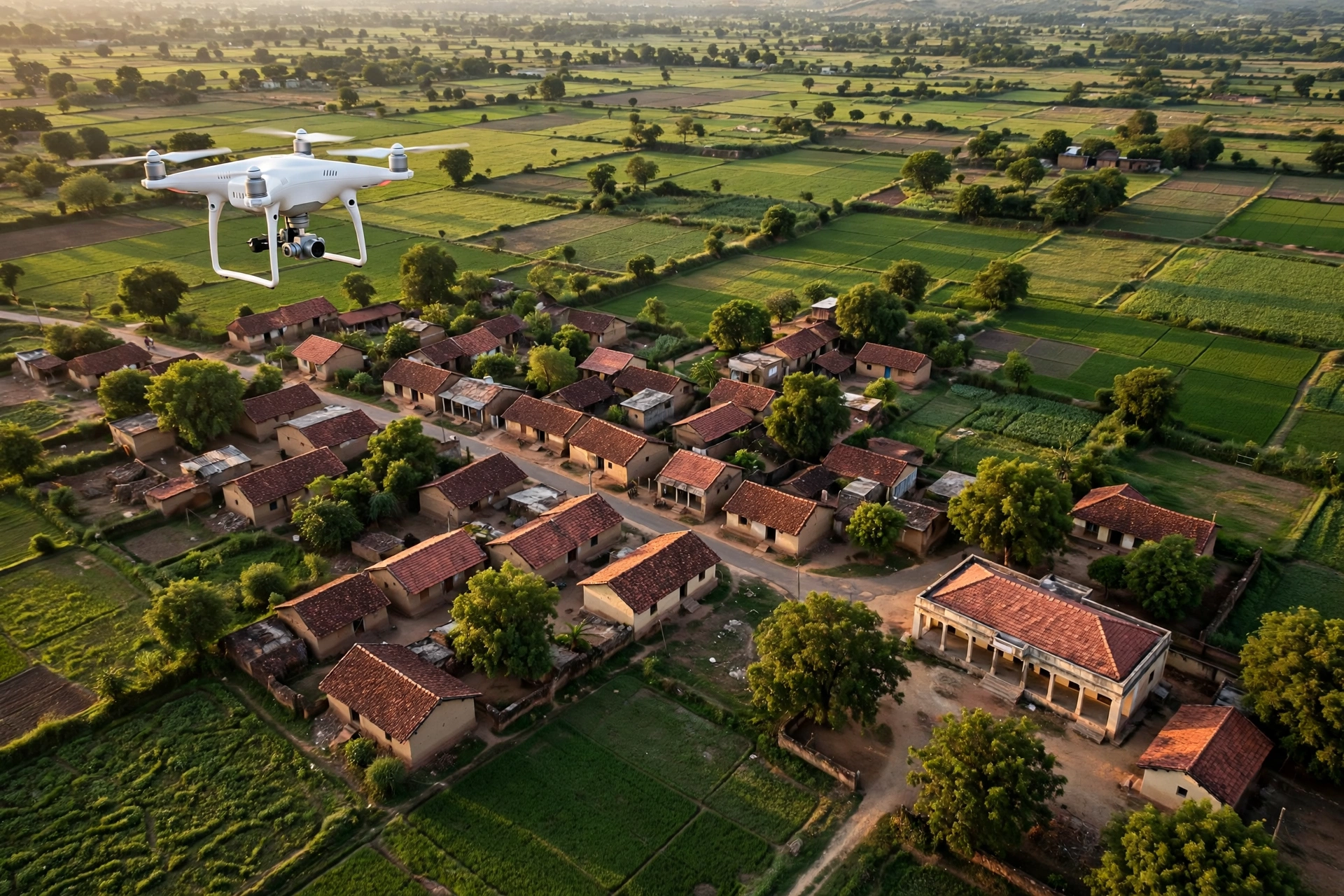
Every village home has an owner, but how many village homes have a proper legal paper proving it? That is the question the SVAMITVA Scheme answers. If a drone survey has taken place in your village, or your family’s property card is about to be issued, this guide is for you. We explain what the SVAMITVA Scheme is, how a property card is made, how to check your card and your village’s survey status, how to use the card for a bank loan, and what to do if your name or map has an error. We also share the latest official figures from 2026, so you get verified facts instead of rumours and agent talk.
What Is the SVAMITVA Scheme? At a Glance
| Detail | Information |
|---|---|
| Full name | SVAMITVA — Survey of Villages Abadi and Mapping wit
The aim of the SVAMITVA Scheme is simple — to fix clear legal ownership of houses standing on village Abadi land. In cities, a house has registry papers. In villages, many houses had no written ownership record at all. For generations, who owned which house rested only on what the village knew and remembered. That is why boundary fights, brother-versus-brother disputes and long court cases were so common. The SVAMITVA Scheme removes this gap. A drone makes an accurate map of the village’s inhabited area, officials verify it on the ground, and then every house owner gets a legal document — the property card. This card is the Record of Rights for that house. One point must be understood clearly — this scheme covers only Abadi land, the inhabited area where houses stand. Agricultural farmland is NOT included. Farm records already exist with the state revenue department and continue under that system. So if someone tells you SVAMITVA will make a card for your farm field, that information is wrong. Benefits of the SVAMITVA Scheme — What Changes After You Get the CardA property card is not just a piece of paper. Once a family receives it, several real benefits follow. The first benefit is legal identity — your house is now recorded in government records in your name. The second is fewer disputes — when every house boundary is marked clearly on a map, fights over boundaries reduce. The third and biggest benefit is credit access — the property card can be shown to a bank as collateral for a home loan, a business loan, or other formal credit. Earlier, banks would not Latest 2026 Figures — How Far Has the Scheme ReachedAccording to the government’s written reply in the Lok Sabha on 3 February 2026, as of 29 January 2026, over 3.06 crore property cards had been prepared across 1.86 lakh villages in the country. Uttar Pradesh leads the list, with more than 1.14 crore cards prepared in 72,938 villages. Madhya Pradesh follows with 65.65 lakh cards in 39,474 villages, Maharashtra with 37.58 lakh cards in 22,609 villages, Haryana with 25.15 lakh cards, and Gujarat with 16.58 lakh cards. In Rajasthan, by March 2026, 14,80,978 cards had been prepared and 14,43,423 cards distributed. As per the Rajya Sabha information of August 2026, mapping of about 3.30 lakh villages had been completed. That means the scheme has covered a large part of its target, but some villages are still pending. In a few states the scheme has not been implemented at all or is still at a very early stage — in Tamil Nadu, for example, drone survey was done in only 3 pilot villages, and the state did not take the scheme further because prior Natham records of inhabited areas already existed there. In Arunachal Pradesh, Assam, Jharkhand, Kerala, Manipur, Sikkim and Telangana, no cards had been prepared as of January 2026. In Delhi, drone survey was completed in 31 villages, but no property card had been prepared by then. These figures carry one clear lesson — your village’s position depends on your state. Do not apply another state’s news to your own village. Always check your status on the official dashboard or with your panchayat. How the Property Card Is Made — The Full Process, Step by StepUnder the SVAMITVA Scheme, no individual person applies on their own. It is a village-by-village government process. The stages are as follows: Step 1 — Village selection and notice: The state government selects the village and issues a notice for the survey. In many places, a Gram Sabha or awareness programme tells residents when the survey will happen and what they need to do. Step 2 — Chunna (lime) marking of boundaries: Revenue officials and the panchayat together mark the boundary of every property in the Abadi area with lime powder. These marks form the base for the drone survey. Step 3 — Drone survey: The Survey of India conducts the survey of the marked Abadi area using survey-grade drones and CORS (Continuously Operating Reference Stations) technology. This produces maps accurate to centimetre level. lend aga Step 4 — Map preparation and ground verification: Digital maps are prepared from the drone data. Officials then verify the maps and boundaries on the ground and make corrections wherever needed. Step 5 — Claims and objections: The verified map is placed before the Gram Sabha. If anyone has an objection about their property’s map, name or boundary, they can file it here. This is the moment when errors get corrected — getting a correction later is much harder. Step 6 — Property card issue: After objections are settled, the final property card is prepared and handed to the owner. Many states give a hard copy, and a digital copy may also be available on the state revenue portal or DigiLocker. The most important point in this whole process is that the house owner, or a family member, should be present on the survey day and cooperate in the boundary check. If you will not be in the village that day, inform the panchayat in advance. How to Check Your SVAMITVA Property Card StatusUse these methods to check your property card or your village’s survey status: Method 1 — Official portal: Visit svamitva.nic.in. In the reports or dashboard section, select your state, district, tehsil and village. You will see details of property cards prepared and distributed in your village. Method 2 — DigiLocker: In many states, the final property card is also available on DigiLocker. After Aadhaar verification in DigiLocker, search for your card. If the card does not appear there, it does not necessarily mean the card was never made — your state may have a different arrangement for digital copies. Method 3 — Panchayat and revenue office: The most reliable method is to ask your Gram Panchayat, Patwari, Lekhpal or Talathi. They hold the latest list for your village. If your village has not been surveyed yet, they can tell you when it is likely to be scheduled. Method 4 — Your state’s own portal: Several states have built their own SVAMITVA portals — for example, Uttar Pradesh has svamitva.up.gov.in. Village-wise information may also be available on your state portal. Remember — there is no single “status check form” for SVAMITVA where you type your name and the card appears. Information is given as village-wise reports, and the a If Your Village Has Not Been Surveyed YetIf your village has not been surveyed yet, there is no need to worry. The survey schedule is fixed by the state government, and no individual can apply to get their village surveyed ahead of schedule. The correct step is to ask the Gram Panchayat or revenue office when your village’s turn will come. The question can also be raised in the Gram Sabha. Meanwhile, keep your house papers ready in advance — Aadhaar card, any old ownership record (if available), electricity or water bills, or any document that proves your possession of the house. These papers can be useful on the survey day. If There Is an Error in Name, Boundary or MapErrors can happen in a drone survey — for example, two property IDs for one house, a wrongly recorded boundary, or a name linked to someone else’s property. The government has kept a correction system for this. First and best, file your objection when the map is placed before the Gram Sabha — that is the easiest and fastest route. If the error is noticed after the card is made, submit a written application to the panchayat and revenue office, along with proof of the correct boundary or name. The record is corrected after fresh ground verification. If there is a boundary dispute with a neighbour, inform the officials during the survey itself. Usually the village-level committee and local officials together resolve such disputes, so that the matter is settled before the map is finalised. Court becomes necessary mostly when this chance is missed. How to Take a Loan on Your Property CardAfter receiving the property card, you can show it to a bank as proof of your property. The usual process is: first visit the bank branch and tell them you hold a SVAMITVA property card and need a loan. The bank will verify the card, assess the property’s value, and check your repayment capacity. The loan is then sanctioned as per the rules. Keep in mind — holding a card is not a guarantee of a loan; the bank will always look at your income and credit history too. Different banks have different rules, so it is wise to enquire at more than one bank. Stay Safe From Fraud — Points to RememberAs discussion of the SVAMITVA Scheme grows, agents and fraudsters are also becoming active. Keep these points in mind: there is no individual application in this scheme, so if anyone says “I will get your card made” and asks for money, do not pay them. There is no fee for getting a card made. Do not trust fake SMS, WhatsApp messages or calls in the name of the property card — always verify information on svamitva.nic.in or with your panchayat. If any website asks for money or an OTP in the name of “online registration”, it is fake. ct Frequently Asked Questions (FAQ)1. What is the SVAMITVA Scheme? 2. Can I apply online for SVAMITVA? 3. What is the official website to check the property card? 4. Can I get a bank loan on a SVAMITVA card? 5. Does SVAMITVA cover agricultural farmland? 6. When will my village be surveyed? 7. What if my property card has a wrong name or boundary? 8. Is a digital copy of the property card available? 9. Is the SVAMITVA Scheme still running? 10. What is the difference between SVAMITVA and Bhulekh/Khatauni? Disclaimer: This article is published by a private information portal (not a government website) for general information only. Scheme rules and figures can change over time. Before taking any step, please confirm the latest information from svamitva.nic.in or your Gram Panchayat / revenue office. Read more: PM Awas Yojana List 2026 | PM Garib Kalyan Anna Yojana ual card copy comes from the panchayat or revenue office. inst a house that had no papers. The fourth benefit goes to the panchayat itself. The drone maps and data feed into Gram Manchitra, a GIS planning application, which helps the Gram Panchayat plan village development — roads, drains, water supply, public spaces — with far better information. The fifth benefit is correct valuation of property — when ownership is clear, sale or partition of a house becomes much easier. Official figures confirm that the loan benefit is real. In a written reply in the Rajya Sabha on 5 August 2026, the government stated that 11,147 loans worth Rs 1,713 crore had been disbursed on the basis of SVAMITVA property cards. The card has therefore become a document banks actually trust. h Improvised Technology in Village Areas |
| Run by | Central Sector Scheme of the Government of India, Ministry of Panchayati Raj |
| Launched | Pilot phase 2020–21 (9 states); nationwide launch 24 April 2021, on National Panchayati Raj Day |
| What it does | Drone survey of village Abadi (residential) land, map-making, property card issue |
| Target | About 3,44,868 villages |
| Property cards (by Jan 2026) | Over 3.06 crore prepared, across 1.86 lakh villages |
| Application fee | No individual application, no fee |
| Official portal | svamitva.nic.in |