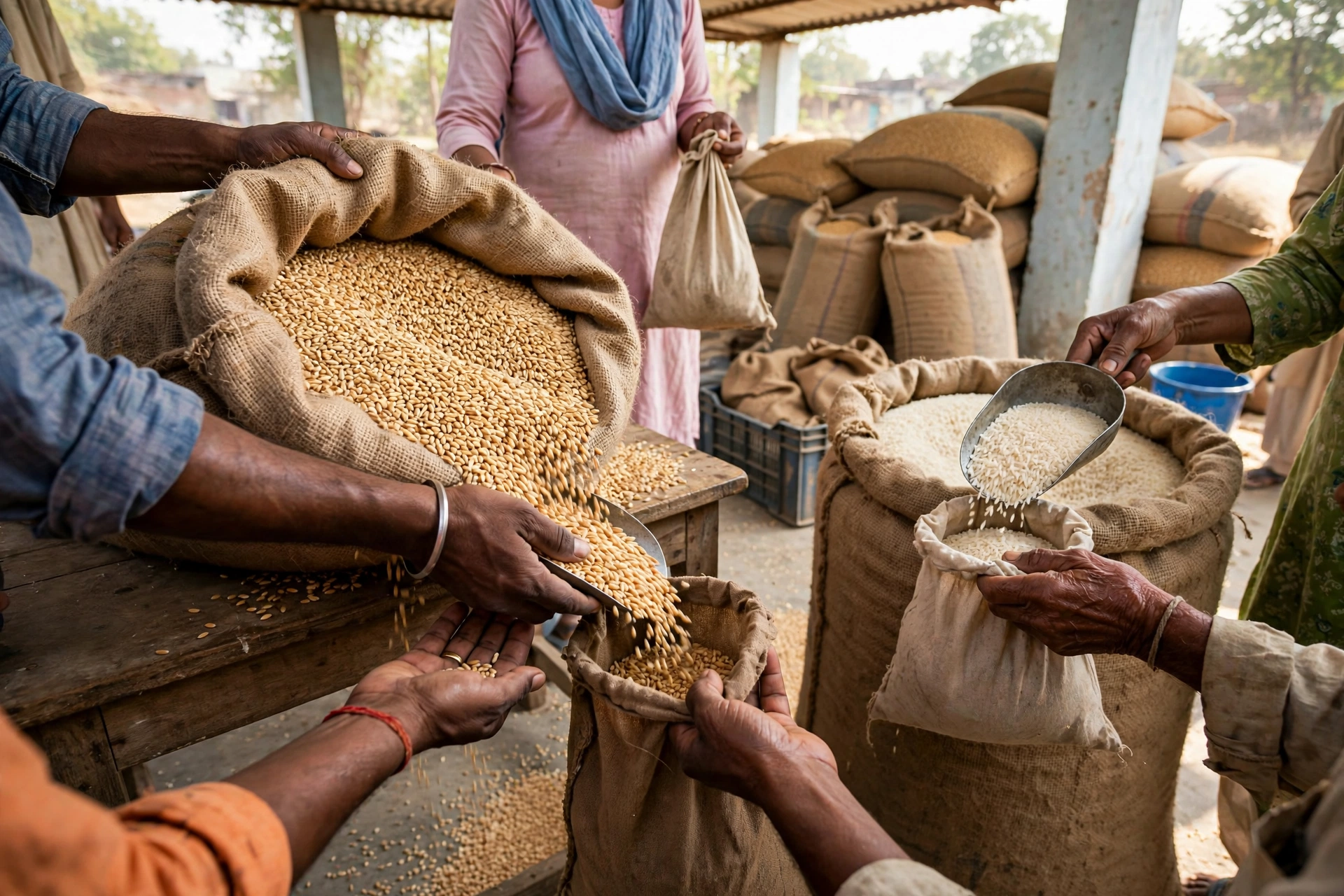
If you hold a ration card, this is for you. The government is giving free food grains every month to crores of poor families across India — and this will continue till 2028. In this article, we explain what PM Garib Kalyan Anna Yojana is, how much grain you get, who is eligible, and how to collect your ration.
What is PM Garib Kalyan Anna Yojana?
Pradhan Mantri Garib Kalyan Anna Yojana (PMGKAY) is a food security scheme of the central government, run by the Department of Food and Public Distribution under the Ministry of Consumer Affairs, Food and Public Distribution. Its goal is simple — deliver free food grains every month to poor and needy families across the country.
The scheme began in 2020 during the COVID-19 pandemic. The lockdown had pushed crores of poor families into a food crisis, and the government decided to distribute free grains as emergency relief. What started as a temporary relief measure was later made a permanent part of the country’s food security system.
Between 2020 and December 2022 — about 28 months — the first seven phases (Phase I to Phase VII) of PMGKAY distributed roughly 1118 lakh metric tonnes of food grains, at a planned cost of about Rs. 3.91 lakh crore. That makes it one of the largest food distribution programmes in the world.
Then, from 1 January 2023, the government took a historic step: food grains given under the National Food Security Act (NFSA) were made completely free. Beneficiaries no longer had to pay even the earlier subsidised rates of Rs. 3 per kg for rice, Rs. 2 per kg for wheat, and Re. 1 per kg for coarse grains.
Keeping in view the welfare of beneficiaries and to strengthen the provisions of the NFSA, 2013, the central government then decided to continue free food grains to about 81.35 crore NFSA beneficiaries for five more years, from 1 January 2024 — that is, till 31 December 2028. The estimated cost is about Rs. 11.80 lakh crore, borne entirely by the central government.
Scheme Benefits — How Much Grain Do You Get?
The quantity of free grain depends on which category your family falls under. Under the NFSA there are two types of beneficiaries — Antyodaya Anna Yojana (AAY) households and Priority Households (PHH).
Antyodaya Anna Yojana (AAY) Households
The AAY category covers the poorest of the poor. These households receive 35 kg of food grains per household per month, free of cost. The quantity does not depend on family size — whether there are 2 members or 6, the household gets 35 kg.
Priority Households (PHH)
PHH beneficiaries receive 5 kg of food grains per person per month, free of cost. So if your family has 4 members named on the ration card, your household gets 20 kg of grain free every month. A 5-member family gets 25 kg, and a 6-member family gets 30 kg.
The grain may be rice, wheat, or coarse grains (such as jowar or bajra), depending on what is distributed in your state. The important point: you do not pay anything for it now. What was earlier given at subsidised prices is now completely free.
Fortified Rice
The government also distributes fortified rice through the public distribution system. Fortified rice is enriched with iron, folic acid, and vitamin B12 to fight anaemia and malnutrition among poor families. The Prime Minister announced this on 15 August 2021, and it is now being supplied in a phased manner across all States and Union Territories.
Who Is Eligible?
PMGKAY covers everyone included under the National Food Security Act (NFSA), 2013. The NFSA covers up to 75% of the rural population and up to 50% of the urban population — about 81.35 crore people as per the 2011 Census. As of October 2025, around 78.90 crore beneficiaries were receiving free food grains under the Act.
Who Comes Under AAY?
State governments identify AAY families as per criteria set by the central government. These include:
- Households headed by widows, terminally ill persons, disabled persons, or persons aged 60 years or more with no assured means of subsistence or social support.
- Widows, terminally ill or disabled persons, persons aged 60 or more, single women or single men with no family, social support, or assured means of subsistence.
- All primitive tribal households.
- Landless agricultural labourers, marginal farmers, rural artisans and craftsmen such as potters, tanners, weavers, blacksmiths, carpenters, slum dwellers, and persons earning a daily living in the informal sector — porters, coolies, rickshaw pullers, hand-cart pullers, fruit and flower sellers, snake charmers, rag pickers, cobblers, and the destitute in rural and urban areas.
- All eligible Below Poverty Line families of HIV-positive persons.
Who Comes Under PHH?
Priority Households are identified by state governments as per their own criteria. The responsibility for identifying beneficiaries and issuing ration cards rests with the concerned state government. Removing ineligible beneficiaries and adding eligible ones is a continuous process — the beneficiary database is updated from time to time.
One important point: there is no BPL or APL category under the NFSA. Only AAY and PHH exist.
How to Get Your Free Ration
If you hold a ration card under the NFSA, you do not need to apply separately for this scheme. Your monthly grain is available at your nearest Fair Price Shop (ration shop).
The distribution system has become far more transparent than before:
- Digitised ration cards: Ration card and beneficiary data is 100% digitised in all States and UTs. Details of nearly 20.06 crore ration cards are available on state transparency portals.
- Aadhaar seeding: More than 99.8% of ration cards are seeded with Aadhaar, which has helped remove fake and duplicate beneficiaries.
- ePoS machines: Of the 5.44 lakh Fair Price Shops in the country, 99.8% (5.41 lakh) are automated with electronic Point of Sale (ePoS) devices. Over 97% of transactions are recorded through biometric or Aadhaar authentication — you place your thumb and collect your grain.
If your name is on the beneficiary list but you are not receiving ration, contact your state’s Food and Civil Supplies Department. The central government regularly advises all States and UTs to identify all eligible poor persons, including vulnerable sections, for inclusion under the NFSA.
What Changed — Before vs. Now
Many people ask how PMGKAY differs from the earlier ration system. Here is the clear picture:
2020 to 2022: During this period, PMGKAY gave an additional 5 kg of free grain per person per month over and above the regular NFSA allocation. It was extra help on top of the normal ration.
From 1 January 2023: The government made the NFSA entitlement itself free. Grain that was earlier sold at Rs. 3 per kg for rice, Rs. 2 per kg for wheat, and Re. 1 per kg for coarse grains began to be given at zero cost. Two food subsidy schemes — Food Subsidy to FCI and Food Subsidy to Decentralised Procurement (DCP) States — were subsumed under PMGKAY.
From 1 January 2024: This free distribution was extended for five more years, till 31 December 2028. The quantity remains as fixed under the NFSA — 35 kg per month per AAY household and 5 kg per person per month for PHH beneficiaries.
In short: earlier you paid a small price for ration; now the same ration is completely free, and this arrangement continues till the end of 2028.
One Nation One Ration Card — Collect Ration Anywhere
A major strength of PMGKAY is its link with the One Nation One Ration Card (ONORC) plan. ONORC started in August 2019 with inter-state portability in just 4 states. Today it is enabled in all 36 States and UTs, covering around 80 crore NFSA beneficiaries — almost 100% of the NFSA population.
This means that even if you live far from your village or town for work, you can collect your ration from any Fair Price Shop in the country. Migrant workers and mobile labourers have benefited the most from this portability.
The numbers show the scale: since ONORC began, more than 125 crore portability transactions have been recorded, delivering over 241 lakh metric tonnes of food grains. In the 11 months of 2023 alone, about 28 crore portability transactions took place.
How Much Does the Scheme Cost?
The scheme is fully funded by the central government — states bear no financial burden. The entire cost of procuring, storing, transporting, and delivering grain up to the Fair Price Shop is borne by the Centre.
The five years of free distribution from 1 January 2024 is estimated to cost about Rs. 11.80 lakh crore. Earlier, the one year of free distribution in 2023 was estimated at more than Rs. 2 lakh crore in food subsidy.
Official Links
For correct and updated information on this scheme, trust only these government sources:
- Department of Food and Public Distribution: dfpd.gov.in
- National Food Security Act portal: nfsa.gov.in
- Press Information Bureau (government announcements): pib.gov.in
Frequently Asked Questions
1. Is PMGKAY still running in 2026?
Yes. The central government has extended free food grain distribution for five years from 1 January 2024, so the scheme continues till 31 December 2028.
2. How much grain will I get every month?
AAY households get 35 kg per household per month; PHH beneficiaries get 5 kg per person per month — all completely free.
3. Who is eligible for this scheme?
All AAY and PHH ration card holders covered under the National Food Security Act (NFSA) are beneficiaries. States identify the beneficiaries.
4. Do I need to apply separately?
No. The scheme covers all NFSA beneficiaries. If you hold an AAY or PHH ration card, your monthly free grain continues at your Fair Price Shop.
5. Can I collect ration in another state?
Yes. Under One Nation One Ration Card (ONORC), you can collect your ration from any Fair Price Shop in the country. The facility works in all 36 States and Union Territories.
private information portal, not a government website