
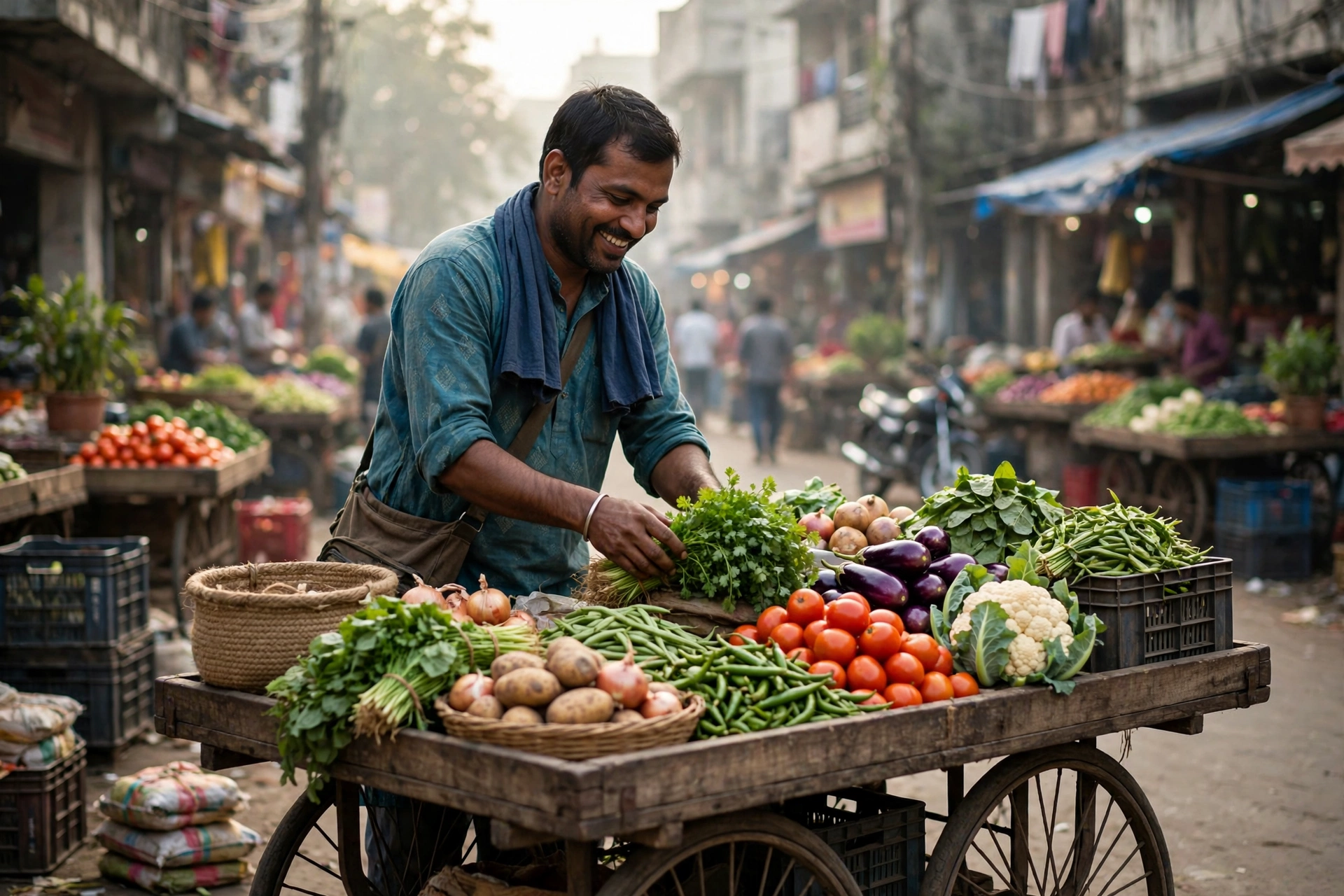
Vegetable sellers, fruit vendors, tea stall owners, cobblers, barbers, tailors — street vendors are the backbone of every Indian city’s economy. But they often lack the capital to grow their work, and getting a bank loan is difficult for them. To solve this problem, the central government launched the PM Swanidhi Yojana. Its official name is PM SVANidhi (Prime Minister Street Vendor’s AtmaNirbhar Nidhi).
This is a Central Sector Scheme of the Ministry of Housing and Urban Affairs, launched in June 2020. Its purpose is to give street vendors affordable working capital loans without any collateral, so they can restart their livelihoods and slowly grow their businesses.
In August 2025, the Union Cabinet restructured the scheme and extended it till 31 March 2030, increased the loan amounts, and added new benefits. In this article, based only on official government information, we explain what the scheme offers, who can apply, which documents are needed, and how to apply.
PM Swanidhi Yojana at a Glance
| Detail | Information |
|---|---|
| Scheme name | PM SVANidhi – Prime Minister Street Vendor’s AtmaNirbhar Nidhi |
| Ministry | Ministry of Housing and Urban Affairs, Government of India |
| Launched | June 2020 |
| Scheme type | Central Sector Scheme |
| First tranche loan | Up to ₹15,000 |
| Second tranche loan | Up to ₹25,000 |
| Third tranche loan | Up to ₹50,000 |
| Interest subsidy | 7% per annum on timely repayment |
| Digital cashback | Up to ₹1,600 per year |
| Lending period | Extended till 31 March 2030 |
| Total outlay | ₹7,332 crore |
| Target beneficiaries | 1.15 crore street vendors (including 50 lakh new beneficiaries) |
| Official website | pmsvanidhi.mohua.gov.in |
2025 Restructuring: What Changed?
On 27 August 2025, the Union Cabinet chaired by the Prime Minister approved the restructuring and extension of the lending period of the PM SVANidhi Scheme. Earlier the scheme was valid till 31 December 2024; now loans will be given till 31 March 2030. The total outlay for the restructured scheme is ₹7,332 crore, and it aims to reach 1.15 crore street vendors, including 50 lakh new beneficiaries.
The biggest change is in the loan amounts. Earlier the first tranche was up to ₹10,000; now the first tranche is up to ₹15,000. The second tranche has been raised from ₹20,000 to ₹25,000, while the third tranche stays at ₹50,000. So vendors who repay on time can now borrow larger amounts than before.
In addition, vendors who have repaid the second tranche loan on time will now get a UPI-linked RuPay Credit Card, so they can get instant credit for urgent business or personal needs. The cashback facility on digital transactions has also been expanded — vendors can now earn cashback on both retail and wholesale digital transactions.
The scheme’s coverage has also been widened. It will no longer be limited to statutory towns; vendors in census towns and peri-urban areas will also be covered in a graded manner. Implementation is the joint responsibility of the Ministry of Housing and Urban Affairs and the Department of Financial Services — the Department of Financial Services handles access to loans and credit cards through banks and financial institutions.
The Three Loan Tranches: How Much, and When?
Under PM Swanidhi Yojana, loans are given in three stages (tranches). To get each next tranche, you must repay the previous tranche on time. This system is designed to build a habit of regular repayment and to create a credit history for vendors.
First tranche: up to ₹15,000
Eligible vendors applying for the first time get a working capital loan of up to ₹15,000. Under the original scheme this amount was ₹10,000 with a one-year tenure; the restructured scheme has raised the first-tranche limit to ₹15,000. The loan is completely collateral-free — you do not need to pledge your shop, land, or any goods.
Second tranche: up to ₹25,000
If you repay the first tranche on time, you become eligible for a second tranche loan of up to ₹25,000 (earlier ₹20,000). On timely repayment you also receive the 7% per annum interest subsidy, credited directly to your bank account.
Third tranche: up to ₹50,000
After repaying the second tranche on time, you can take a third tranche loan of up to ₹50,000. This is the largest amount, meant to help you expand your business on a permanent basis.
One important point: there is no penalty for repaying the loan before the scheduled date. In fact, early repayment still gets you the full interest subsidy benefit.
7% Interest Subsidy: How Does It Work?
One of the biggest attractions of this scheme is the 7% per annum interest subsidy. This means that if you repay your loan on time or early, the government bears a large part of the interest on your loan.
The subsidy is credited every quarter directly into your bank account through Direct Benefit Transfer (DBT). If you repay the loan early, the full admissible subsidy amount is credited in one go.
The official FAQ gives an example: under the original scheme, on a ₹10,000 loan, if you paid all 12 EMIs on time, you would receive approximately ₹400 as interest subsidy. Under the restructured scheme, with higher loan amounts, the benefit scales in the same proportion, since the subsidy rate is fixed at 7% per annum.
Note: the subsidy is available only when you repay on time or early. Missing regular payments can cost you this benefit — and you will also not qualify for the next tranche.
Cashback on Digital Transactions: Up to ₹1,600 a Year
The government wants street vendors to adopt digital payments. That is why the scheme offers cashback on digital transactions. Under the restructured scheme, vendors can earn cashback in two ways:
- On regular retail sales: cashback of up to ₹1,200 on digital sales, with a maximum of ₹100 per month.
- On wholesale purchases: cashback of up to ₹400 on wholesale purchases of ₹2,000 or more — ₹20 per transaction, with a maximum of ₹100 per quarter.
Together, a vendor can earn up to ₹1,600 in cashback in a year. Under the original scheme, the cashback structure was: ₹50 on executing 50 eligible transactions, an additional ₹25 on the next 50 transactions, and another ₹25 on the next 100 transactions — a monthly cashback in the range of ₹50 to ₹100. Each transaction had to be above ₹25 to be counted.
To help vendors start digital transactions, the scheme provides them with a QR code and trains them in digital payments. Agents from micro-finance institutions or payment aggregators visit vendors, onboard them onto digital platforms, and demonstrate sample transactions.
UPI-linked RuPay Credit Card
A new feature of the restructured scheme is the UPI-linked RuPay Credit Card. This card will be given to beneficiaries who have repaid the second tranche loan on time. Its purpose is to give vendors immediate access to credit for urgent business or personal needs, without applying for a fresh loan.
This shows the scheme is no longer just about relief — its goal is to connect vendors to the formal financial system and turn them into sustainable micro-entrepreneurs.
Who Can Apply? (Eligibility)
According to the official FAQ, the target beneficiaries are: street vendors and hawkers vending in urban areas as on or before 24 March 2020, including vendors from surrounding peri-urban and rural areas who vend within the geographical limits of cities and towns.
Who is a street vendor? As per the official definition, any person engaged in vending articles, goods, food items, or merchandise of daily use — or offering services to the public — in a street, footpath, or pavement, from a temporary structure or by moving from place to place. This includes:
- Goods sellers: vegetables, fruits, ready-to-eat street food, tea, pakodas, bread, eggs, textiles, apparel, artisan products, books and stationery, and similar items.
- Service providers: barber shops, cobblers, pan shops, laundry services, and similar services.
Vendors in the survey list: If your name is in the survey conducted by the Urban Local Body (ULB), you can apply directly. You can check whether your name is in the surveyed list on pmsvanidhi.mohua.gov.in. Even if your name is in the survey but you do not have an Identity Card or Certificate of Vending, you can still get the benefit — a Provisional Certificate of Vending will be issued through an IT-based platform.
Not in the survey? Get a Letter of Recommendation. Vendors left out of the survey can apply with a Letter of Recommendation (LoR) from the ULB or Town Vending Committee (TVC). To obtain the LoR, you must produce one of the following:
- Proof of having received one-time assistance given by certain States or UTs during the lockdown; or
- Documents of a past loan taken from a bank, NBFC, or MFI for the purpose of vending; or
- Membership details with vendors’ associations; or
- Any other document proving that you are a vendor.
You can also request the ULB, through a simple application on white paper, to conduct a local enquiry to verify your claim. After receiving the LoR, you can approach a Banking Correspondent or MFI agent to apply for the loan.
Vendors from nearby rural areas: If you live in a surrounding rural area but vend in the city, you are also eligible — apply through the LoR process described above.
Documents Required for Application
As per the official FAQ, apart from the Certificate of Vending, Identity Card, or LoR, the following KYC documents are required:
- Aadhaar Card (mandatory)
- Voter Identity Card (mandatory)
- Driving Licence
- MNREGA Card
- PAN Card
Aadhaar and Voter ID are mandatory. The other documents serve as supporting proof. You must also have a bank account at the time of application, because the loan amount and the interest subsidy are credited directly to that account.
How to Apply: Step-by-Step Process
The application process has been made simple and transparent — it is automated through a mobile app and web portal. You can check the real-time status of your application. If your papers are complete, the whole process may take less than 30 days.
Step 1: Check your eligibility
First, visit pmsvanidhi.mohua.gov.in and check whether your name is in the surveyed vendors’ list. If your name is there and you have an ID card or vending certificate, you can proceed directly.
Step 2: Meet a Banking Correspondent or MFI agent
Contact the Banking Correspondent (BC) or Micro Finance Institution agent in your area — the ULB keeps a list of these persons. They will help you fill in the application and upload documents on the mobile app or portal.
Step 3: Fill the form and upload documents
With the agent’s help, fill the online application and upload your KYC documents (Aadhaar, Voter ID, and others). If your name is not in the survey, first obtain the LoR from the ULB or TVC.
Step 4: Loan approval and identity card
Once the loan is approved, you will be issued a Provisional Identity Card, and a permanent Certificate of Vending or ID will be issued within 30 days. The loan amount is credited directly to your bank account.
Which banks and institutions give the loan?
Lending institutions under the scheme include: Scheduled Commercial Banks, Regional Rural Banks, Small Finance Banks, Cooperative Banks, Non-Banking Financial Companies (NBFCs), Micro-Finance Institutions, and SHG Banks. So you can also apply through your nearest bank or MFI.
To improve your chances, you can also join a Common Interest Group (CIG) formed by the ULB or a Joint Liability Group (JLG) formed by a lending institution.
SVANidhi se Samriddhi: More Than Just a Loan
PM Swanidhi Yojana is not limited to loans. Under its ‘SVANidhi se Samriddhi’ component, beneficiaries are linked to 8 welfare schemes of the Government of India. The aim is to bring vendors and their families under social security coverage.
According to official data, profiling of more than 47 lakh street vendors and their families has been completed, and over 1.46 crore scheme benefits had been sanctioned as of 9 December 2025. To strengthen this component, Lok Kalyan Melas were held from 17 September to 15 October 2025 across all Urban Local Bodies — these melas helped mobilise vendors, collect loan applications, speed up loan disbursal, and onboard beneficiaries digitally.
Capacity Building and Training
The scheme also focuses on building the capacity of street vendors, with training in entrepreneurship, financial literacy, digital skills, and marketing. For street food vendors, standard hygiene and food safety training is conducted in partnership with FSSAI, so that customers get safe and clean food.
The scheme has received national recognition — it won the Prime Minister’s Award for Excellence in Public Administration (2023) and the Silver Award for Excellence in Government Process Re-engineering for Digital Transformation (2022).
Where to Go for Complaints or Help
If you have any grievance or need help related to the scheme, you can contact the following officer in the Ministry (as per the official FAQ):
- Director (NULM), Ministry of Housing and Urban Affairs
- Room No. 334-C, Nirman Bhawan, Maulana Azad Road, New Delhi – 110011
- Email: neeraj.kumar3@gov.in
- Phone: 011-23062850
You can also meet a member of an SHG, ALF, or CLF in your area, or call the scheme’s toll-free number.
Official Links
- Official portal: pmsvanidhi.mohua.gov.in — apply here, check the survey list and loan status
- Ministry website: mohua.gov.in
- Email: dirnulm@gov.in
Always apply through the official website. Do not pay any middleman — the application process under the scheme is free, and no guarantee is required.
Frequently Asked Questions (FAQ)
1. How and when do I get the interest subsidy?
On timely or early repayment of the loan, you get an interest subsidy of 7% per annum. It is credited every quarter directly to your bank account through DBT. If you repay the loan early, the full admissible subsidy is credited in one go.
2. Do I need to pledge anything to get the loan?
No. The loan is completely collateral-free. You do not need to pledge any property or goods.
3. My name is not in the survey list. Can I still apply?
Yes. You can apply with a Letter of Recommendation (LoR) from the ULB or Town Vending Committee. For the LoR you must prove that you are a vendor — for example, proof of lockdown assistance, documents of an old loan, membership of a vendors’ association, or any other proof. You can also request the ULB on plain white paper to conduct a local enquiry.
4. What do I need to do to earn the digital cashback?
You need to carry out transactions through digital means (such as UPI or QR code). You can earn up to ₹1,200 a year on retail sales (maximum ₹100 per month) and up to ₹400 a year on wholesale purchases of ₹2,000 or more. The scheme also provides you with a QR code and digital training.
5. When will I get the second and third tranche loans?
When you repay the first tranche on time, you become eligible for the second tranche (up to ₹25,000). After repaying the second tranche on time, you get the third tranche (up to ₹50,000). There is no penalty for repaying the loan early.
private information portal, not a government website



1 thought on “PM Swanidhi Yojana 2026: ₹15,000 Loan, Eligibility and How to Apply”
Comments are closed.