Deen Dayal Antyodaya Yojana is suddenly trending on Google in India — but before you go further, one critical clarification: this is not what most people think it is. It is not a monthly cash-transfer scheme, and no money lands directly in anyone’s bank account each month. It is one of the world’s largest livelihood missions — connecting poor households, especially women, to jobs, skills, and bank credit through community institutions.
This guide gives you the full roadmap: (1) what the scheme actually is and its two components, (2) what rural and urban families each get, (3) the correct way to benefit — how SHG membership works, (4) fresh 2026 updates verified from official PIB releases, and (5) the similarly-named schemes you must not confuse it with. FAQs at the end. Let’s begin.
First, clear the confusion: which “Antyodaya Yojana”?
Searching “Deen Dayal Antyodaya Yojana” throws up several different schemes, and this is where most websites — and most readers — go wrong. Let’s set the record straight:
- Deen Dayal Antyodaya Yojana (DAY) — the central government’s livelihood mission. Two parts: DAY-NRLM (rural, Ministry of Rural Development) and DAY-NULM (urban, Ministry of Housing and Urban Affairs). This is what this article covers.
- Haryana’s “Deen Dayal Upadhyaya Antyodaya Parivar Suraksha Yojana (DAYALU)” — a completely separate state scheme (Haryana only) giving financial help to families on accidental death/disability of a member. Not connected to DAY.
- Antyodaya Anna Yojana (AAY) — the foodgrain/ration scheme for the poorest households. Nothing to do with DAY.
- Rajasthan’s Pandit Deendayal Upadhyaya poverty-free village scheme — a separate state initiative.
Many websites mix all of these into one article or publish wrong details. Here we cover only the central Deen Dayal Antyodaya Yojana mission — and every figure is verified from an official source.
What is Deen Dayal Antyodaya Yojana, really?
Deen Dayal Antyodaya Yojana is the Government of India’s flagship poverty-reduction mission built on a simple idea: instead of handing out doles, build durable livelihoods — sustainable self-employment and skilled wage employment for poor households.
It has two major components:
1. DAY-NRLM — for villages (National Rural Livelihoods Mission)
Run by the Ministry of Rural Development. It began in June 2011 as the National Rural Livelihoods Mission (NRLM) — a restructured version of the old Swarnajayanti Gram Swarozgar Yojana (SGSY) — and was renamed “Deendayal Antyodaya Yojana – NRLM” in November 2015. It organises rural women into Self Help Groups (SHGs) and connects them to savings, bank loans, training, and markets.
2. DAY-NULM — for cities (National Urban Livelihoods Mission)
Run by the Ministry of Housing and Urban Affairs. It serves the urban poor — street vendors, the homeless, unemployed youth — with skill training, self-employment support, and shelters.
Important correction: one older government page claims DAY’s rural component has been “closed” — that information is outdated and wrong. Per the Ministry of Rural Development’s August 2026 official press release, DAY-NRLM is actively running across the country (except Delhi and Chandigarh).
Quick facts at a glance
| Point | Detail |
|---|---|
| Full name | Deen Dayal Antyodaya Yojana — National Rural Livelihoods Mission (DAY-NRLM) / National Urban Livelihoods Mission (DAY-NULM) |
| Rural component ministry | Ministry of Rural Development, Government of India |
| Urban component ministry | Ministry of Housing and Urban Affairs, Government of India |
| Launched | June 2011 (as NRLM); renamed DAY-NRLM in November 2015 |
| Who benefits | Poor rural/urban households — benefits flow through SHGs and community institutions |
| Scale (Aug 2026, PIB) | 10.08 crore women mobilised into 92 lakh Self Help Groups |
| Bank linkage (Feb 2026, PIB) | 50,548 Bank Sakhis deployed; ₹12.18 lakh crore bank credit reached SHG women since 2013-14 |
| Revolving Fund | ₹10,000 to ₹15,000 per SHG (government grant) |
| Community Investment Fund (CIF) | Up to ₹2.50 lakh per SHG (routed through federations) |
| Interest subvention | Women SHGs get bank loans up to ₹3 lakh at 7% p.a.; effective rate 4% on timely repayment |
| Is it a monthly cash scheme? | No. It is a livelihood mission — benefits come via groups, not individual cash transfers |
Note: every figure above is verified from the government’s Master Circular or PIB press releases. Some websites quote 2026-27 budget numbers or “Lakhpati Didi” counts we could not trace to any official source — so we have deliberately left those out rather than repeat them as fact.
For villages: what DAY-NRLM offers
The rural mission revolves entirely around women’s Self Help Groups (SHGs). Here’s how it works:
Self Help Groups — the foundation
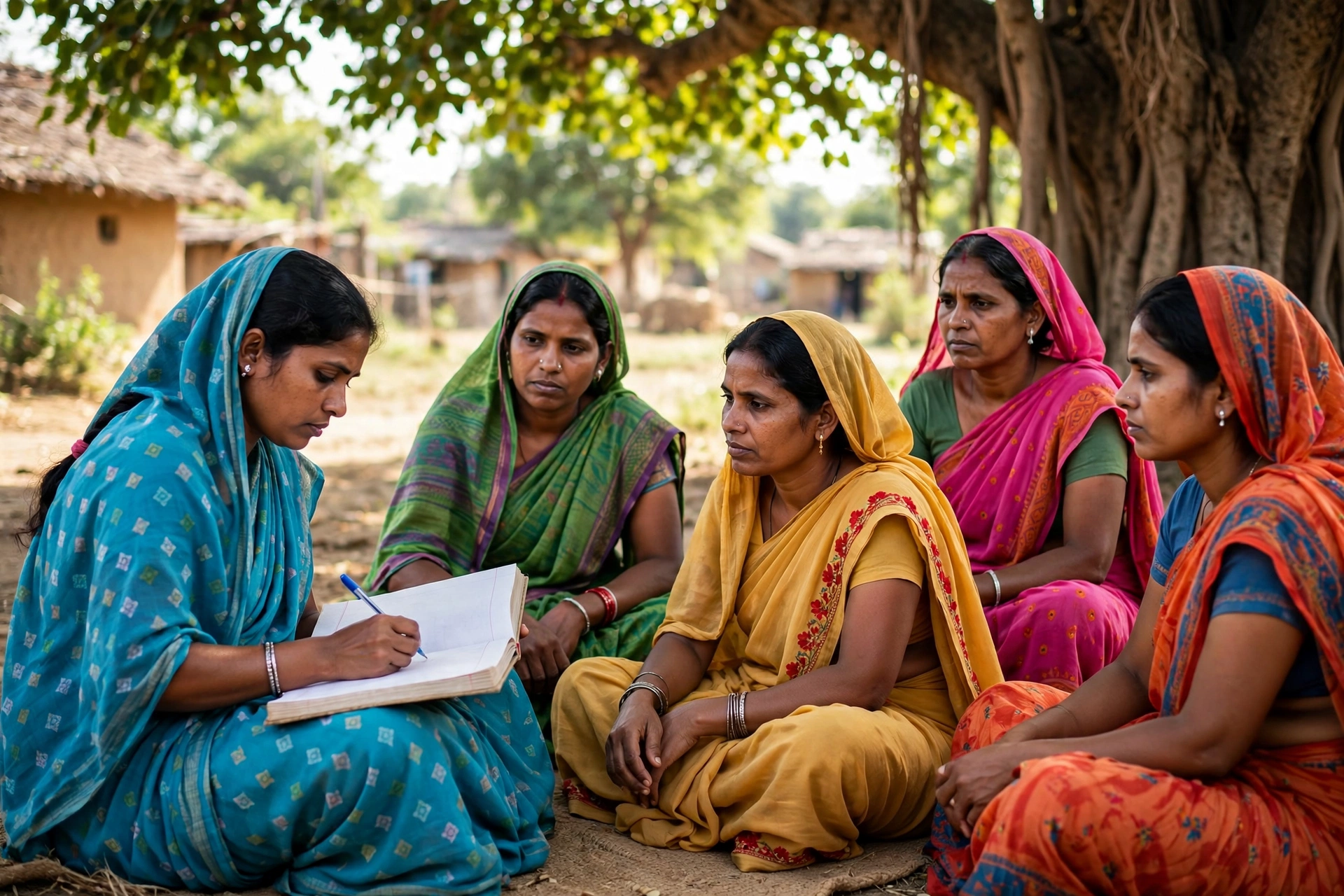
An SHG has 10 to 20 women (up to 5 in hilly, desert, or difficult areas) who come together voluntarily. Groups run on the “Panchasutra” — regular meetings, regular savings, regular internal lending, regular recoveries, and proper bookkeeping. Only groups that follow these norms qualify for government support.
Poor households are identified through a Participatory Identification of Poor (PIP) process validated by the Gram Sabha, and the mission aims to bring at least one woman from every eligible poor household into the SHG network.
The financial support
- Revolving Fund: well-functioning SHGs receive a ₹10,000–₹15,000 grant to strengthen their internal lending and financial management. The money goes to the group, not to individuals.
- Community Investment Fund (CIF): routed through SHG federations, up to ₹2.50 lakh per SHG, so members can borrow for livelihood activities. The fund stays with the federation in perpetuity.
- Interest subvention: women SHGs borrowing from banks get loans up to ₹3 lakh at 7% per annum. In 250 identified districts, an additional 3% subvention rewards timely repayment — bringing the effective rate down to just 4%. In other districts, the state mission covers interest charged above 7%. (Note: capital subsidy has been discontinued under DAY-NRLM — beware of old articles claiming otherwise.)
Bank Sakhi — the village banking friend
The mission trains local women as Bank Sakhis who help SHGs open bank accounts, prepare loan applications, follow up on pending proposals, and ensure timely repayment. As of February 2026, 50,548 Bank Sakhis were deployed across India.
Skills and enterprise pathways
- DDU-GKY (Deen Dayal Upadhyaya Grameen Kaushalya Yojana): free, placement-linked skill training for rural youth aged 15–35 — a sub-scheme within DAY-NRLM.
- SVEP (Start-up Village Entrepreneurship Programme): helps SHG members and their families set up small non-farm enterprises. By December 2025, 5.88 lakh enterprises had been supported.
- Lakhpati Didi: the government’s goal of making at least 3 crore SHG women “Lakhpati Didis” — women earning over ₹1 lakh per year. A National Campaign on Entrepreneurship launched in January 2026 aims to train 50,000 community resource persons and give entrepreneurship training to 50 lakh SHG members toward this goal.
- Markets and SARAS fairs: SHG products — pickles, garments, handicrafts — reach buyers through fairs and, increasingly, public procurement. In July 2026 the Ministry signed an MoU to link women-led enterprises to government procurement over 2026–2029.
For cities: what DAY-NULM offers
The urban mission targets the urban faces of poverty — street vendors, the homeless, unemployed youth:
- Free skill training: urban poor youth get trained at City Livelihood Centres, with the government bearing roughly ₹15,000 per person in training costs.
- Self-employment support: seed support of about ₹10,000 per group and about ₹50,000 for registered area-level federations to start small ventures.
- Shelters for the urban homeless: night shelters (rain baseras) built with full central funding.
- Street vendor support: ID cards, vending zones, institutional credit, and social security — freeing cart-owners from moneylenders.
Clarification: PM SVANidhi — the working-capital loan scheme for street vendors — is a separate central scheme (same ministry, but not part of DAY-NULM). Several websites present the two as one scheme; that is incorrect. We have a separate detailed guide on PM SVANidhi.
Fresh 2026 updates (verified from PIB)
The newest confirmed developments — all from official Ministry of Rural Development press releases:
- 14 January 2026 — National Campaign on Entrepreneurship: launched under DAY-NRLM with the slogan “Har Ghar Udyam, Har Gaon Samriddh”. Target: train 50,000 community resource persons (CRPs) in enterprise promotion and deliver entrepreneurship development training to 50 lakh SHG members.
- 3 February 2026 — Lok Sabha reply: as of December 2025, 10.05 crore households were mobilised into 90.91 lakh SHGs; 50,548 Bank Sakhis deployed; ₹12.18 lakh crore in bank credit had reached SHG women since 2013-14; 5.88 lakh enterprises supported under SVEP.
- 29 July 2026 — push for women-led enterprises: the Ministry signed a 3-year (2026–2029) MoU with Project Concern International to connect women-led and SHG enterprises with public procurement; a National Resource Cell will be set up inside DAY-NRLM.
- 7 August 2026 — NITI Aayog evaluation: an independent study of 2,206 rural households across 11 states and 2 UTs found DAY-NRLM raised average household income by 49%; 58% of women reported greater confidence; 46% could now handle banking transactions independently.
- 4 August 2026 — mission status: cumulatively 10.08 crore women in 92 lakh SHGs; the mission works through four pillars — social mobilisation, financial inclusion, sustainable livelihoods, and social inclusion — and SVEP had supported over 6.5 lakh enterprises by May 2026.
How to benefit: the correct step-by-step process
The most important truth: there is no “online apply form” for individuals under DAY-NRLM. Benefits come through SHG membership. Websites showing an “Apply Online” button for this scheme are misleading. The genuine path is:
In villages (DAY-NRLM)
- Visit the Gram Panchayat or Block office: ask which SHGs are active in your village under DAY-NRLM.
- Meet the local worker: the Community Resource Person (CRP), ASHA, or Anganwadi worker will connect you to an existing women’s group — or help 10–12 women form a new one.
- Form the group and open a bank account: record the group’s formation resolution and open an SHG savings account at the nearest bank (Bank Sakhis assist with this).
- Start regular savings: deposit a small fixed amount monthly (e.g. ₹50–100) and follow the Panchasutra — regular meetings, savings, internal lending, recovery, and bookkeeping.
- Become eligible for government support: after a few months of disciplined functioning, the group qualifies for the Revolving Fund, then CIF and bank-linkage loans. The Bank Sakhi/block mission helps prepare the loan application.
- Training and enterprise: youth can take free DDU-GKY training; families can get SVEP support to start a small business.
In cities (DAY-NULM)
- Visit the municipal office: ask for the NULM section at your Nagar Palika / Municipal Corporation (Urban Local Body).
- State your need: skill training, starting a micro-enterprise, or vendor support — the process is explained based on your case.
- Street vendors: register with your city’s Town Vending Committee (TVC) — that is the route to ID cards and vending zones.
- Homeless persons: can walk into a government night shelter directly — no strict income proof is demanded for basic shelter.
Documents to keep ready
- Aadhaar card (the key ID for all government schemes)
- Bank account passbook copy
- Address proof — Voter ID, electricity bill, or ration card
- Income certificate / BPL card (to establish low-income status)
- Caste certificate (SC/ST/OBC, where applicable)
- Passport-size photographs and an Aadhaar-linked active mobile number
Note: joining an SHG costs nothing. If anyone demands money in the name of DAY, it is fraud — report it to the block/district mission office immediately.
Don’t confuse these (related but separate)
- PM SVANidhi: a separate central scheme giving working-capital loans to street vendors — related to urban livelihood goals, but not part of DAY-NULM. Read our PM SVANidhi guide here.
- DDU-GKY: the skill-training component inside DAY-NRLM — accessed via the SHG/rural youth network, not a separate application.
- PM Mudra Loan: a separate bank-loan scheme for starting a small business — worth knowing alongside SHG enterprise plans: PM Mudra Loan Yojana 2026 details.
- State self-employment schemes: states run their own youth enterprise support too — e.g. UP Mukhyamantri Yuva Swarozgar Yojana.
Deen Dayal Antyodaya Yojana — Frequently Asked Questions
1. How much money do beneficiaries get every month under Deen Dayal Antyodaya Yojana?
Nothing per month — and this is the biggest misconception. Deen Dayal Antyodaya Yojana is not a cash-transfer scheme. It is a livelihood mission: SHG membership brings savings discipline, cheap bank loans, training, and enterprise support. Any website promising “₹X per month” under this scheme is publishing false information.
2. Can men join Self Help Groups under this scheme?
Generally, DAY-NRLM SHGs are for women — women’s empowerment is the mission’s core. Special SHGs for persons with disabilities and the elderly may include men. DAY-NULM’s urban training and self-employment support is open to both young men and women.
3. Do SHG loans require pledging property as guarantee?
No. Bank loans to SHGs under this scheme are collateral-free. With interest subvention, women SHGs pay 7% per annum on loans up to ₹3 lakh — and timely repayment brings the effective rate down to 4% in the identified districts.
4. How much government support does a new SHG receive?
A disciplined, active SHG gets a ₹10,000–₹15,000 Revolving Fund grant, and can access up to ₹2.50 lakh in Community Investment Fund support via its federation (as a loan for livelihood activities). The funds go to the group, not to individuals.
5. Is there an online application for Deen Dayal Antyodaya Yojana?
For the rural mission, there is no direct online application for individuals — SHG membership through your Panchayat/CRP/Bank Sakhi is the application route. For the urban mission, contact the NULM section of your municipal corporation/ULB. Be wary of sites claiming “one-click apply”.
6. What is Lakhpati Didi?
Under DAY-NRLM, SHG women earning over ₹1 lakh per year are called “Lakhpati Didis”. The government’s goal is at least 3 crore Lakhpati Didis, backed by the National Campaign on Entrepreneurship launched in January 2026.
7. What is the difference between DAY-NRLM and DAY-NULM?
DAY-NRLM is for villages (Ministry of Rural Development) — SHGs, bank linkage, farm and non-farm livelihoods. DAY-NULM is for cities (Ministry of Housing and Urban Affairs) — skill training, self-employment, street-vendor support, and homeless shelters. Both carry the “Deen Dayal Antyodaya Yojana” umbrella name.
Official links (verified)
- DAY-NRLM official portal: aajeevika.gov.in (the official portal cited in the government’s own Master Circular)
- Government scheme page: transformingindia.mygov.in — Deen Dayal Antyodaya Yojana
- PIB press releases (2026 updates): pib.gov.in — Ministry of Rural Development releases dated 14 January, 3 February, 29 July, and 7 August 2026
- For the urban mission: the NULM section of your city’s municipal corporation / Urban Local Body office
Note: some sources name daynulm.nic.in as the urban mission’s portal, but we could not verify its current availability at the time of writing — contacting your ULB office directly is the most reliable route.
Disclaimer: GramSuvidha is a private information portal, not a government website. This article is based on the Ministry of Rural Development’s Master Circular and official PIB press releases, but rules change over time — please confirm with your block/district mission office or the official portal before acting.
Updated: 11 October 2026 | Sources: Ministry of Rural Development (PIB), DAY-NRLM Master Circular