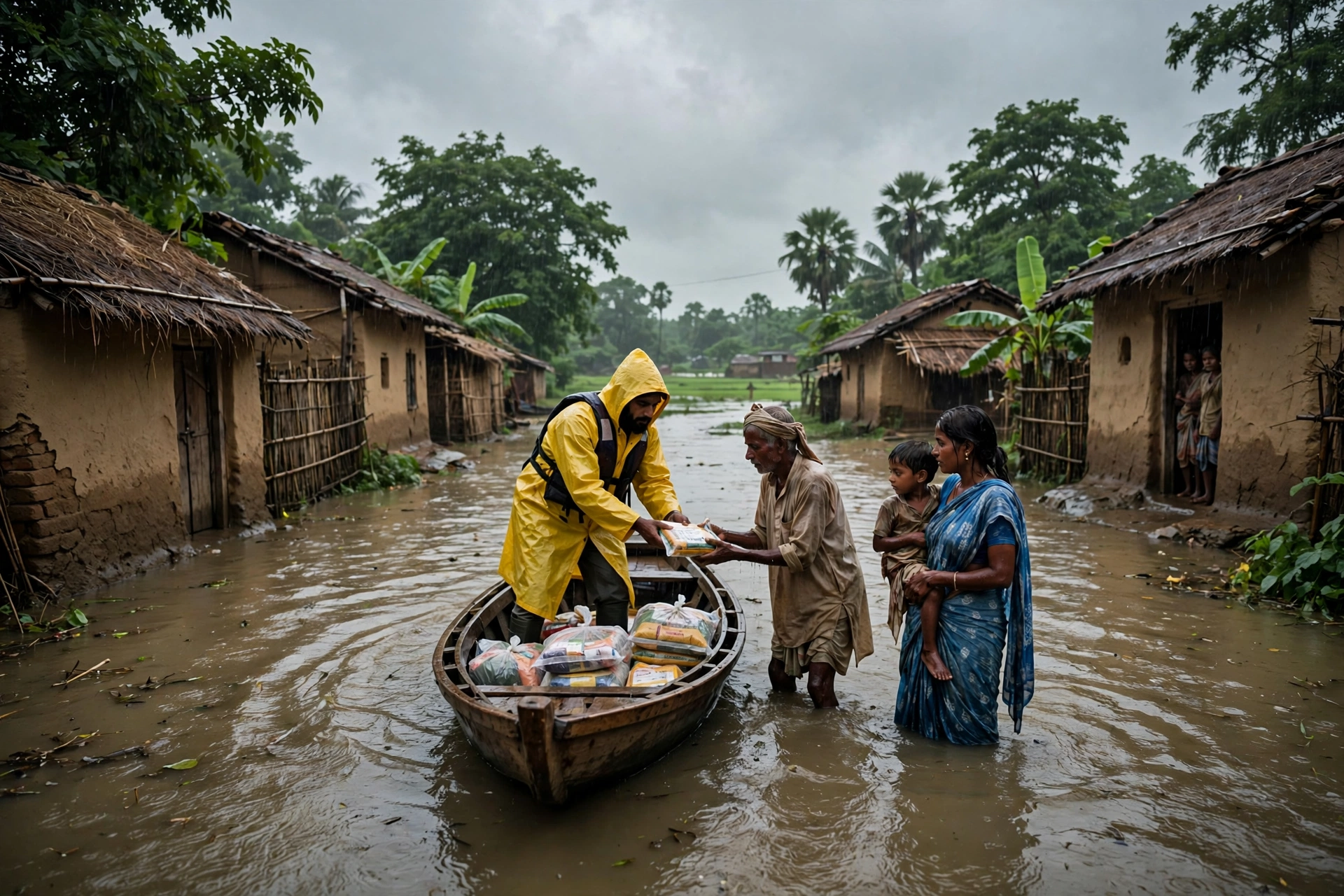
Bihar faced severe floods once again in 2026. The Ganga and its tributaries overflowed into villages, fields and homes across several districts. Crops were submerged, houses filled with water, and lakhs of families saw their livelihoods washed away. In response, the Bihar government announced cash relief for flood-affected families. Under the Bihar Badh Sahayata Yojana 2026, every affected family is receiving Rs 7,000 directly into its bank account through DBT.
The latest development came on 12 October 2026, when the Chief Minister released the second phase of the relief amount at an event in Patna. In this phase, Rs 112.14 crore was transferred to the bank accounts of 1,60,201 families. Earlier, on 15 September 2026, the first phase was released, in which Rs 614.03 crore reached 8,77,190 families. Taken together, both phases have so far delivered a total of Rs 726.17 crore to 10,37,391 families.
In this article you will find complete and up-to-date information about the scheme: what the Bihar Badh Sahayata Yojana is, who is entitled to the Rs 7,000 assistance, how Phase 1 and Phase 2 differ, which districts are covered, how the beneficiary list is prepared, how to check whether your family is on the list, what to do if your name was left out, when the money will reach your account, which documents you may need, and how to protect yourself from fraud. At the end you will also find answers to the most common questions (FAQ) and official links.
What Is the Bihar Badh Sahayata Yojana 2026
The Bihar Badh Sahayata Yojana is the Bihar government’s flood-relief scheme, implemented through the state’s Disaster Management Department. Its purpose is to give immediate cash assistance to flood-affected families so they can meet urgent needs such as food, medicines and daily expenses.
This time the government has raised the assistance amount to Rs 7,000 per family. Earlier the amount was Rs 6,000, but given the severity of the 2026 floods, it was increased to Rs 7,000. The full amount is sent directly to the beneficiary’s bank account through DBT (Direct Benefit Transfer). There is no middleman involved — the money lands straight in your account.
The entire relief operation is managed through the aapda.bihar.gov.in portal, also known as the “Aapda Sampoorti” portal. Data of flood-affected families, the beneficiary list and payment details are all recorded on this portal. At the district level, affected families are identified and the list is prepared on the instructions of the District Magistrate.
One important point: this is not a scheme where you fill an application form to apply. The government itself prepares the beneficiary list after surveying flood-affected areas. In other words, if your family was affected by the floods and your name was recorded in the survey, the money will come directly to your account.
Scheme at a Glance — Quick Facts
| Point | Detail |
|---|---|
| Scheme name | Bihar Badh Sahayata Yojana 2026 |
| State | Bihar |
| Department | Disaster Management Department, Government of Bihar |
| Assistance amount | Rs 7,000 per family (raised from Rs 6,000) |
| Payment mode | DBT — directly into bank account |
| Official portal | aapda.bihar.gov.in (Aapda Sampoorti) |
| Phase 1 | 15 September 2026 — Rs 614.03 crore, 8,77,190 families |
| Phase 2 | 12 October 2026 — Rs 112.14 crore, 1,60,201 families |
| Total so far | Rs 726.17 crore, 10,37,391 families |
| Area affected | Around 15 districts, about 49.5 to 55 lakh people |
| Application process | No separate application — survey-based list |
Phase 1 vs Phase 2 — Full Comparison
Many news reports quote the Phase 1 and Phase 2 figures separately, which creates confusion. The table below gives a clear side-by-side comparison of both phases so you get the complete picture in one place.
| Point | Phase 1 | Phase 2 |
|---|---|---|
| Release date | 15 September 2026 | 12 October 2026 |
| Amount released | Rs 614.03 crore | Rs 112.14 crore |
| Beneficiary families | 8,77,190 | 1,60,201 |
| Amount per family | Rs 7,000 | Rs 7,000 |
| How it was released | Directly to accounts through DBT | Through DBT at the Chief Minister’s event in Patna |
| Key point | The largest relief tranche, released right after the floods | Covered left-out and newly identified families |
Adding both phases together, Rs 726.17 crore has so far been transferred to 10,37,391 families. According to the government, work to identify families that are still left out is continuing at the district level, so that no affected family is deprived of assistance.
Which Districts Are Covered
The 2026 floods affected around 15 districts of Bihar, and roughly 49.5 to 55 lakh people came under the impact of the disaster. The relief amount is being given to families in these districts whose homes, fields or livelihoods were affected by the floods. The major affected districts are listed below.
| S. No. | District | S. No. | District |
|---|---|---|---|
| 1 | Patna | 9 | Munger |
| 2 | Bhojpur | 10 | Katihar |
| 3 | Saran | 11 | Lakhisarai |
| 4 | Vaishali | 12 | Khagaria |
| 5 | Bhagalpur | 13 | Purnea |
| 6 | Begusarai | 14 | Madhepura |
| 7 | Buxar | 15 | Arwal |
| 8 | Samastipur |
Note that this is the list of the worst-affected districts. If your district is on this list and your family was affected by the floods, your name should be on the beneficiary list. If your district is not listed but your area was flooded, do not panic — read the section below on “what to do if your name was left out”.
How the Beneficiary List Is Prepared
Many people wonder how the government knows which family was affected by the floods. The process works like this:
- Ground survey: During and after the floods, district administration teams survey affected villages and localities. Information about affected families is also collected at the panchayat level.
- Identification of families: The survey marks families whose homes were flooded, whose crops were submerged, or whose livelihoods were hit by the floods.
- Verification at block level: The prepared list is verified at the block level so that no ineligible name is added and no eligible family is left out.
- Approval by the District Magistrate: The final list is settled at the district level after approval by the District Magistrate.
- Upload to the portal: The approved list is uploaded to aapda.bihar.gov.in (Aapda Sampoorti portal).
- DBT payment: Rs 7,000 is transferred directly to the bank accounts recorded on the portal.
This is why there is no need to apply online separately for this scheme — the government prepares the list itself on the basis of the survey. But that does not mean you have nothing to do: checking your name on the list and keeping your bank account ready for DBT is your responsibility.
How to Check Your Name on the Beneficiary List
If you want to know whether your family’s name is on the list, follow these methods:
- Check the official portal: Visit aapda.bihar.gov.in and look for the relief or beneficiary-list section. If the option to view the list is available on the portal, select your district, block and panchayat to search for your name.
- Visit the block office: Go to your block (prakhand) office and ask about the flood-relief list. You may be able to view the list for your village or panchayat there.
- Contact your panchayat representative: Your mukhiya or ward member may also have information about the list of affected families.
- District disaster management office: If the above methods do not work, contact the helpdesk of the district disaster management office or the District Magistrate’s office.
While checking the list, match your name carefully with your father’s or husband’s name and your address. Sometimes there are small spelling mistakes in names, so check with other family members’ names too, not just your own.
What to Do If Your Name Was Left Out
This is the most important part of this scheme. Many eligible families get missed in the survey — perhaps they were not in the village at the time of the survey, or their home was not recorded. The good news is that the government has instructed District Magistrates to identify left-out families.
If your family was affected by the floods but your name is not on the list, take these steps:
- Submit a written application: Give a written application to your Block Development Officer (BDO) or Circle Officer, mentioning your name, address, details of the flood damage, and your bank account information.
- Keep proof ready: Keep copies of your Aadhaar card, ration card and bank passbook, along with any evidence of flood damage such as photographs taken during the floods. These documents strengthen your claim.
- District Magistrate’s office: If you do not get a hearing at the block level, raise your case at the public hearing (janata darbar) or grievance day held at the District Magistrate’s office.
- Get panchayat verification: Obtain a certificate or verification letter from your mukhiya or ward member confirming that your family was affected by the floods.
Remember — the work of adding left-out families is in progress, and Phase 2 (12 October) was part of this very effort. So do not delay; submit your application as soon as possible.
When Will the Money Reach Your Account — DBT Details
The relief amount is sent directly to the beneficiary’s bank account through DBT. The Phase 1 amount of Rs 614.03 crore was transferred on 15 September 2026, and the Phase 2 amount of Rs 112.14 crore on 12 October 2026.
To make sure the money reaches you on time, ensure the following:
- Keep your bank account active: The account should not be closed or dormant. If there has been no transaction for a long time, visit the bank and get the account reactivated.
- Aadhaar must be linked: Your bank account must have the Aadhaar number linked and seeded for DBT. If Aadhaar is not linked, the payment may get stuck.
- Correct account number: The account number recorded in the list must be correct. If your account has changed, get the information updated at the block office.
- Keep SMS alerts on: Watch the SMS alerts from your bank so that you get immediate notice when the money arrives.
Documents You May Need
There is no separate application for this scheme, so no form needs to be filled. However, these documents may be asked for during name inclusion or verification:
- Aadhaar card (of the head of the family)
- Bank passbook or account details (linked with Aadhaar)
- Ration card
- Mobile number (better if linked with the bank account)
- Any proof of flood damage — photographs, panchayat certificate
Never hand over the original of any document to a stranger for any government work. Give only photocopies, and write the purpose on them, such as “for flood relief list”.
Is Fresh Application Open for This Scheme
No. There is no new online application form open for the general public under the Bihar Badh Sahayata Yojana. The scheme is fully survey-based — the government itself prepares the list of affected families and sends the money.
This means that if any person or website tells you to “fill a form and get Rs 7,000” or asks for money in the name of the application, it is fraud. The government has fixed no fee for this. The only route for left-out families is to submit a written application at the block office or the District Magistrate’s office to get their name added to the list, as explained above.
Agriculture Input Subsidy Announcement for Farmers
Farmers suffered the heaviest losses as floodwater destroyed standing crops. Update (14 October 2026): the agriculture input subsidy has also been released — the Chief Minister transferred ₹112.52 crore via DBT to 2,48,704 farmers from Patna for crop damage caused by floods and heavy rainfall in the last week of August 2026.
Farmer readers can also find information about Bihar’s crop-assistance schemes in our posts on Bihar Fasal Sahayata Yojana 2026 and Bihar Krishi Input Anudan Yojana 2026.
Essential Precautions Against Fraud
Whenever relief money is announced, fraudsters also become active. Keep these points in mind:
- No fee: The government charges no application fee or registration charge for this scheme. Anyone asking for money is a fraudster.
- Never share OTP: Banks and the government never ask for OTP on phone calls. A call asking for OTP is 100% fraud.
- Beware of fake links: Do not click links like “check your relief amount” received on WhatsApp or SMS. Use only the official portal aapda.bihar.gov.in.
- Stay away from middlemen: Be careful of people who say “I will get your name added to the list”. Only government officers handle the list.
Frequently Asked Questions — FAQ
1. Will I get the Rs 7,000 relief amount
Yes, if your family was affected by the 2026 floods and your name is on the beneficiary list — you will receive Rs 7,000 through DBT directly into your bank account. The amount was earlier Rs 6,000 and has been raised to Rs 7,000.
2. How do I check my name on the beneficiary list
Look for the relief or beneficiary-list section on the aapda.bihar.gov.in portal. If it is not available online, check your name by contacting your block office, panchayat representative, or the district disaster management office.
3. My name was left out of the list — what should I do
Do not worry. The government has instructed District Magistrates to identify left-out families. Submit a written application to your BDO or Circle Officer, attaching copies of Aadhaar, ration card, bank passbook, and any proof of flood damage. Also get a verification letter from your panchayat.
4. Do I need to apply online for this scheme
No. There is no separate online application form for this scheme. The government prepares the list itself on the basis of surveys. Families that were left out can get their names added through a written application at the block or district office.
5. When will the money come to my account
The Phase 1 amount was sent on 15 September 2026 and the Phase 2 amount on 12 October 2026. If your name is on the list and your bank account is Aadhaar-linked and active, the money will come directly to your account. Keep an eye on your bank’s SMS alerts.
6. Earlier the news said Rs 6,000 — why Rs 7,000 now
The relief amount was earlier Rs 6,000 per family, but given the severity of the 2026 floods, the government raised it to Rs 7,000 per family. Both phases (15 September and 12 October) were paid at Rs 7,000 per family.
7. Will more money be released after Phase 2
So far, Rs 726.17 crore has been given to 10,37,391 families in two phases. The identification of left-out families is continuing at the district level. If a third phase or a new announcement comes, we will update this article immediately.
Official Links
- Aapda Sampoorti Portal: aapda.bihar.gov.in — the official portal of the Bihar Disaster Management Department
For final confirmation of any information, always contact the official portal or your district administration.
Related Reading
- Bihar Flood Relief Phase 2 — Full News of 12 October 2026
- Bihar Ration Card List — How to Check Your Name
- Bihar Fasal Sahayata Yojana 2026
- Bihar Krishi Input Anudan Yojana 2026
This article was last updated on 22 October 2026. GramSuvidha is a private information portal, not a government website — we explain government schemes in simple language, but always confirm final and official information from the concerned government portal or office.